
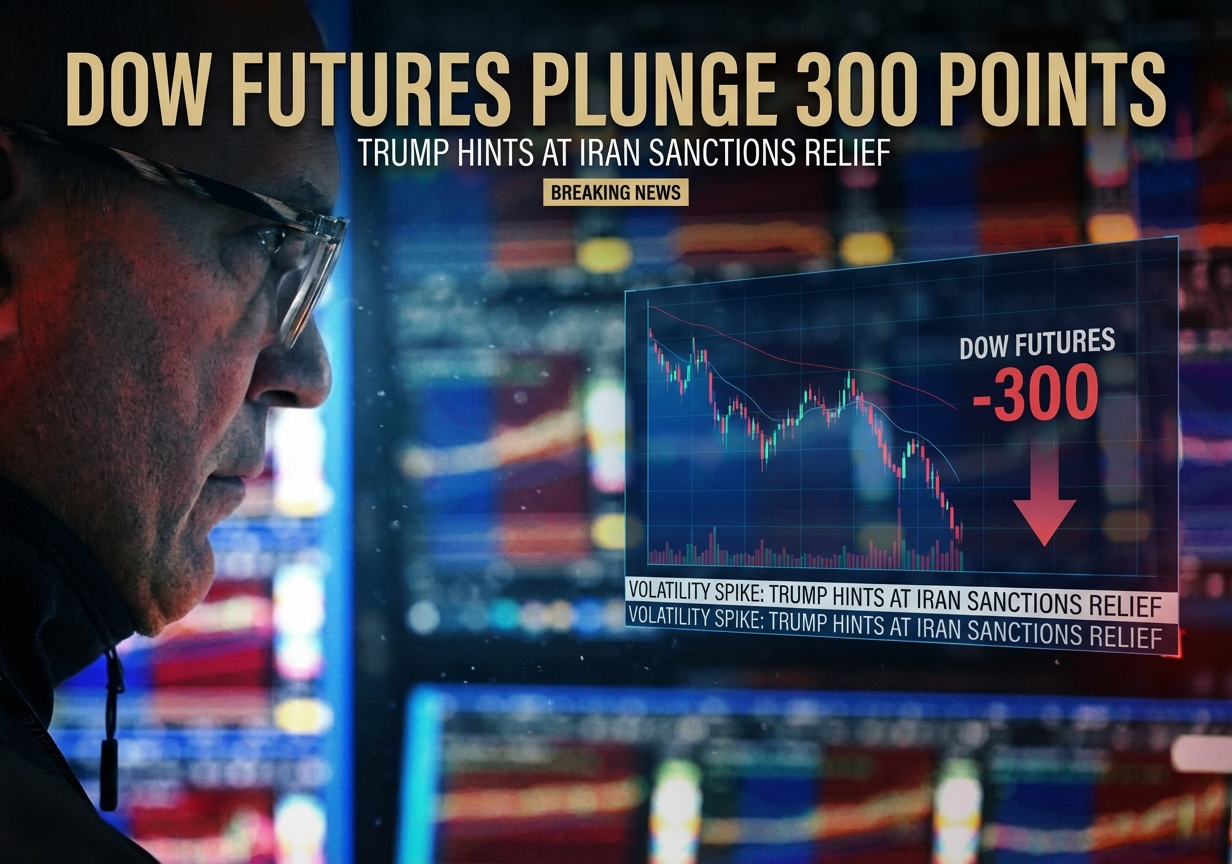
The Market’s Whiplash: Decoding Massive Dow Futures Movement
The wires are buzzing with a narrative of whiplash, and frankly, Dow futures are giving us the jitters. We witnessed an initial, teeth-rattling plunge, seemingly driven by hard geopolitical news involving Iran, only to see those losses significantly pared back as President Trump hinted at potential sanctions relief. This rapid reversal isn’t just market noise; it’s a critical signal that investor positioning right now is incredibly fragile, dependent on soundbites rather than solid economic data.
The immediate story pits two massive forces against each other: the very real, tangible threat of escalating conflict in the Middle East versus the powerful, often counterintuitive, pull of monetary policy expectations. When Dow futures were shedding hundreds of points, the fear was clearly rooted in supply chain disruption, specifically concerning oil flowing through the Strait of Hormuz. Reports of tanker halts and soaring crude prices—oil jumping as much as 10 percent—naturally trigger inflation fears, which cripple corporate earnings forecasts.
However, the subsequent swing back, fueled by the suggestion of dialogue or relief from sanctions, shows how quickly traders pivot when the immediate apocalypse seems averted. Investors are actively trying to front-run the next move by central banks. If geopolitical risk subsides, the argument for aggressive interest rate cuts strengthens, boosting asset valuations across the board. This volatility isn’t about long-term structural change today; it’s about short-term hedging and the psychological impact of headlines.
What this means for the average investor is heightened risk awareness. When the primary drivers swinging major indices by hundreds of points in a single session are geopolitical maneuvers rather than quarterly earnings reports or inflation metrics, the market is operating under peak uncertainty. We must look beneath the surface volatility affecting the Dow futures to understand the underlying currents driving this nervousness.
Geopolitical Shocks Echoing Through Global Equities
The immediate reaction across global markets was severe, illustrating just how interconnected capital flows are during moments of high tension. Reports filtering through that Asian aviation stocks plunged due to flight cancellations over Middle Eastern airspace demonstrate the physical, real-world costs of military escalation. These aren’t abstract financial derivatives; these are billions of dollars in lost revenue for airlines forced to reroute flights, burning more fuel and increasing ticket costs for consumers.
Furthermore, the casualty reports—the loss of three U.S. service members—while tragic, introduces a domestic political dimension that markets must price in. Any perception that the situation is spiraling beyond controlled escalation raises political risk premiums globally. This isn’t just about Iran; it’s about stability in global trade lanes which underpin everything from semiconductors to consumer goods manufactured overseas.
We also saw related impacts in commodities far beyond crude oil. While the focus remains heavily on energy, any conflict that threatens major maritime chokepoints has ripple effects on shipping insurance rates and the cost of global logistics. This increased operating cost environment is what eventually filters down into slower GDP growth and pressures on corporate profit margins, which is the true fear behind any stock market decline.
The narrative around Dubai being a tax-free haven for the global elite facing potential fallout underscores how interconnected global finance is with political stability. When capital centers feel threatened, money flow patterns—which underpin asset prices everywhere, from New York to Tokyo—can shift dramatically and unexpectedly, creating secondary shocks for markets like the SSE Composite Index.
Historical Parallels: When Uncertainty Rules the Trading Floor
To truly gauge the current situation, one must look back at periods where sentiment, rather than strict fundamentals, dictated market direction. We saw similar headline-driven spasms during flashpoints like the Gulf War in the early nineties, or even during specific flare-ups in US-China trade tensions where official statements caused immediate, sharp retracements in futures trading.
What distinguishes today’s environment, perhaps, is the speed of information transmission. In the past, news of an oil tanker halt might take hours to fully process across global trading desks. Today, algorithmically driven trading systems react within milliseconds to a single tweet or a wire report confirming casualties. This accelerates the pendulum swing, making volatility a much larger feature of the daily trading landscape than it was even a decade ago.
Consider the volatility during the European sovereign debt crisis. While fundamentally different—a credit crisis versus a geopolitical one—the market psychology was similar: intense fear priced in based on the worst-case scenario, followed by tentative rallies based on bailouts or diplomatic maneuvers. Traders were constantly walking a tightrope between panic selling and bargain hunting, a behavior mirrored in the Dow futures seesaw we just experienced.
It is crucial to remember that markets abhor uncertainty more than they fear bad news. Bad news can often be quantified; uncertainty is a mathematical unknown. The hints of sanctions relief—even from a source as notoriously unpredictable as the sitting President—provided that quantifiable off-ramp, allowing nervous capital to momentarily stop fleeing and even start returning, seeking the perceived safety of high-quality US equities.
The Engine of Modern Volatility: Algorithmic Trading and Sentiment
The underlying mechanism amplifying these swings lies in modern trading architecture. Portfolio insurance strategies and high-frequency trading desks are constantly slicing volatility into tradable assets. When geopolitical news breaks, these systems trigger massive sell orders based on predetermined risk parameters, often hitting derivatives contracts that influence the corresponding cash market, like the Dow futures.
This digital reaction forces human traders to respond defensively. If your risk model indicates exposure to an escalation event, you sell first and ask questions later. The subsequent attempt to dial those positions back when the headline softens is what drives the sharp reversal. It’s a feedback loop where fear feeds technology, and technology amplifies fear.
We must also discuss the role of macroeconomic positioning. Leading into this event, were investors already stretched? Were the market rallies based on flimsy economic grounds, perhaps relying too heavily on expected corporate efficiency gains or low inflation? If the market was riding high on anticipated stability, any shock—like military action near critical shipping lanes—will naturally lead to a more violent correction as those stretched positions are unwound rapidly.
The hints regarding utility costs and AI data centers also paint a picture of an underlying economy already stressed by input costs and infrastructure demand. Geopolitical instability places another layer of cost uncertainty onto an already complicated operational environment for major corporate components of the Dow, making investors hypersensitive to news that might further inflate operational expenses.
Decoding the Next Play: Three Potential Paths Forward
The immediate question facing investors now is which direction the leash holds—will the flight to safety reassert itself, or will the geopolitical tension flare up again? We can map out three primary pathways for the markets following this volatile session.
Scenario One is a Gradual De-escalation and Return to Normalcy. If diplomatic channels remain open and no further kinetic events occur, the extreme risk premium built into oil prices and market volatility will rapidly deflate. In this scenario, the Dow futures will likely stabilize, perhaps rebounding strongly as capital that exited rushes back in, seeking to capture the slight dip. This path suggests the market correctly priced in the initial shock but realized the underlying US economic structure, including low unemployment and potential Fed accommodation hinted at by some architect discussions regarding 401(k)s, remains sound. We might see a brief rally fueled by short covering.
Scenario Two involves Lingering Uncertainty and Stagnation. This is characterized by low-level, tit-for-tat actions that keep the Strait of Hormuz tense without outright war. Oil prices remain elevated, perhaps hovering 5 to 8 percent higher than pre-event levels. In this environment, the market finds no clear direction. The SSE Composite Index and US indices struggle to make new highs because input costs have increased, and geopolitical risk remains an unquantifiable drag on sentiment. Volatility stays high, marked by daily 200-point swings in futures as different officials leak conflicting messages.
Scenario Three is the Full Escalation Event. This occurs if the initial military action prompts a significant, measured retaliation that threatens broader regional stability or directly targets major energy infrastructure. Should this happen, the preceding volatility lesson will feel quaint. Crude oil would skyrocket, eclipsing the initial surge, and the market would price in a genuine global recession risk due to energy scarcity and trade collapse. In this path, the Dow futures would experience a severe, sustained drop as investors aggressively dump risk assets for perceived safety, likely treasury bonds, until international actors step in with a definitive peace plan.
The Psychology of the Pivot: Why Investors Believed the Rally
The speed at which the market pivoted away from absolute panic highlights a deep-seated behavioral trait in this current bull run: a persistent belief that major central governments will always step in to prevent systemic collapse or catastrophic economic downturns. This is the “Fed Put,” adapted for geopolitical risk.
When President Trump hinted at sanctions relief, he provided an immediate psychological release valve. Traders didn’t need a treaty; they needed an indication that the situation was manageable, not a one-way street toward disaster. This expectation biases them toward buying the dip, especially if they believe the market overreacted initially, which it often does in headline-driven flash crashes.
The conversation about Gen Z eating novel diets to save money, while seemingly tangential, speaks volumes about the background pressure on household budgets from persistent inflation. When consumers are already stretched, any external shock like higher energy prices can push discretionary spending—the engine of the US economy—to a halt. This sensitivity makes the market cling tighter to any signal suggesting those costs will not materialize.
Ultimately, the market is currently digesting geopolitical news through a narrow, high-stakes lens: how does this affect corporate profit margins and the Federal Reserve’s interest rate path? The swing in Dow futures illustrates a market holding its breath, ready to run hard toward the daylight of de-escalation, yet terrified of the shadow of a prolonged conflict. Navigating this environment requires patience and a complete disregard for the intraday noise.
FAQ
What immediate geopolitical event caused the significant dive in Dow futures?
The initial plunge in Dow futures was triggered by hard geopolitical news involving tensions and potential conflict in the Middle East, specifically concerning Iran.
Why did Dow futures rapidly pare back their initial losses?
The losses were significantly reduced after President Trump hinted at potential sanctions relief, suggesting dialogue might replace escalation.
What is the primary fear driving market concern related to Middle Eastern conflict near the Strait of Hormuz?
The core fear revolves around potential supply chain disruption, specifically concerning the flow of essential oil supplies through the Strait of Hormuz.
How does an oil price surge specifically impact corporate earnings forecasts?
Soaring crude oil prices increase operating costs for transportation and manufacturing, which directly pressures corporate profit margins.
What underlying force, aside from geopolitics, are investors actively trying to front-run with their positioning?
Investors are actively trying to anticipate future monetary policy expectations from central banks.
What does the rapid reversal in Dow futures suggest about current investor positioning?
The rapid reversal indicates that investor positioning is incredibly fragile and highly dependent on immediate political soundbites rather than established economic fundamentals.
Beyond crude oil, what other commodities are affected when maritime chokepoints are threatened?
Any conflict threatening major maritime chokepoints causes ripple effects on shipping insurance rates and the overall cost of global logistics.
How did the conflict reports manifest physically in global equities outside of the US indices?
Asian aviation stocks plunged due to reports of flight cancellations and necessary rerouting over Middle Eastern airspace.
What historical market periods are cited as parallels for current headline-driven volatility?
The article draws parallels to moments like the Gulf War in the early nineties and specific escalations during US-China trade tensions.
What factor currently accelerates the pendulum swing of volatility compared to past market flashpoints?
The speed of information transmission via algorithmically driven trading systems accelerates reactions within milliseconds.
Why do markets generally abhor uncertainty more than they fear quantifiable bad news?
Bad news, while negative, can usually be quantified and priced into assets, whereas uncertainty represents a mathematical unknown.
What role does algorithmic trading play in amplifying the speed and size of market swings?
High-frequency trading systems are programmed to trigger massive sell orders based on predetermined risk parameters when geopolitical news breaks.
What is the ‘feedback loop’ described in the article regarding market fear and technology?
The loop occurs when fear-driven technological responses trigger massive sell orders, forcing human traders to defensively sell, thus amplifying the initial fear.
What condition preceding the geopolitical event makes the market more susceptible to violent corrections?
The market is more susceptible if general rallies were already based on flimsy economic grounds or if investors were highly ‘stretched’ in their positions.
What is Scenario One for the market if diplomatic channels remain open following the event?
Scenario One predicts a Gradual De-escalation and Return to Normalcy, where the extreme risk premium rapidly deflates.
What defines Scenario Two, characterized by Lingering Uncertainty and Stagnation?
Scenario Two involves ongoing, low-level tit-for-tat actions that keep oil prices elevated without outright war.
What triggers the market into the Full Escalation Event described in Scenario Three?
Scenario Three occurs if the initial action prompts a significant, measured retaliation that threatens broader regional stability or critical energy infrastructure.
In a Full Escalation Event (Scenario Three), where is capital likely to flee for safety?
In the event of a severe escalation, investors would aggressively dump risk assets like equities for perceived safe-haven assets.
What is the ‘Fed Put’ concept applied to geopolitical risk, driving investor behavior?
This is the deep-seated belief among investors that major governments, like the US administration, will intervene to prevent systemic collapse or catastrophe.
How does the background pressure from household budgets influence market sensitivity to energy price shocks?
If household budgets are already stressed by persistent background inflation, external shocks like higher energy prices quickly halt discretionary spending.
What should patient investors prioritize when navigating the current environment defined by Dow futures swings?
Investors must look beneath the immediate, volatile surface noise caused by political maneuvering and headline reactions.
What immediate geopolitical event caused the significant dive in Dow futures?
Why did Dow futures rapidly pare back their initial losses?
What is the primary fear driving market concern related to Middle Eastern conflict near the Strait of Hormuz?
How does an oil price surge specifically impact corporate earnings forecasts?
What underlying force, aside from geopolitics, are investors actively trying to front-run with their positioning?
What does the rapid reversal in Dow futures suggest about current investor positioning?
Beyond crude oil, what other commodities are affected when maritime chokepoints are threatened?
How did the conflict reports manifest physically in global equities outside of the US indices?
What historical market periods are cited as parallels for current headline-driven volatility?
What factor currently accelerates the pendulum swing of volatility compared to past market flashpoints?
Why do markets generally abhor uncertainty more than they fear quantifiable bad news?
What role does algorithmic trading play in amplifying the speed and size of market swings?
What is the ‘feedback loop’ described in the article regarding market fear and technology?
What condition preceding the geopolitical event makes the market more susceptible to violent corrections?
What is Scenario One for the market if diplomatic channels remain open following the event?
What defines Scenario Two, characterized by Lingering Uncertainty and Stagnation?
What triggers the market into the Full Escalation Event described in Scenario Three?
In a Full Escalation Event (Scenario Three), where is capital likely to flee for safety?
What is the ‘Fed Put’ concept applied to geopolitical risk, driving investor behavior?
How does the background pressure from household budgets influence market sensitivity to energy price shocks?
What should patient investors prioritize when navigating the current environment defined by Dow futures swings?
