
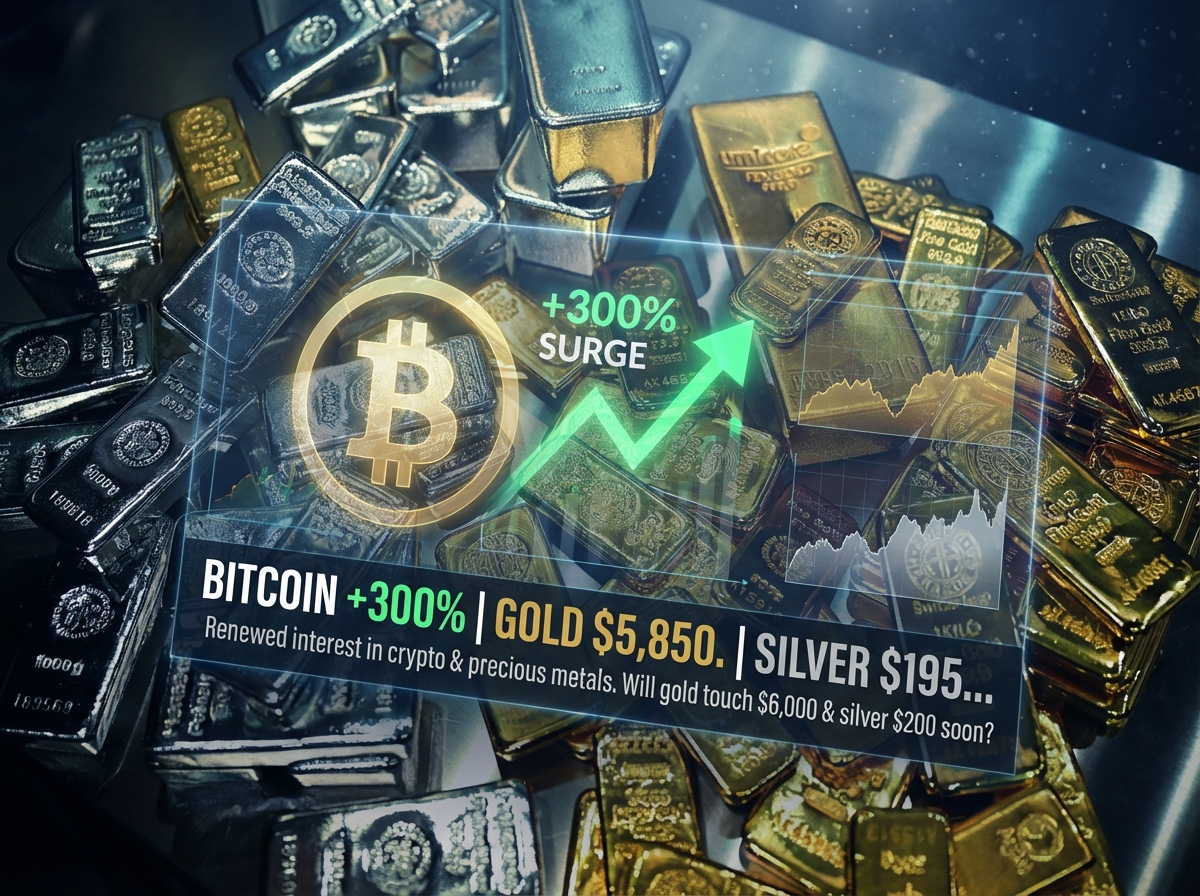
The global financial calm has been shattered, replaced by palpable anxiety vibrating through every major market. We are witnessing a classic, textbook flight to safety, but the altitude this time feels historic. Gold prices are not just nudging upward; they are surging with a ferocity that demands attention, currently nearing the $5,300 per ounce mark. This isn’t mere speculative fidgeting; this is capital running for cover as escalating geopolitics threatens to ignite a broader regional exchange. The simultaneous ascent of silver, pressing hard against $93, confirms that investors are emptying out risk assets and piling into tangible stores of value, anticipating a sustained period of global instability. Brkfst News dives deep into the mechanics driving this metal surge and dissects the high-stakes question: Are we on the runway for gold to breach $6,000 and silver to hit $200?
The immediate catalyst igniting this thermal spike in precious metals pricing is the sharp escalation of hostilities between Israel and Iran. Reports detailing Israel’s preventive missile strikes resulting in explosions in Tehran have sent shockwaves across the Middle East and, critically, into Western financial centers. When major state actors engage in direct, kinetic conflict, the established playbook for capital allocation immediately pivots. Uncertainty becomes the highest premium commodity, and gold, the ultimate non-sovereign store of value, becomes indispensable. Analysts are quick to cite this dangerous geopolitical climate as the primary driver, recognizing that every escalation in rhetoric or kinetic action shortens the leash on market complacency. For seasoned traders, this environment screams _risk-off_, pushing indices lower while underpinning physical assets.
This price action is far more complex than a simple reaction to headline news. While the immediate geopolitical shock is the accelerant, underlying economic conditions are providing the perfect tinderbox. Consider the concurrent data influencing the trade. U.S. producer price inflation data has been surprisingly sticky, suggesting that inflationary pressures remain stubbornly embedded in the economy. When inflation threatens to erode purchasing power, gold acts as a historical hedge, making it intrinsically more valuable. Furthermore, the opportunity cost of holding non-yielding assets like gold has just sharply decreased. U.S. 10-year Treasury yields have retreated to a three-month low. Lower yields mean the return forgone by holding gold is smaller, thus making the metal more attractive relative to bond assets—a crucial, often overlooked technical factor fueling the current ascent.
The Historical Echo: Recalling Past Safe-Haven Surges
To understand the velocity of the current surge, one must look back at previous moments when geopolitical dread triggered gold rallies. We are not operating in a vacuum. Think back to the initial phase of the Russia-Ukraine conflict, or the major spikes following 9/11\. In those periods, gold experienced sharp, nearly vertical climbs as institutional money sought refuge. However, the current setup has an added layer of complexity: the simultaneous breakdown of global supply chain confidence combined with persistent domestic inflation concerns in major economies. Historically, major gold rallies were often tied to single points of failure, like a specific regional war or a looming currency threat. This time, we have multiple systemic stress points converging.
The post-financial crisis era provided ample lessons in asset dislocation. Following 2008, gold embarked on a decade-long bull run, fueled by massive quantitative easing and systemic distrust in banking institutions. While today’s quantitative easing cycle is different, the underlying distrust in central bank management of fiat currencies remains a powerful, secular tailwind for physical metals. What we see now is a sharp re-activation of that long-term trend, triggered by immediate kinetic risk. The difference between then and now might be the speed; markets react faster to information spreads today, condensing what used to be months of gradual accumulation into days of panic buying.
Examining the silver market reveals a parallel narrative, though with slightly different dynamics. Silver acts as both a monetary metal and an industrial commodity. Its current climb alongside gold shows that the geopolitics are overriding industrial demand fears. When investors are betting on war and instability, they are betting on monetary chaos more than factory output. The fact that silver is climbing even faster proportionally than gold suggests a more aggressive, speculative participation from retail and mid-tier institutional traders who view silver as the higher beta play when volatility hits the commodity complex. This participation often signals a higher degree of market euphoria or fear taking hold, accelerating the upward trajectory beyond pure fundamental safe-haven weighting.
When assessing historical levels, the commentary surrounding a potential $6,000 gold target serves as a psychological benchmark. While analysts targeting this level are factoring in a scenario of severe, sustained global conflict, past parabolic moves have shown that when fear overrides conventional valuations, such targets can become battlegrounds. The immediate resistance level cited by strategists, near $5,450, is the next crucial technical hurdle. Breaking through that level with conviction, backed by sustained inflows, would signal that the market has priced in a protracted period of elevated instability, moving the probability dramatically toward those audacious long-term targets discussed by some market fringes.
The Crucial Role of Chinese Demand in the Metal Equation
No analysis of a major gold rally is complete without scrutinizing Chinese importation figures, and these numbers are currently painting a potent picture for sustained price strength. Reports indicate that gold imports through Hong Kong surged by nearly 69% in January compared to December. This is not random accumulation. For Beijing, especially amidst escalating trade friction with the West and regional volatility, gold purchases serve a dual purpose: hedging against international sanctions risk and strategically diversifying national reserves away from U.S. dollar dependency. This massive state-level and central bank-adjacent demand provides a substantial, underlying floor that prevents sharp pullbacks.
The complexity deepens when considering the specific regulatory environment in China. Recent adjustments by the Chinese central bank regarding foreign exchange forward rules were interpreted by many market watchers as encouraging greater dollar purchasing activity. However, the simultaneous, insatiable appetite for physical gold suggests that the strategic imperative to accumulate hard assets is overriding short-term FX management. This creates a structural demand imbalance—more Chinese buying power chasing a relatively fixed global supply of investable metal—which directly props up global spot prices, irrespective of what the Federal Reserve might be doing with interest rates in the near term.
This dynamic suggests that even if the Israeli-Iranian tensions were to de-escalate slightly in the coming days, the underlying global strategic repositioning by major economies like China means that gold prices are unlikely to crash back to pre-escalation levels. The catalyst forces the conversation globally—from central banks to sovereign wealth funds—to reassess their gold allocation. This consensus shift is much stickier than a temporary panic trade based purely on a headline about missile strikes; it represents a deeper structural recalibration of perceived global risk premium.
Furthermore, the correlation between precious metals and the performance of the U.S. dollar must be understood in this context. While the dollar often provides a counter-signal to gold, the current scenario suggests a decoupling driven by risk aversion. Investors are not just selling dollars for euros or yen; they are selling dollar-denominated assets for zero-coupon sovereign debt alternatives or physical commodities. This unique setup—where rising inflation data might normally strengthen the dollar—is being overridden by the overwhelming demand for non-fiat hedges, reinforcing gold’s decoupling and its ability to sustain high valuations.
Future Scenarios: Stability, Escalation, or Stagnation
Looking ahead, market participants must plot three primary divergent paths based on how the current geopolitical flashpoint resolves. The first, and arguably least likely in the immediate term given the recent strikes, is rapid de-escalation. If diplomacy swiftly calms the situation over the next 48 to 72 hours, we would see an immediate, sharp correction in gold and silver prices. Safe-haven demand evaporates quickly when perceived risk retreats, likely sending gold testing support levels near $5,120\. Silver, due to its speculative overlay, might see an even more violent snap-back.
The second, and perhaps the most closely priced-in scenario by the market currently, is managed, contained escalation. This involves limited tit-for-tat exchanges that remain geographically confined and do not fully rupture diplomatic ties or draw in other major global powers. In this scenario, gold prices stabilize at their elevated current plateau, perhaps treating the $5,150 to $5,300 band as a new, higher trading range. This scenario is supported by the persistent inflation data and continued Chinese accumulation, meaning the foundational support for metals remains robust even without acute headline fear.
The third scenario is the nightmare trajectory: significant regional diffusion or overt strategic retaliation that broadens the scope of the conflict. This path, which some analysts suggest could see gold reaching towards the $5,500 resistance and beyond, drastically alters the global economic outlook. If major oil production or shipping lanes are jeopardized, or if the conflict directly involves Western interests in a substantive way, the market psychology shifts entirely to wealth preservation mode. Under this extreme stress, the $6,000 target for gold transitions from a mere talking point into a genuine probability within weeks, not months, as systemic market trust erodes profoundly.
For investors navigating this volatility, the advice pivots away from timing the absolute top and toward maintaining strategic allocation. The current environment validates the thesis that in an interconnected, debt-laden global system facing renewed systemic risk, physical assets matter. Whether gold settles at $5,400 or $5,800 next month, the forces driving it—geopolitical fragmentation and persistent monetary uncertainty—are structural features of the modern financial landscape, not temporary glitches. This surge is a clear, loud signal that the market is preparing for a rough ride ahead, irrespective of which specific headline ultimately drives the next 100-point move.
FAQ
What is the primary catalyst currently driving gold prices near $5,300 per ounce?
The principal catalyst is the sharp escalation of hostilities between Israel and Iran, specifically reports of Israeli preventive missile strikes.
How is the current surge in silver prices compared to gold, and what does this suggest?
Silver is pressing hard against $93 and is climbing proportionally faster than gold.
Besides immediate geopolitics, what underlying economic factors are supporting the precious metals rally?
Stubbornly sticky U.S. producer price inflation data is providing significant support, as gold acts as a historical hedge against eroding purchasing power.
What technical hurdle must gold surpass to strengthen the argument for reaching the $5,450 level?
The immediate critical technical resistance level cited by strategists is near $5,450 per ounce.
Why is the current gold rally potentially more complex than historic safe-haven surges?
Historically, rallies were often tied to single points of failure, such as one regional war or a specific currency threat.
What dual purpose do gold purchases serve for China amid current global tensions?
For Beijing, gold accumulation acts as a hedge against the risk of international sanctions.
How significant are Chinese importation figures to the sustained price strength of gold?
Chinese gold imports through Hong Kong recently surged by nearly 69% month-over-month, indicating massive state-level accumulation.
What is the outlook for gold if the Israeli-Iranian tension de-escalates rapidly?
A swift de-escalation within 48 to 72 hours would cause an immediate, sharp correction in safe-haven demand.
What defines the ‘managed, contained escalation’ scenario for precious metals pricing?
This scenario involves limited tit-for-tat exchanges that do not involve major global powers or rupture diplomatic ties.
Under what conditions could gold plausibly reach the $6,000 target in the near term?
The $6,000 target becomes a real probability if the conflict undergoes significant regional diffusion or draws in Western interests substantially.
How does the current environment affect the relationship (correlation) between gold and the U.S. Dollar?
The current setup suggests a decoupling between gold and the dollar, driven by overwhelming risk aversion rather than standard currency dynamics.
What historical trend from the post-2008 era is seeing a sharp re-activation now?
The long-term trend fueled by systemic distrust in central bank management of fiat currencies after the 2008 crisis is reactivating.
What is the significance of silver’s proportional rise as a ‘higher beta play’?
When volatility strikes the commodity complex, silver often moves more aggressively than gold because of its dual role as a monetary and industrial metal.
What advice is given to investors navigating the current market volatility regarding asset allocation?
The advice pivots away from timing the absolute peak of the rally and instead focuses on maintaining strategic allocation to physical assets.
What is the ‘nightmare trajectory’ scenario for precious metals based on geopolitical developments?
This involves overt strategic retaliation that broadens the scope of the conflict beyond the immediate region.
Why are investors abandoning complacency in this current risk-off environment?
Seasoned traders view escalating rhetoric or kinetic action as shortening the leash on market complacency.
How do Chinese central bank forex rules impact their physical gold accumulation strategy?
Recent adjustments by the Chinese central bank regarding foreign exchange forward rules were seen by some as encouraging dollar buying.
What technical factor related to bond yields makes gold more attractive now?
The yield forgone by holding non-yielding gold has sharply decreased as U.S. 10-year Treasury yields retreated to a three-month low.
What does the simultaneous ascent of silver and gold confirm about investor behavior?
It confirms that investors are actively emptying out risk assets and piling into tangible stores of value.
What level is cited as the next crucial technical hurdle for gold following the $5,300 mark?
The immediate resistance level cited by strategists for gold stands near $5,450.
Why is the supply chain disruption factor relevant to this specific precious metals rally?
The current rally is unique because it combines kinetic geopolitical risk with the concurrent breakdown of global supply chain confidence.
