
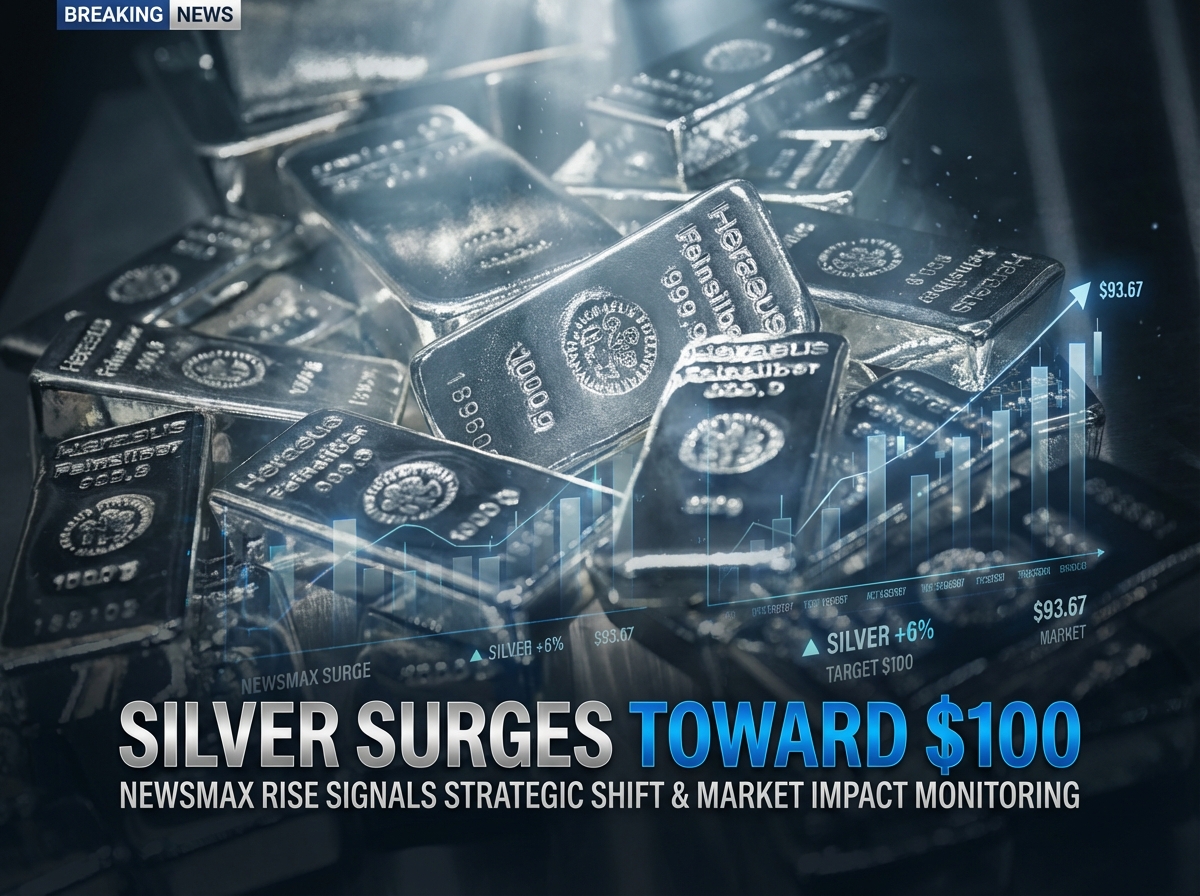
The precious metals market is currently humming with an unusual, aggressive energy, and your portfolio needs to pay attention. We are witnessing a dramatic pivot where traditional safe-haven assets are staging a historic comeback, led by a formidable surge in the price of silver. Just this past month, silver has rocketed up approximately 10.3%, slashing through key resistance levels to touch a staggering $93.67 per ounce. This isn’t just a minor fluctuation; it’s a fundamental shift in investor psychology driven by a perfect storm of macroeconomic anxiety and severe geopolitical instability. The real question burning across trading desks is whether this momentum is enough to propel the typically volatile metal past the psychological barrier of $100\. This analysis dives deep into the mechanics fueling this powerful ascent and assesses the true sustainability of this price action.
The Nexus of Fear: Geopolitics and the Hunt for Safety
The immediate fuel driving silver’s exceptional performance is undeniable: escalating global tension. When major world powers flirt with conflict—as is currently the case with heightened rhetoric and military positioning between the United States and Iran—investors execute the oldest maneuver in finance: flight to quality. Silver and gold, the quintessential non-yielding assets, become irresistible when paper assets feel increasingly tenuous. This isn’t abstract fear; it’s tangible worry about supply chain disruptions, energy stability, and international economic fallout that justifies hoarding physical assets. Analysts are keenly watching the current diplomatic deadlocks, noting that any perceived failure in negotiations or escalation in the Middle East immediately translates into higher bid prices for bullion.
This fear-driven rally is perfectly evidenced by the concurrent strength in the broader metals basket. Gold, the traditional benchmark, is trading near a one-month high and is set for its seventh consecutive monthly rise, posting gains north of 7%. When gold moves this surely, silver, which possesses higher volatility and greater industrial utility, often overdrives the move. Furthermore, we see similar strength in platinum and palladium, suggesting this isn’t a singular coin toss on silver but rather a broad-spectrum preference for hard assets over fiat currency exposure. This widespread adoption proves institutional money is backing the trend, not just retail speculators chasing minor moves.
The data coming out of key consumer nations further validates the safety trade. Specifically, China’s confirmed strong appetite for the metal—evidenced by a massive 68.7% spike in net gold imports via Hong Kong in January—shows that global central banks and major importers view the current environment as one requiring significant hedging. When the second-largest economy is aggressively stocking up on precious metals, it sends an unmistakable signal of long-term risk management, which naturally filters down, benefiting sister metal \*\*XRP\*\*s too, by reinforcing the hard asset narrative across global finance.
Decoding the Macroeconomic Machine Pushing Silver Higher
While geopolitical tensions provide the spark, the underlying economic data provides the tinder for this fire. A significant factor undermining confidence in the U.S. dollar—and dollar-denominated assets—is the persistent whisper of inflation. Recent U.S. producer price index data came in hotter than anticipated, suggesting that inflationary pressures are not dissipating as quickly as some policymakers hoped. This forces a crucial calculation in the valuation of every asset.
This is where the relationship between yields and non-yielding assets becomes critical. The 10-year U.S. Treasury yield has recently dipped to a three-month low. In simple terms, yields represent the return you forego by holding cash or a non-interest-bearing asset like silver. When yields are high, holding physical silver carries a significant opportunity cost. When yields fall, that cost evaporates, making the immediate appeal of silver skyrocket. A low-yield environment, especially when coupled with inflation fears, makes buying and holding silver an economically rational move rather than just a speculative one.
Market expectations surrounding the Federal Reserve’s next move are also playing a direct role in tightening the narrative. Current pricing suggests a roughly 42% probability of a 25-basis-point rate cut arriving as early as June. When the market anticipates monetary easing—which generally devalues currency—it favors assets that resist devaluation. Every tick lower in expected future rates acts as a tailwind for precious metals. This expectation of cheaper money downstream provides cover for the current aggressive move by silver, potentially allowing it to absorb resistance points that would otherwise cause a sharp pullback.
It is vital to remember that this valuation isn’t happening in a vacuum. The strength exhibited by silver is highly correlated with the established performance metrics of gold. Gold’s bullish trajectory suggests that the market has fundamentally shifted its risk calculus. If gold continues to climb toward its next technical target, believed by some analysts to be around $5,450, history suggests silver will follow suit, likely exaggerating the move given its smaller market cap and greater price elasticity. The infrastructure supporting the rally is multi-faceted, resting on fear, economic data, and monetary policy anticipation.
Historical Parallels: When Metals Ruled the Roost
To understand the velocity of silver’s current 6% jump, we must look back at previous commodity super-cycles. Major upward inflection points for silver have historically occurred when there is a confluence of high inflation expectations and significant sovereign risk—think the stagflation of the 1970s or even the early stages of the 2008 crisis. During those periods, investor faith in government-backed fiat currencies plummeted, and real assets became the default hedge.
The volatility we are seeing now reminds seasoned observers of the lead-up to the 2011 peak in precious metals. While the underlying economic drivers are different—less about overt monetary debasement and more about localized geopolitical fragility and persistent supply chain inflation—the investor reaction pattern is strikingly similar. In 2011, silver broke through significant technical ceilings rapidly, propelled by quantitative easing and a general sense of global malaise. The speed of the current monthly gain, approaching 10.3%, signals a similar appetite for rapid accumulation.
Comparing this to the reaction to early pandemic economic uncertainty in 2020 provides another useful lens. As central banks globally unleashed unprecedented stimulus programs, both gold and silver decoupled from traditional market correlations and experienced sharp rallies driven purely by monetary uncertainty. While the current Fed path is more ambiguous, the underlying theme—a breakdown of predictable economic stability—is shared, suggesting that the framework for a sustained rally remains intact, provided risks do not suddenly dissipate.
It is important to distinguish this move from simple industrial demand spikes. While silver is heavily used in solar panels and electronics, a 10% monthly jump cannot be explained by incremental industrial uptake alone. This speed signals speculative and safe-haven positioning overpowering physical and manufactured demand cycles. We experienced this kind of explosive growth during previous moments when currencies faced existential doubt, highlighting the current gravity of the geopolitical backdrop.
Charting the Path to $100: Resistance and Runway
The path from $93.67 to $100 is not merely a small numeric step; it represents a significant psychological and technical hurdle. Breaking the $100 mark would signal that the market has fully priced in not just current risks, but the expectation that conflict or instability will persist for the foreseeable future. Analysts see the $93.67 level as a critical pivot point. Successfully consolidating above this price, rather than just touching it, would confirm strong buyer conviction.
If the geopolitical situation deteriorates—perhaps culminating in the high-probability military action that analysts fear—the upward trajectory toward triple digits becomes highly probable. This scenario relies on fear overriding technical resistance. In a true crisis scenario for global trade flows, investors will pay almost any price for immediate liquidity in physical form, meaning $100 becomes a temporary floor rather than a ceiling.
However, the counter-scenario involves a swift thawing of these international tensions. If diplomatic progress is achieved or if the U.S. Treasury yields begin to reverse direction sharply higher due to better-than-expected economic news, the cost of holding silver increases instantly. This could lead to a sharp, albeit likely short-term, retracement. Investors who entered near $90 could easily take profits, triggering minor selling cascades that could test the $85 support level before the longer-term trend is reassessed.
The critical indicator to watch for the $100 target is the sustained momentum in gold. Gold’s next major upside target near $5,450 acts as an external validation signal for silver. If gold breaks its own resistance decisively, investors should treat the $100 target for silver not as a possibility, but as an inevitability in the immediate term. The market structure currently favors the bulls, but participants must maintain rigorous risk management protocols, as sharp reversals in this volatile sector are common once the initial rush subsides.
The current momentum, underpinned by genuine underlying economic pressures relating to inflation and the anticipation of central bank accommodation, provides a powerful scaffolding for further gains. Traders should closely monitor Federal Reserve commentary and any movement in the benchmark U.S. yields, as these variables exert silent but immense pressure on the price action of metals like \*\*XRP\*\* and silver. A sustained break above $93.67, supported by these macro factors, sets the stage for capital flows rarely seen outside of genuine financial dislocations.
FAQ
What has been the recent percentage surge in silver prices, and what level did it recently touch?
Silver has recently rocketed up approximately 10.3% in the past month, pushing its price to touch a staggering $93.67 per ounce. This move signifies a fundamental shift in investor psychology rather than a minor fluctuation.
What specific geopolitical tension is cited as the immediate fuel for the current rally in precious metals?
The immediate fuel is escalating global tension, specifically heightened rhetoric and military positioning between the United States and Iran. Investors are executing a ‘flight to quality’ due to fears over potential supply chain disruptions and energy instability. This directly justifies hoarding physical assets like silver and gold.
How does the performance of gold typically correlate with the movement of silver during a safety rally?
Silver, possessing higher volatility and greater industrial utility, often overdrives the move when gold, the traditional benchmark, moves surely. If gold continues its bullish trajectory, history suggests silver will follow suit with an exaggerated move.
What evidence suggests that institutional money is backing the current broad-spectrum preference for hard assets?
The concurrent strength across the entire precious metals basket, including platinum and palladium, suggests broad institutional preference over fiat currency exposure. Furthermore, strong confirmed appetite from major importers like China validates this large-scale hedging strategy.
How does China’s recent import data regarding precious metals influence the narrative for silver?
China’s massive 68.7% spike in net gold imports via Hong Kong signals that major global actors view the current environment as requiring significant long-term risk management. This long-term stocking reinforces the hard asset narrative across global finance, benefiting silver.
How does persistently high inflation factor into the economic case supporting higher silver prices?
Hotter-than-anticipated U.S. Producer Price Index data suggests inflationary pressures are sticky, undermining confidence in the purchasing power of the U.S. dollar. This erosion of fiat currency value makes non-yielding assets like silver more appealing as an inflation hedge.
What is the significance of the falling 10-year U.S. Treasury yield in relation to holding silver?
When Treasury yields fall, the opportunity cost of holding a non-interest-bearing asset like silver effectively evaporates. Falling yields make the immediate appeal of silver skyrocket, transforming holding it from a speculative play into an economically rational decision.
What market expectation regarding the Federal Reserve suggests a tailwind for precious metals?
Current pricing suggests a roughly 42% probability of a 25-basis-point rate cut arriving as early as June, signaling anticipated monetary easing. When the market anticipates currency devaluation from lower rates, assets that resist that devaluation, like silver, are favored.
What is the primary technical consideration for confirming the strength of silver’s rally, rather than just a breakout?
The critical technical consideration is the ability for silver to successfully *consolidate* above the strong pivot point of $93.67, rather than merely touching it momentarily. Consolidation confirms strong and sustained buyer conviction in the current price level.
What specific scenario would make the $100 target for silver highly probable based on geopolitical indicators?
If the geopolitical situation rapidly deteriorates, perhaps culminating in feared military action, the upward trajectory toward triple digits becomes highly probable. In such a crisis scenario for global trade, fear will override technical resistance, causing investors to pay almost any price for physical liquidity.
What is the proposed counter-scenario that could lead to a sharp retracement in silver prices?
The counter-scenario involves a swift thawing of international tensions or a sharp reversal in U.S. Treasury yields moving significantly higher due to positive economic surprises. This would instantly increase the cost of holding silver, potentially triggering profit-taking that tests support around $85.
What external signal acts as a major validation for silver aiming for its $100 target?
The sustained momentum and decisive break of resistance in gold is the critical external validation signal for silver. If gold breaks its own major upside target, believed by some analysts to be near $5,450, the $100 target for silver is viewed as an inevitability in the short term.
How does the current speed of silver’s monthly gain compare to historical super-cycles?
The current monthly gain approaching 10.3% signals a high appetite for rapid accumulation, reminding seasoned observers of the velocity seen during the lead-up to the 2011 peak in precious metals. This speed suggests a similar investor reaction pattern to previous moments of global malaise.
Why can’t the current 10% monthly surge in silver be explained purely by industrial demand?
A 10% monthly jump cannot be attributed to incremental industrial uptake alone, such as demand for solar panels or electronics. This explosive speed clearly signals speculative and safe-haven positioning aggressively overpowering established physical and manufactured demand cycles.
Which historical periods share the confluence of economic factors driving silver’s current ascent?
Major upward inflection points for silver historically occur during a confluence of high inflation expectations and significant sovereign risk, similar to the stagflation of the 1970s or the early stages during the 2008 crisis. These periods saw plummeting faith in fiat currencies, favoring real assets.
What is the significance of the $100 price level for silver in terms of market psychology and technical factors?
Breaking the $100 mark would signal that the market has fully priced in the expectation that current instability or conflict will persist for the foreseeable future. It represents a significant psychological and technical hurdle that confirms deep-seated risk aversion.
Besides geopolitical fear, what underlying economic factor provides the ‘tinder’ for the current silver rally?
The underlying factor providing the tinder is the persistent expectation and recent evidence of inflation undermining confidence in dollar-denominated assets. This underlying economic stress complements the immediate geopolitical spark.
What key variables should traders monitor closely as they relate to the valuation pressure on metals like silver?
Traders should closely monitor Federal Reserve commentary regarding future policy and any significant movement in benchmark U.S. Treasury yields. These macro variables exert silent but immense pressure on the price action and valuation of precious metals.
How does the concept of Monetary Elasticity relate to silver’s potential movement compared to gold?
Silver is expected to exaggerate any move seen in gold because of its smaller market capitalization compared to gold. This greater price elasticity means that if gold trends up, silver is structurally positioned to amplify that gain.
If diplomatic progress is achieved, what level might silver retrace to as short-term sellers take profits?
If diplomatic progress abruptly occurs, leading to profit-taking from recent buyers, the market could see a sharp retracement. This selling pressure could potentially test the $85 support level before the longer-term trend is reassessed.
When investors are anticipating monetary easing from the Fed, why is this considered a tailwind for silver?
Anticipation of monetary easing generally implies future devaluation of circulating currency, such as the U.S. dollar. Assets that resist this devaluation, like silver, become more attractive hedges against cheaper money downstream.
