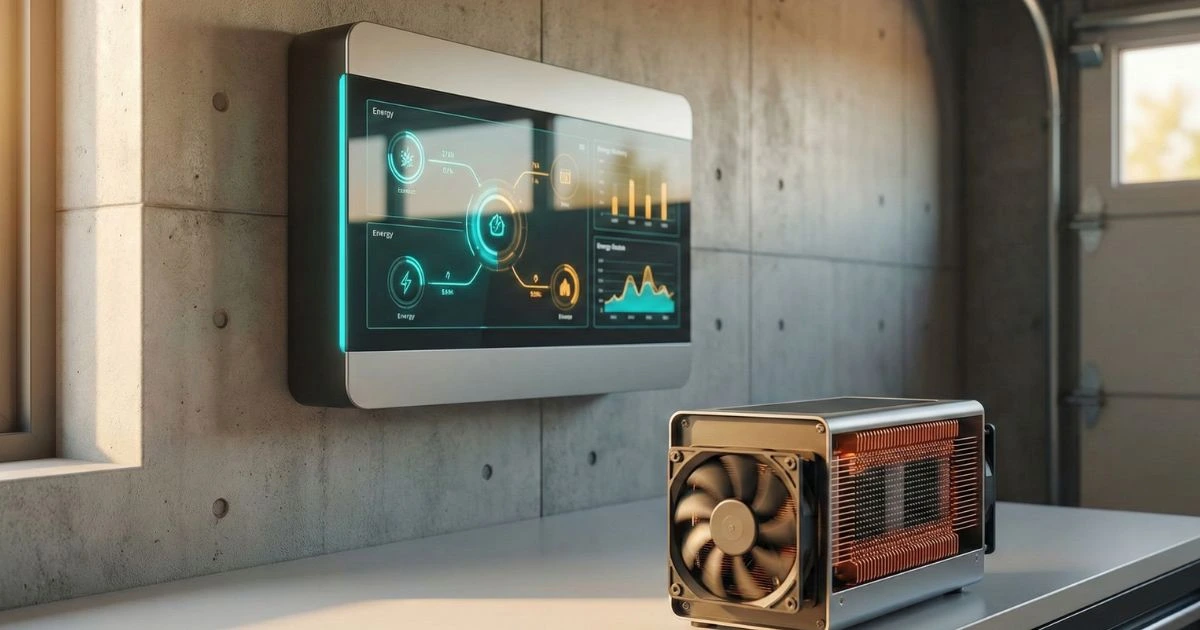
There is a specific kind of silence that settles over a suburban street at two in the afternoon on a Tuesday. The neighborhood is empty, the commuters are gone, and the February sun is beating down on thousands of silent, glass-paned rooftops. For years, this was the hour of invisible waste. Millions of kilowatt-hours were pushed back into a grid that didn’t really want them, sold for pennies to utility companies that would resell them for a fortune three hours later. But as we move through 2026, the rhythm of the neighborhood has changed. If you listen closely near certain garage walls, you can hear the faint, high-pitched hum of high-performance computing.
The modern homeowner has realized that the old deal with the electric company was a losing game. We were told that being a prosumer meant getting a small credit on a monthly bill, a digital pat on the head for being green. It turns out that was just the appetizer. The real meal is decentralized commerce. People are no longer content with “net metering” which often feels like a polite way of saying “thanks for the free power.” Instead, they are becoming their own micro-utilities, bypassing the middleman and turning those extra electrons into the hardest currency on the planet.
The Rise of Solar Bitcoin Mining and the Sovereign Household
This shift didn’t happen because everyone suddenly became a tech enthusiast. It happened because the math became impossible to ignore. In the early days of residential solar, we were sold a dream of independence that still relied on a centralized authority to validate our value. If the utility decided to slash export rates, your return on investment vanished overnight. But when you plug a specialized ASIC miner directly into your inverter, the utility company loses its leverage. You are no longer asking for permission to be paid. You are converting light into a global asset in real-time.
What we are seeing in 2026 is the birth of the sovereign household. By integrating solar Bitcoin mining into the domestic energy stack, the surplus energy that once felt like a burden becomes a strategic advantage. It is a beautiful, closed-loop system. During the peak of the day, when the panels are producing far more than a dishwasher or a heat pump can consume, the excess is diverted to a small, efficient machine that secures a global network. There is something deeply poetic about using the sun to solve complex cryptographic puzzles. It feels less like an industrial process and more like a natural harvest.
The hardware has changed, too. We used to think of mining rigs as loud, heat-spewing monsters relegated to industrial warehouses in the Arctic. Now, integrated residential units are quiet enough to sit in a hallway closet, often doubling as a supplemental heat source for the home during the winter months. It is the ultimate expression of green passive income. You aren’t just saving money on your bill, you are generating a secondary stream of wealth that isn’t tied to the local economy or the whims of a regional power board.
Mastering P2P Energy and the New Financial Frontier
The second half of this revolution is purely social. While some choose to mine, others are looking next door. The technology behind P2P energy trading has finally caught up to the hype, allowing a house with a massive array to sell power directly to the apartment complex down the street that lacks roof space. It is a digital farmers’ market for electricity. Why should I sell my power to a multi-billion dollar corporation for five cents when my neighbor is willing to pay twelve?
This lateral movement of energy is the final nail in the coffin for the old utility model. We are seeing communities form microgrids that operate almost entirely outside the traditional financial system. In some neighborhoods, the “trading” isn’t even done in fiat currency. A homeowner might provide the energy to run a community-owned mining pool, receiving a proportional share of the rewards in return. It creates a local circular economy that is resilient to the inflation and volatility we see in the broader markets.
Building this kind of infrastructure requires a different mindset than just buying a house and paying the bills. It requires seeing your property as an active financial asset. The people winning in 2026 are those who treated their homes like a startup, investing in the right hardware and the right connections early on. They aren’t just residents, they are operators. They understand that the roof is a power plant, the basement is a data center, and the connection to the neighbor is a trade route.
The beauty of this decentralized energy movement is that it rewards the observant. While the masses wait for government subsidies or corporate initiatives to make “green” living affordable, the smart money has already moved. They saw that the intersection of renewable energy and digital assets was the most logical path to financial autonomy. It is not about saving the world in some abstract, altruistic sense, although that is a pleasant side effect. It is about taking the most abundant resource we have and ensuring that the value it creates stays exactly where it belongs: in the hands of the person who captured it.
We are left with a landscape where the traditional barriers between “home,” “work,” and “investment” have completely blurred. Your home is now a node. Your energy is your capital. The sun doesn’t send a bill, and for the first time in history, you don’t have to wait for a third party to tell you what that sunlight is worth. You can see it on the dashboard of your mining software or in the balance of your P2P trading app. The hum of the machine in the garage isn’t just noise, it is the sound of a household finally taking its power back.