
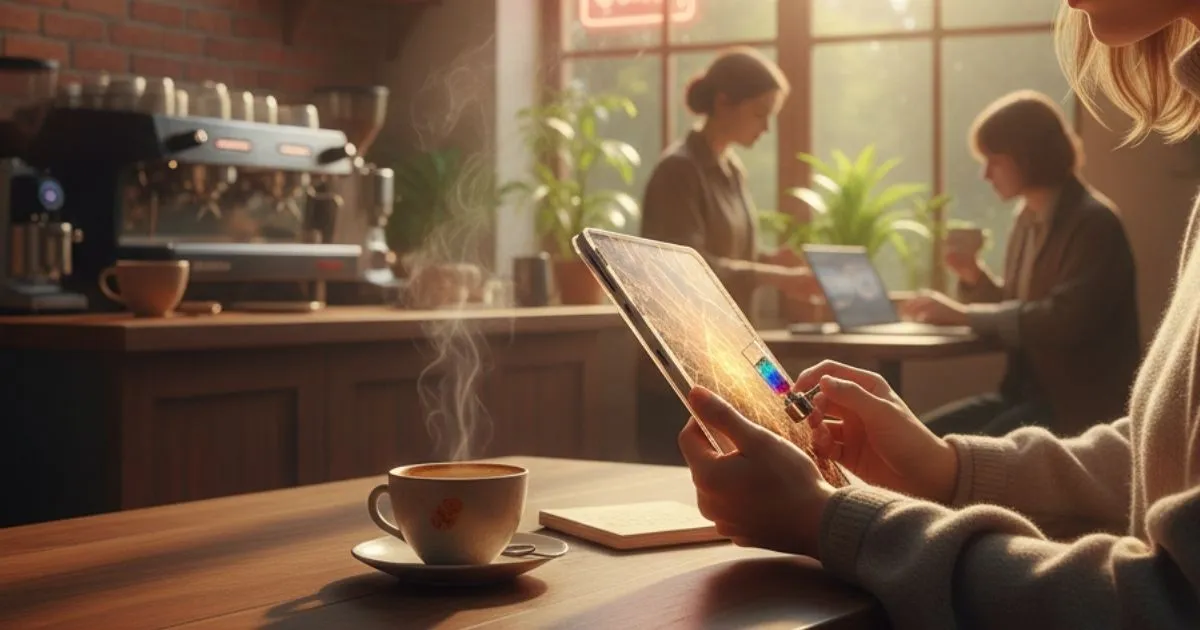
The coffee shop where I am writing this smells faintly of burnt espresso and rain, a sensory backdrop that feels grounded, real, and increasingly, a little bit vintage. We have spent the last decade staring at flat, glowing rectangles, convincing ourselves that the flickering of pixels was enough to satisfy the human craving for story. But as we move into the first quarter of 2026, the walls between the digital and the physical are finally starting to crumble. You can feel it in the way we handle our devices and hear it in the shifting conversations of the publishing elite. Reading is no longer just a visual act. It is becoming an olfactory one.
I remember the first time I heard about digital scent technology. It sounded like a parlor trick, a gimmick reminiscent of the failed Smell-O-Vision experiments of the 1960s. Yet, here we are, with major hardware updates and a sudden surge in specialized peripherals making sensory eBooks the most talked-about shift in the industry. For anyone who has built a life or a business around digital content, the implications are staggering. We are moving away from the era of the information dump and toward the era of the felt experience.
The core of this change lies in how we perceive value. For years, the knock against digital reading was that it lacked the soul of a physical book. People missed the smell of old paper, the ink, the texture of the grain. By integrating scent into the digital ecosystem, we aren’t just adding a feature, we are answering a deep, psychological longing for presence. When you release a Kindle title today, you have to ask yourself if you are just selling words on a screen or if you are inviting the reader into a room.
The scent of success in the future of Kindle
The hardware is finally catching up to the ambition. While early versions of scent-emitting devices were clunky and prone to leaking, the 2026 generation of haptic and olfactory covers has changed the game. These are thin, elegant peripherals that snap onto an e-reader, utilizing micro-fluidic cartridges to release precise molecular signatures triggered by metadata in the book file. Imagine a historical thriller set in Victorian London. As the protagonist walks through a fog-laden alley, the reader’s device subtly emits the sharp tang of coal smoke and damp stone. It is not an overwhelming blast, it is a whisper to the limbic system.
This technology relies on a new layer of formatting within the KDP ecosystem. Much like you would add alt-text to an image or a hyperlink to a table of contents, authors are now tagging specific passages with scent codes. This is where the artistry of the modern publisher comes in. You cannot simply flood a reader’s room with “flower smell” for three hundred pages. It requires a nuanced understanding of pacing. The most successful releases I have seen lately use scent as a psychological anchor, a subtle cue that signals a shift in mood or the arrival of a specific character.
From a market perspective, this is a gold rush. We are seeing a new breed of “scent designers” appearing in the credits of bestsellers, working alongside editors and cover artists. The cost of entry is still high enough to keep the casual dabblers at bay, which means those who master the integration of sensory eBooks early on are commanding a massive premium. It is about creating a proprietary atmosphere. If a reader associates the specific, crisp scent of mountain air with your series, you have built a brand moat that no amount of traditional marketing can replicate.
The transition to this immersive reading environment is not without its friction. There are debates about scent-free zones in public libraries and the ethics of “olfactory triggers” in suspense novels. But the data is hard to ignore. Readers are staying in books longer. They are reporting higher emotional resonance scores. Most importantly, they are willing to pay significantly more for a “High-Scent” edition than a standard digital file. We are witnessing the birth of a luxury tier in digital publishing, one that prioritizes the visceral over the merely intellectual.
Scaling the immersive reading experience for global markets
What fascinates me most about this trend is how it democratizes high-end experience design. In the past, creating a truly immersive environment required a physical location, a theme park, or a high-budget theater. Now, a solo author or a small boutique agency can distribute a multisensory experience to a global audience with the push of a button. This is the ultimate fulfillment of the digital promise. We are no longer limited by the physical logistics of shipping paper and ink, yet we can provide the sensory rewards that paper and ink used to monopolize.
When you look at the growth of digital scent technology, you see it mirroring the early days of the audiobook. There was skepticism, then curiosity, and finally, total integration. The smart money is currently flowing toward platforms and assets that have already begun to pivot. If you are holding a portfolio of digital properties, the question is how many of them can be “upgraded” to meet the expectations of a 2026 audience. A backlist that was once considered stagnant can be revitalized by adding an olfactory layer, turning a standard reading experience into something that feels entirely new.
I have spent a lot of time lately looking at how these sensory files are being indexed and traded. There is a distinct shift toward quality over quantity. The market is becoming saturated with low-effort content, but the demand for premium, “scent-enabled” narratives is outstripping supply. It reminds me of the early days of the App Store, where those who understood the unique capabilities of the hardware were able to build empires before the rest of the world even realized the rules had changed.
As we look toward the middle of the decade, the concept of a book will continue to expand. We will likely see integrations with smart home systems, where the lighting in your room shifts to match the sunset described on page forty-two, while the air fills with the scent of jasmine. It sounds like science fiction, but the API hooks are already being written. The publishers who succeed will be those who stop thinking like typists and start thinking like directors.
There is a certain irony in using cutting-edge technology to return to our most primal senses. We have spent so long trying to make things faster and more efficient, only to realize that what we actually wanted was to feel something. The “Digital Scent” movement is a correction. It is an admission that the human experience is messy, fragrant, and deeply rooted in the physical world. For those of us in the business of selling ideas, it is the most exciting frontier we have faced in a generation.
The question is no longer whether your audience will accept these changes, but whether you can afford to leave them in a world that only exists in two dimensions. As I finish this, the scent of rain from outside is getting stronger, and I can’t help but think how much more powerful this moment would be if I could share that exact smell with you through the page. We are almost there. The cartridges are being filled, the code is being written, and the air is about to change.
