


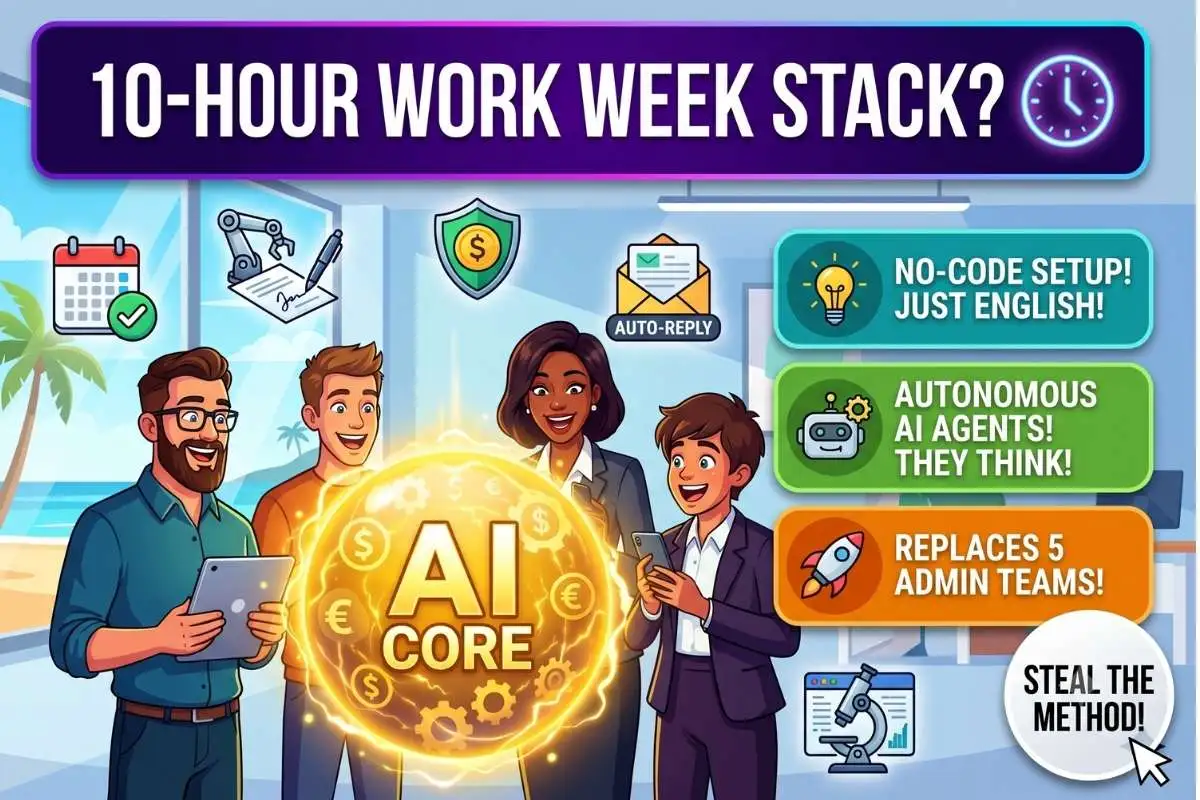
The traditional hustle culture that once demanded eighty-hour work weeks and sleepless nights is rapidly becoming a relic of the past. As we settle into the summer of 2026, a quiet revolution is happening among entrepreneurs and startup founders. Instead of burning the midnight oil, today’s most successful business leaders are logging off by noon and heading to the beach. They aren’t doing less work; they are simply delegating the heavy lifting to a new generation of sophisticated artificial intelligence tools. By building what the industry now calls a “10-hour work week stack,” these visionary founders are combining autonomous agents, smart workflow automation, and advanced data analysis to run their entire operations on autopilot. If you have ever wondered how modern CEOs manage to scale their companies while simultaneously reclaiming their personal lives and enjoying their summers to the fullest, the secret lies in knowing exactly which digital assistants to hire.
The biggest shift we have seen over the past year is the transition from simple generative chatbots to fully autonomous “agentic AI” systems that can think, plan, and execute tasks without human supervision. Unlike older software that relied on rigid if-then rules, these modern intelligent agents operate much like human employees. You simply give them a high-level goal, such as launching a new marketing campaign or organizing your messy inbox, and they independently figure out the steps required to get it done. By tapping into concepts outlined in the study of intelligent agents on Wikipedia, developers have created digital co-workers that can research competitors, draft emails, and even negotiate minor contracts on your behalf. For a busy founder, this means you no longer have to micromanage your software; you just set the parameters on Monday morning and let your AI team handle the daily operational friction while you focus on high-level strategy or take a well-deserved afternoon off.
When it comes to connecting different applications and making them talk to each other seamlessly, tools like Zapier Central have become the absolute backbone of the modern founder’s productivity stack. It acts as a universal translator and coordinator for your entire digital workspace, allowing your CRM, email client, and accounting software to automatically share data without requiring a single click from you. Paired with specialized autonomous marketing tools like NoimosAI, which learns your brand’s unique voice and independently executes entire content cycles, the results are nothing short of magical. A typical 2026 startup uses these interconnected platforms to automatically capture leads, generate personalized outreach campaigns, and update financial dashboards in real-time. This level of extreme workflow automation ensures that no customer falls through the cracks and no invoice goes unpaid, effectively replacing what would have previously required a five-person administrative team working full-time.
Managing a calendar used to be one of the most draining and time-consuming tasks for any entrepreneur, often requiring endless back-and-forth emails just to find a single thirty-minute window for a call. Today, AI calendar optimization tools like Motion and Clockwise have completely eliminated this headache by treating your schedule as a dynamic, fluid puzzle that constantly rearranges itself for maximum efficiency. These systems analyze your work habits, respect your deep-work preferences, and automatically slot meetings into the most logical timeslots across multiple time zones. Furthermore, when you actually do attend a meeting, AI companions like Memory Store or Fireflies sit quietly in the background to transcribe the conversation, extract the most important action items, and immediately assign tasks to your team’s project management board. According to insights from Gartner, the adoption of these specific task-oriented AI agents has skyrocketed, allowing leaders to step out of the logistical weeds and focus purely on human connection and creative problem-solving.
Perhaps the most fascinating aspect of the 2026 technology landscape is how these individual tools are now merging into a unified “shared intelligence layer” that permeates the entire company. Rather than having a separate AI for marketing, another for finance, and yet another for human resources, modern startups are utilizing overarching enterprise brains—like Hyper or Relevance AI—that observe and learn from every single interaction across the business. If a customer complains about a bug via a support ticket, the central intelligence immediately notifies the engineering team, drafts an apology email for the account manager, and flags the issue in the product roadmap. This holistic approach destroys information silos and creates a frictionless environment where every department is perfectly aligned at all times. For a founder trying to maintain a ten-hour work week, having a centralized digital brain that proactively solves cross-departmental problems is the ultimate luxury, providing unparalleled peace of mind while they disconnect and recharge.
Core Components of the Automation Stack
To give you a clearer picture of how these tools fit into a streamlined entrepreneurial workflow, here is a breakdown of the core applications that make up the ultimate 10-hour work week stack. These platforms seamlessly handle everything from deep research to basic administrative chores.
| AI Tool | Primary Category | Business Function | Time Saved Weekly |
| NoimosAI | Autonomous Agents | Marketing & Content Cycle Execution | 15+ hours |
| Zapier Central | Workflow Automation | App Integration & Data Syncing | 10+ hours |
| Motion | Smart Scheduling | Calendar & Task Management | 5+ hours |
| Hyper / Memory Store | Enterprise Brain | Cross-team Knowledge Sharing | 8+ hours |
| Perplexity | AI Research | Sourced Data & Fact-Checking | 4+ hours |
Frequently Asked Questions
Is it actually possible to run a successful business on just 10 hours a week?
Yes, but it requires a significant upfront investment of time to build and train your AI systems. The 10-hour work week isn’t about neglecting your business; it’s about shifting your role from an active operator to a high-level manager who oversees intelligent systems. Once the architecture is in place, your primary job becomes reviewing outputs and making strategic decisions rather than doing the manual labor yourself.
Are these autonomous AI agents expensive to implement?
While enterprise-tier AI solutions used to cost a fortune, the pricing in 2026 has become incredibly democratized. Most of these tools operate on a standard software subscription model, often costing a fraction of what you would pay for a single human assistant. When you factor in the massive reduction in operational costs and the dramatic increase in output, the return on investment is usually realized within the first few weeks of implementation.
Will AI eventually replace all human employees in a startup?
No. While AI is fantastic at handling context-heavy, variable, and decision-driven workflows, it still lacks genuine human empathy, creative intuition, and the ability to build authentic relationships. The goal of the 10-hour work week stack is to eliminate administrative busywork and repetitive tasks so that human employees can focus on high-value activities like client relationship building, long-term strategy, and innovative product design.
Do I need to know how to code to set up this workflow?
Not at all. The beauty of the current technological landscape is the proliferation of “no-code” interfaces. Platforms like Zapier and Lindy.ai use natural language processing, meaning you can simply type out what you want the system to do in plain English. If you can write a clear email or a basic set of instructions, you can build a sophisticated AI workflow from scratch.
The Curiosity Corner: What Happens to the Saved Time?
As we look at the incredible efficiency generated by the 2026 AI stack, it raises an interesting philosophical question: what are founders actually doing with all this reclaimed time? The answer might surprise you. While some are undoubtedly taking extended summer vacations and perfecting their golf swings, many are redirecting their newly found mental bandwidth toward solving more complex, meaningful global problems. Free from the endless grind of inbox zero and spreadsheet formatting, today’s entrepreneurs are launching secondary ventures focused on climate tech, educational reform, and community building.
The 10-hour work week isn’t just a hack for personal relaxation; it is rapidly becoming an incubator for human creativity. By outsourcing the mundane to artificial intelligence, we are giving our brightest minds the space to daydream, wander, and invent. So, as you build your own automated stack and prepare to reclaim your summer, remember that the goal isn’t just to work less—it is to free yourself up to do the work that truly matters.

