
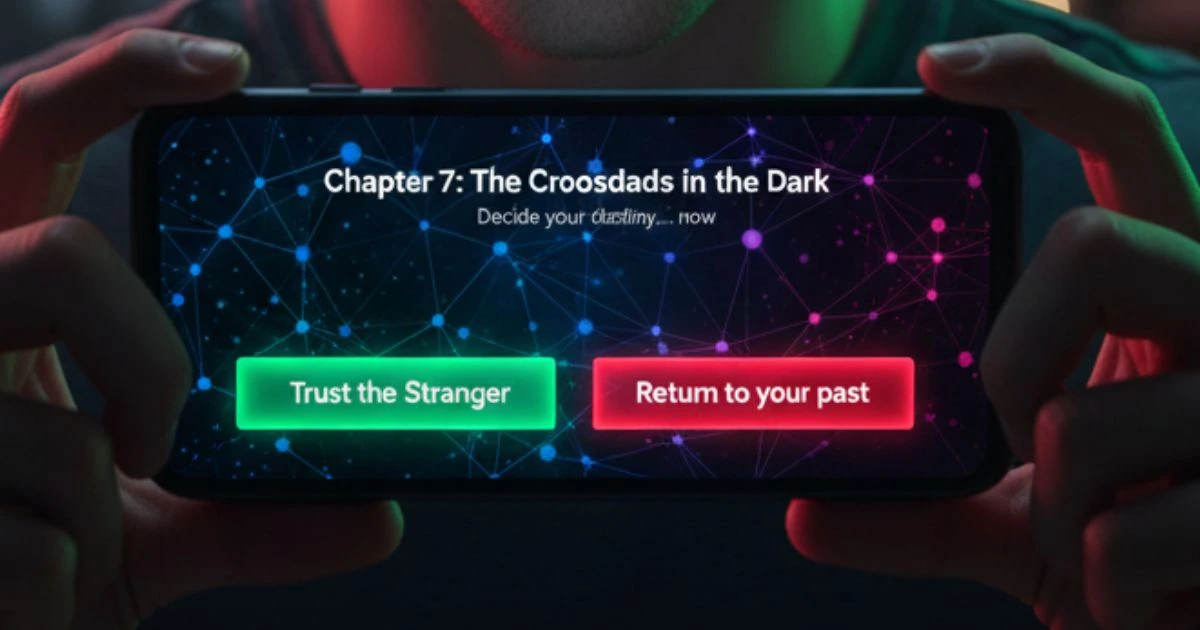
I was sitting in a terminal at O’Hare last week, watching a teenager across from me. He wasn’t playing a shooter, and he wasn’t scrolling through mindless dance clips. He was reading, or at least, that is what it looked like from a distance. Every thirty seconds, his thumb would hover, hesitate, and then tap with a rhythmic intensity. He was navigating a branching narrative where his choice to betray a digital syndicate or save a fictional city actually carried weight. It struck me then that we are no longer in the era of passive consumption. We have moved into a space where the line between a novel and a game has blurred so much that it has practically vanished. Interactive Fiction isn’t just a niche hobby for the nostalgic anymore, it is a massive, multi-billion dollar pivot in how human beings process stories in 2026.
There is a specific kind of electricity in the air when a new medium finds its footing. I remember the early days of mobile gaming when everything felt like a cheap imitation of a console experience. But what we are seeing now with these narrative apps is different. It is native. It is built for the five-minute gap between meetings or the long commute where you want to lose yourself without needing a controller. These platforms have figured out a psychological loop that traditional publishers have ignored for decades. They’ve realized that people don’t just want to be told a story, they want to own the outcome. This shift in agency is creating a level of engagement that makes standard e-books look like relics from a museum.
When you look at the numbers, the growth is staggering, but the data only tells half the story. The real magic is in the retention. People aren’t just downloading these apps, they are living in them. They are spending their digital currency to unlock “premium” choices that change the course of a romance or a thriller. It is a brilliant, albeit slightly manipulative, evolution of the micro-transaction model, applied to the oldest art form we have. We are witnessing the birth of a hybrid industry that combines the scalability of software with the emotional depth of literature.
The Financial Pulse of Gamified Books and Narrative Equity
The shift toward gamified books represents more than just a change in user interface, it is a fundamental restructuring of digital intellectual property. In the traditional world, a book is a static asset. You buy it, you read it, and its life cycle ends there unless it gets a movie deal. In the digital ecosystem of 2026, a story is a living, breathing economy. We are seeing developers treat their narrative libraries like real estate portfolios. Each chapter is a new development, each character arc is a potential revenue stream through cosmetic upgrades or branching paths. The monetization isn’t an afterthought, it is woven into the very fabric of the plot.
Investors who used to look at the gaming sector for high-adrenaline action titles are suddenly pivoting toward these text-heavy powerhouses. Why? Because the overhead is significantly lower. You don’t need a team of five hundred 3D animators to create a world that exists in the reader’s imagination. You need incredible writers, a sharp UI, and a deep understanding of behavioral economics. The profit margins on a successful interactive story can be astronomical compared to a traditional indie game. It is a lean, mean, storytelling machine that scales across borders without the need for massive localization budgets for voice acting or complex physics engines.
What fascinates me most is how these apps handle community. They aren’t just silos. They are platforms where users discuss their “playthroughs” of a book like they would a season finale of a prestige TV show. This social layer creates a viral loop that is incredibly difficult to replicate in other media. When a story goes viral in 2026, it doesn’t just get talked about, it gets played. This interactivity creates a sense of FOMO that drives rapid user acquisition. If your friend chose to marry the villain and you didn’t even know that was an option, you are going back to the start of the book and spending whatever it takes to see that ending. It is a masterful blend of curiosity and competition.
Mobile Storytelling and the Rise of the Independent Narrative Agency
The decentralization of content has reached a tipping point where mobile storytelling is no longer dominated by three or four major publishing houses. We are seeing a surge in specialized agencies and studios that do nothing but craft these experiences. These are the modern-day equivalents of the pulp fiction houses of the thirties, but instead of newsstands, they are conquering the App Store. The technical barriers to entry have crumbled. With the advent of sophisticated narrative engines, a small team can produce a global hit from a home office. This democratization is where the real opportunity lies for those looking to acquire established digital assets.
I have spoken with several developers who have moved away from hyper-casual games because the churn was too high. They found that in the world of interactive fiction, the “whales” aren’t just looking for a dopamine hit from a match-three game, they are looking for an emotional connection. Once a reader is invested in a character, they are loyal in a way that is rare in the digital age. This loyalty translates to a much higher lifetime value per user. It is a stable, recurring revenue model that looks a lot more like a SaaS business than a hit-driven entertainment company. The stability of these assets in a volatile market is making them a favored choice for those looking to build a diversified digital portfolio.
There is also something to be said for the sheer versatility of the format. We are seeing interactive non-fiction, gamified educational tools, and even corporate training modules that use these same branching narrative techniques. The technology is a skeleton that can be dressed in any genre. But the heart of it remains the same: the human desire to choose. As we look toward the latter half of the decade, the integration of generative AI is only going to make these stories more personalized. Imagine a book that adapts its prose style to your reading level or a mystery where the culprit changes based on the clues you specifically decided to ignore. We aren’t just reading anymore, we are collaborating with the medium itself.
I often wonder where the limit is. Will we eventually reach a point where every piece of media we consume requires our input? Probably not. Sometimes you just want to sit back and let a story wash over you. But for a generation raised on the autonomy of the internet, the static page feels like a cage. They want to rattle the bars. They want to see what happens if they turn left instead of right. And as long as there are people willing to pay to see behind the curtain of “what if,” this industry will continue to explode. The transition from reader to player is complete, and the financial implications are only just beginning to be understood by the broader market.
It makes you think about the value of a story. Is it worth more when it is told to you, or when you have to fight for the ending you want? For the millions of users currently tapping away on their screens, the answer is clear. They are buying into an experience that is uniquely theirs, even if it is built on a foundation of code and carefully plotted variables. The question for the rest of us is whether we will be the ones reading the stories or the ones owning the platforms that tell them.
