


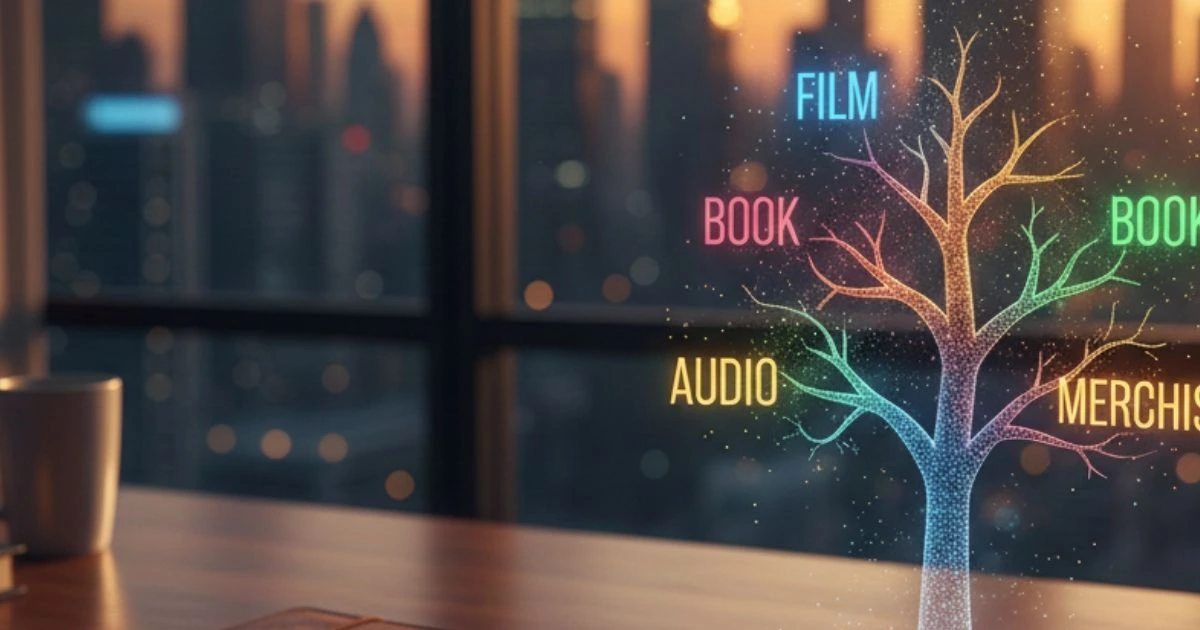
I spent a long afternoon last week looking over the acquisition data for a small publishing house that recently sold its entire catalog to a private equity firm. It was a clean, clinical transaction, the kind that happens behind closed doors and involves a lot of people in expensive suits talking about cash flow and risk mitigation. What struck me, however, was not the price tag, which was substantial, but the nature of the assets being moved. They weren’t just buying books. They were buying worlds. They were buying the architecture of stories that could be disassembled and rebuilt across a dozen different platforms.
In the early 2020s, a book was often seen as the end of a creative journey. You wrote it, you polished it, you threw it into the digital abyss of a retail giant, and you hoped the algorithm would be kind. But by early 2026, that mindset has become a relic of a slower, less efficient era. The writers who are actually thriving right now, the ones who view their output as a serious author business model, have stopped thinking of themselves as mere novelists. They are founders of intellectual property empires. They understand that a single story is just the seed of a much larger garden, one that requires careful cultivation to yield more than just a few royalty checks.
There is a quiet revolution happening in how we value creative labor. We are moving away from the “one-off” mentality and toward a more integrated approach. When I talk to creators today, the conversation is rarely about word counts or plot twists. It is about scalability. It is about how a single narrative thread can be woven into a tapestry that includes audio adaptations, foreign language rights, and even niche merchandise. This is the birth of the IP ecosystem, a defensive and offensive strategy designed to survive a volatile market where traditional gatekeepers are losing their grip.
How to navigate book licensing deals and the secondary market
The mechanics of this shift are fascinating because they require a level of business acumen that many writers used to find distasteful. There was always this romantic notion that the art should speak for itself, that the business side was a necessary evil. In 2026, that wall has crumbled. If you want to survive, you have to understand the levers of power. This starts with how you handle your rights from the very beginning.
I recently saw a debut author turn down a mid five figure advance from a traditional publisher because they wanted to take all of his sub-rights. Ten years ago, that would have been seen as career suicide. Today, it was a tactical masterstroke. By retaining his translation rights and his audio rights, he was able to build a diversified revenue stream that outperformed the advance within eighteen months. He didn’t just sell a book, he licensed the right to print it, while keeping the keys to every other door in the house.
Navigating book licensing deals is no longer about just signing on the dotted line. It is a game of chess. You have to look at your Intellectual Property as a collection of modular pieces. Can this be a graphic novel? Is there a market for a specialized non-fiction companion? Could the world you built serve as a setting for a tabletop game? When you start asking these questions, the value of the work shifts. You aren’t just selling a story to a reader, you are building an asset that can be leveraged, sold, or partnered with other businesses. This is where the real growth happens, far away from the race to the bottom that we see in the saturated ebook markets.
The secondary market for these rights has become incredibly liquid. We see investors now who aren’t looking for the next Great American Novel, they are looking for proven IP with a built in audience that can be transitioned into other formats. They want assets that have been de-risked. If a book has a loyal following on a platform like Substack or a dedicated email list, it becomes a much more attractive proposition for a licensing deal. It is no longer about the quality of the prose alone, it is about the strength of the ecosystem surrounding it.
The strategic shift toward a sustainable author business model
Sustainability in the creative world is often a myth, but we are seeing a new blueprint emerge that feels remarkably stable. It involves a move away from the “hit or miss” nature of traditional publishing and toward a more predictable, data driven approach. This doesn’t mean the art is being sacrificed for the sake of the numbers. In fact, it is the opposite. By securing the financial foundation of their work, authors are finding the freedom to take more risks.
The modern author business model is built on three pillars: ownership, diversification, and direct connection. Ownership is the most critical. If you don’t own your IP, you are just a tenant in someone else’s building. We are seeing a massive trend of authors buying back their rights from old contracts or choosing hybrid paths that allow them to keep a larger share of the pie. They are realizing that their backlist is a goldmine that can be mined indefinitely if they have the right tools.
Diversification is the hedge against the unknown. We have seen platforms change their terms overnight, wiping out entire income streams for those who were too dependent on a single source. The authors who are building ecosystems are spreading their risk. They have their books on multiple platforms, they are experimenting with direct sales through their own websites, and they are exploring the growing library markets which have seen a resurgence in 2026. They aren’t waiting for a gatekeeper to give them permission to succeed.
Finally, there is the direct connection with the audience. This is the moat that protects the IP ecosystem. In a world where AI-generated content is flooding every channel, the human element has become a premium commodity. Readers want to feel like they are part of something. They want to support the creator, not just the corporation. This connection allows for unique licensing opportunities, such as limited edition hardcovers or exclusive digital content, that wouldn’t be possible through traditional channels.
I often wonder where this will lead in another five years. The boundaries between industries are blurring. A writer might end up being the creative director of a multimedia franchise, overseeing a team of artists, narrators, and developers. It sounds exhausting, perhaps, but it is also incredibly empowering. We are finally seeing a world where the creator has the upper hand, provided they are willing to step out of the ivory tower and into the marketplace.
The reality is that Intellectual Property is the currency of the future. It is a tangible asset in an increasingly intangible world. Whether you are a writer looking to scale your work or an investor looking for the next big opportunity, the lesson remains the same. Don’t look at the cover. Look at the foundation. The value isn’t in the paper or the pixels, it is in the rights, the reach, and the resilience of the ecosystem. We are just beginning to see what is possible when we treat stories with the strategic respect they deserve.
It is a strange time to be a creator, filled with both immense pressure and unparalleled opportunity. But for those who can navigate the complexities of this new landscape, the rewards are more than just financial. They are the keys to a kingdom that no one can take away from them. And in a world that feels increasingly out of our control, that might be the most valuable thing of all.

