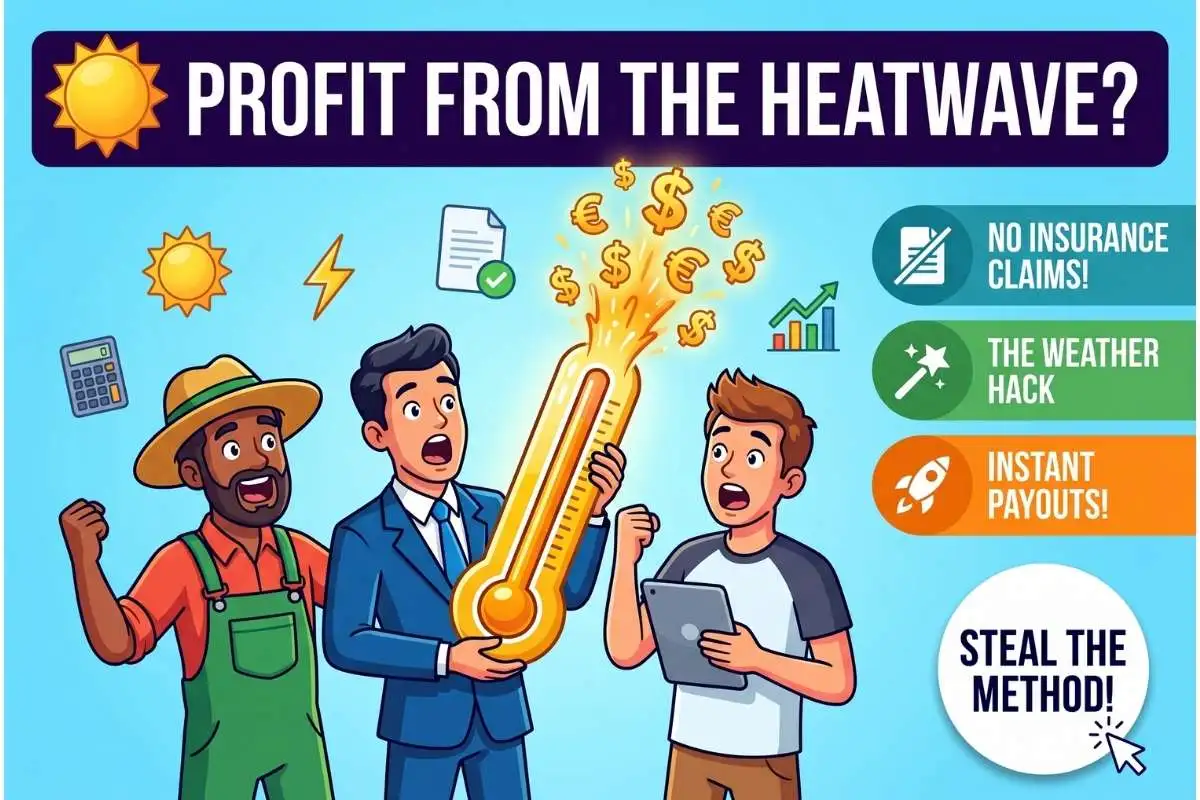
Imagine looking at the weather forecast and seeing a massive, unseasonable heatwave predicted to roll in this Friday. Most people immediately think about turning on their air conditioning, planning a trip to the beach, or making sure their pets stay hydrated in the sweltering temperatures. But for a distinct group of financial professionals, a heatwave isn’t just a meteorological event; it is a profound financial opportunity and a significant risk factor. Welcome to the fascinating world of weather derivatives, a specialized financial market where the unpredictability of Mother Nature becomes a tradable asset. As we approach the early summer heatwave of 2026, understanding how these instruments work offers a unique window into how global industries protect their bottom lines against extreme weather.
The Basics of Weather Financials
At its core, a weather derivative is a financial instrument used by companies or individuals to hedge against the risk of weather-related losses. Unlike traditional insurance, which pays out only after a demonstrable disaster like a hurricane or a flood destroys physical property, weather derivatives trigger payouts based strictly on objective, measurable weather data. The most common metrics used in this market are Heating Degree Days (HDD) and Cooling Degree Days (CDD). To put it simply, a Cooling Degree Day measures how much the average daily temperature rises above a baseline—usually 65 degrees Fahrenheit. If the average temperature on a given day is 85 degrees, that day registers 20 CDDs. Traders buy and sell contracts based on the accumulation of these degree days over a specific month or season. When this Friday’s heatwave pushes temperatures into the upper 90s, the CDD index will spike, meaning those who hold the right weather derivative contracts will see an immediate financial return. This objective, data-driven approach removes the lengthy claims process associated with standard insurance, providing immediate liquidity to businesses exactly when they need it most. You can learn more about the technical definitions of these metrics on the Wikipedia page for Weather derivatives.
Navigating the 2026 Heatwave Context
As we stand on the precipice of the 2026 summer season, meteorological models are predicting an exceptionally early and intense heatwave beginning this Friday. The National Weather Service has already begun issuing excessive heat watches across major metropolitan areas, signaling a rapid shift in atmospheric conditions. For energy providers, this sudden spike in temperature is an operational nightmare. Air conditioners across the country will be working overtime, driving up the demand for electricity exponentially. If an energy company has to purchase additional power on the spot market to meet this sudden surge in demand, the exorbitant costs could devastate their quarterly profits. By purchasing a call option on a Cooling Degree Day index, the energy company effectively locks in a safety net. If the heatwave is as brutal as predicted, the weather derivative pays out a substantial sum, offsetting the high cost of buying emergency power. Conversely, if the forecast changes and the weekend turns out to be mild, the company only loses the initial premium paid for the contract, functioning exactly like a standard insurance policy.
Beyond Energy: Agriculture and Retail Applications
While energy companies are the most prominent players in the weather derivatives market, the ecosystem has expanded to include a wide variety of industries deeply affected by climate shifts. Consider the agricultural sector, where farmers rely heavily on predictable weather patterns to ensure a successful harvest. An unexpected heatwave in early summer can scorch young crops, dry out the soil, and severely reduce yields. By utilizing weather derivatives, agricultural cooperatives can secure financial compensation if temperatures exceed a certain threshold or if rainfall drops below the necessary levels during a critical growing period. Beyond farming, even the retail and hospitality sectors are actively participating. A sprawling outdoor amusement park, for instance, might purchase contracts that pay out if weekend temperatures become so oppressively hot that attendance numbers predictably plummet. In these diverse scenarios, the weather derivative acts as a critical financial stabilizer, ensuring that unpredictable summer weather doesn’t lead to bankruptcy. The beauty of this system is its sheer flexibility; contracts can be customized to cover specific cities, distinct temperature ranges, and even precise times of the day, making it an incredibly versatile tool for modern business management.
Market Mechanics and Global Exchanges
If you are wondering how someone actually goes about trading a weather derivative, the process is highly standardized and heavily regulated. The vast majority of these trades occur on major financial exchanges, most notably the Chicago Mercantile Exchange (CME), which pioneered weather futures back in the late 1990s. Contracts are tied to specific weather stations located in major cities around the world, such as New York, London, Tokyo, and Sydney. This geographical anchoring ensures that the data used to settle the contracts is completely transparent, publicly available, and virtually impossible to manipulate. Each contract dictates a “tick size,” which is the amount of money paid out for every single degree day that falls above or below the agreed-upon strike price. For example, a standard CME contract might assign a value of $20 per tick. If a company buys a contract with a strike price of 300 CDDs for the month of June, and the historic early summer heatwave pushes the actual accumulated CDDs to 400, the contract pays out 100 ticks multiplied by $20, resulting in a clean $2,000 payout per contract. Institutional investors, hedge funds, and specialized trading desks use sophisticated algorithmic models to predict these exact scenarios, turning meteorological science into a highly competitive financial game.
Climate Change and the Future of Trading
Looking toward the future, the importance and overall trading volume of weather derivatives are only expected to grow, driven largely by the accelerating realities of global climate change. As extreme weather events become more frequent, more intense, and far less predictable, traditional methods of forecasting and risk management are proving increasingly inadequate. Heatwaves are arriving earlier in the year, as we are seeing with this Friday’s unusual forecast, and unpredictable weather patterns are making the global economy incredibly sensitive to the whims of the atmosphere. Consequently, financial institutions are aggressively expanding their weather trading desks, and new, innovative contracts are being developed continuously to cover events like excessive snowfall, wind speed variations for renewable energy farms, and even variations in solar radiation for solar power grids. What began as a niche financial experiment over two decades ago has transformed into a critical pillar of global economic stability. As we navigate the complex and warming world of 2026, understanding how to price and trade the weather will be an absolutely essential skill for the next generation of financial leaders and risk managers.
Understanding the Data: Common Weather Derivative Contracts
To help visualize how these financial instruments are structured in the real world, here is a simplified data table showcasing typical contract configurations used by different industries.
| Contract Type | Underlying Metric | Typical Buyer | Strike Value (Example) | Potential Payout Trigger |
| Summer Temperature | Cooling Degree Days (CDD) | Electricity Providers, Ice Cream Vendors | 350 CDDs in July | Accumulated temperatures significantly exceed historical averages. |
| Winter Temperature | Heating Degree Days (HDD) | Natural Gas Companies, Ski Resorts | 800 HDDs in January | Unseasonably warm winters causing lack of snow or heating demand. |
| Precipitation | Cumulative Rainfall (Inches) | Agricultural Cooperatives, Event Organizers | 10 Inches in Spring | Severe drought conditions threatening crop yields. |
| Wind Speed | Average Daily Wind Knots | Wind Energy Farms | 15 Knots in October | Periods of “wind drought” causing drops in renewable energy production. |
Frequently Asked Questions (FAQ)
Can individual retail investors trade weather derivatives? While the weather derivatives market is heavily dominated by large institutional investors, hedge funds, and major corporations, it is technically possible for retail investors to participate. However, it requires a specialized brokerage account that permits futures and options trading on the Chicago Mercantile Exchange (CME). Due to the high risk and complex meteorological modeling required, it is generally not recommended for casual traders.
How is the weather data verified to prevent fraud? To ensure absolute market integrity, weather derivative contracts are settled using automated data generated by independent, government-operated meteorological stations. In the United States, this data is continuously gathered and verified by the National Weather Service and the National Climatic Data Center. Because the data is strictly public and recorded by highly calibrated government equipment, it is practically immune to manipulation by private traders.
Are weather derivatives just a form of crop insurance? No, they are distinct financial tools. Traditional crop insurance pays out only after an assessor verifies that physical damage has occurred to a farm, a process that can take months. A weather derivative pays out automatically the moment a specific weather metric (like low rainfall) is officially recorded, regardless of whether actual physical damage took place. This provides instant liquidity.
What happens if the designated weather station breaks down? Exchanges have strict contingency protocols in place for equipment failure. If a primary weather station goes offline during a contract period, the exchange will rely on a pre-determined, secondary backup station located nearby. If necessary, they will use scientifically rigorous interpolation methods from surrounding stations to accurately estimate the missing data and settle the contracts fairly.
A Final Curiosity: The Origins of Weather Trading
It may surprise you to learn that the very first over-the-counter weather derivative trade took place in 1997, and it involved the infamous energy company Enron. Long before their scandalous collapse, Enron’s traders executed a pioneering contract with Koch Industries based on the winter temperatures in Milwaukee, Wisconsin. This experimental trade proved that weather risk could be successfully quantified, priced, and traded just like stocks or bonds. Fast forward to 2026, and that single experimental transaction has birthed a multi-billion-dollar global market. As this Friday’s heatwave approaches, remember that while you are adjusting your thermostat, somewhere in the world, a trader is watching the exact same temperature gauge and calculating a multi-million-dollar payout. The sky isn’t just the limit anymore; the sky is the market itself.