


VR Manuscript Polishing: The 2026 secret to editing in a distraction-free world
I sat in a coffee shop in Austin last Tuesday watching a woman struggle with a laptop that seemed to be screaming for her attention. Every three minutes, a notification bubbled up in the corner of her screen. She would click it, lose four minutes of her life, and then stare at her Word document with the vacant expression of someone trying to remember a dream. It reminded me of why I stopped trying to polish my own work on a flat screen. The traditional screen is a battlefield where the author almost always loses to the algorithm. We think we are disciplined, but we are just biological machines being outmaneuvered by software designed to keep us scrolling.
That is why the shift toward VR book editing has felt less like a tech trend and more like a mass migration toward sanity. For those of us in the self-publishing world, the stakes are different. We don’t have a giant publishing house providing a buffer or a stern editor calling our landline to demand a rewrite. We are the marketing department, the cover designer, and the janitor. When it comes time to actually look at the prose, we need a way to shut the door on the world without actually leaving our rooms.
Why immersive writing environments are replacing the home office
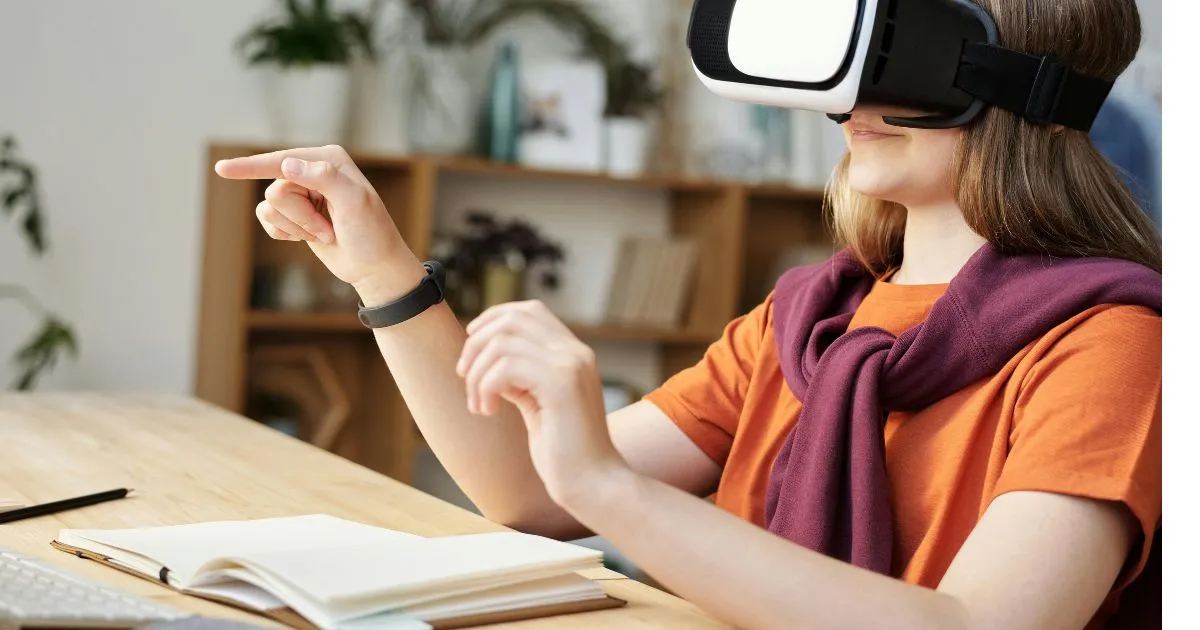
There is a specific kind of silence you only find when you are three hundred feet underwater or inside a well-designed digital void. When I put on the headset, the clutter of my physical desk disappears. The half-empty mugs, the dust on the monitor stand, and the insistent blinking of the router are gone. Instead, I am standing in a cathedral of my own words. The text isn’t just a flickering line on a screen anymore. It has weight. It has height.
In these immersive writing spaces, the manuscript becomes a physical object. I have spent years trying to find a flow state while staring at a 14-inch rectangle, but the human brain wasn’t built for that kind of narrow focus. We are spatial creatures. We remember where we put our keys because of their position in a room, not because we read a line of text saying the keys are on the table. By turning a book into a 360-degree environment, we tap into a different part of our cognitive hardware. I find myself “walking” through my chapters. If a scene feels sluggish, I can see the literal density of the paragraphs surrounding me. It is harder to ignore a boring middle section when it is physically looming over you like a gray cloud.
Self-publishing has always been about reclaiming control, and this is the ultimate version of that. It is the ability to curate the exact atmosphere required for a specific emotional beat. If I am editing a tense thriller, I don’t want to see my neighbor mowing his lawn through the window. I want shadows. I want a focused, dim perimeter where nothing exists but the rhythm of the sentences. This isn’t about the bells and whistles of the technology. It is about the absence of everything else. The “secret” everyone talks about isn’t the hardware itself, but the psychological permission it gives you to be unavailable to the rest of the planet.
The evolution of author focus tools in a noisy decade
We spent the early 2020s trying to “hack” our productivity with apps that blocked websites or timers that buzzed every twenty-five minutes. Those felt like bandages on a gaping wound. The real problem was never the websites; it was the proximity of the distraction. As long as the distraction is one Alt-Tab away, your brain knows it is there. It keeps a small percentage of its power reserved for the temptation.
The current landscape of author focus tools has moved away from restriction and toward total replacement. VR book editing works because it replaces your reality with one that is intentionally more boring, or at least more singular. There is a strange irony in using the most advanced visual technology ever created to simulate the experience of a 1950s typewriter in a dark room, but that is exactly what many of us are doing. We are using the future to buy back the past.
I talked to a friend who lives up in Portland who recently finished a 120,000-word space opera. He told me he couldn’t have done the final pass without a spatial interface. He mapped his plot points to different corners of a virtual library. When he needed to check for consistency in a character’s arc, he didn’t scroll through a digital file; he turned his head and looked at the “character wall” he had built. It makes the act of editing feel less like a chore and more like a construction project. You are building a world, so why shouldn’t you stand inside it while you are sanding the edges?
This shift also changes how we perceive our own errors. On a standard monitor, a typo is just a typo. In an immersive space, a clunky sentence feels like a crack in the wall. You notice the cadence of the dialogue because there is nothing else to look at. The lack of peripheral visual noise forces your internal monologue to speak louder. You start to hear the “clunks” and “thuds” of bad prose. It is an unforgiving way to work, which is exactly why the quality of self-published work has spiked so dramatically lately. We are finally seeing our work without the filter of our own cluttered lives.
There is a specific exhaustion that comes after a three-hour session of VR book editing. It isn’t the usual eye strain of staring at a backlit LED. It is a mental fatigue that comes from truly being “somewhere else.” When I take the headset off, the real world feels a bit thin for a moment. My living room feels less real than the fictional landscape I was just inhabiting. That transition is where the magic happens. It’s the proof that you were actually inside the story, rather than just looking at it through a window.
Some people argue that this is too much. They say that writing should be a simple act of pen and paper, or at least a simple word processor. They might be right, in a vacuum. But we don’t live in a vacuum. We live in a world that is actively trying to prevent us from finishing anything. The “purist” approach works great if you live in a cabin with no internet, but for the rest of us, we need a fortress.
I don’t think we have even scratched the surface of what this does to the narrative structure. When you can see your entire book laid out like a topographic map, you start to see patterns you never noticed. You see that you use the word “suddenly” too much in the bottom-left quadrant of your third act. You see that your chapters are getting shorter and more frantic toward the end, and you can decide if that was intentional or just a result of your own impatience to finish. It turns editing into a visual art form.
Whether this is the “correct” way to write is a boring question. The better question is whether it helps you finish. For a lot of us who have struggled with the fragmented attention spans of the modern era, the answer is a resounding yes. It isn’t about the gadgets. It’s about the silence. It’s about the fact that for two hours a day, the internet doesn’t exist, my phone is a thousand miles away, and I am the only person in the universe.
The sun is going down over the hills now, and the light in my room is changing. Normally, this would be the part of the evening where I get distracted by the shadows or the need to turn on a lamp. But I think I’ll go back in for another hour. There is a chapter in the middle of my latest project that still feels a bit soft, and I want to go stand next to it until I figure out why.
FAQ
The initial hurdle is mostly about getting used to the weight of the headset and finding a comfortable chair. Most of the software is designed to be invisible once you are inside. If you can navigate a smartphone, you can likely handle a spatial writing environment. The goal isn’t to learn new tech, but to use the tech to forget the world.
It is a different kind of strain. Modern headsets use focal depths that are often more natural for the eye than a flat screen eighteen inches from your face. However, the mental intensity of being in a total-immersion environment means you probably shouldn’t stay in for more than ninety minutes at a time without a break.
Most current platforms allow you to mirror your existing desktop. You aren’t losing your favorite tools; you are just moving them into a space where they don’t have to compete with browser tabs and system notifications. You can keep your Scrivener or your Word docs exactly as they are.
The cost of a mid-range headset is now comparable to a decent tablet or a budget laptop. When you consider the “cost” of the months spent struggling with distractions, many authors find the investment pays for itself in sheer word count and finished projects.
Most authors who use this method are touch-typists, so they don’t need to see the keys. However, many modern headsets have a “passthrough” feature that allows you to see a small window of your actual keyboard while the rest of your vision remains in the virtual world.

