


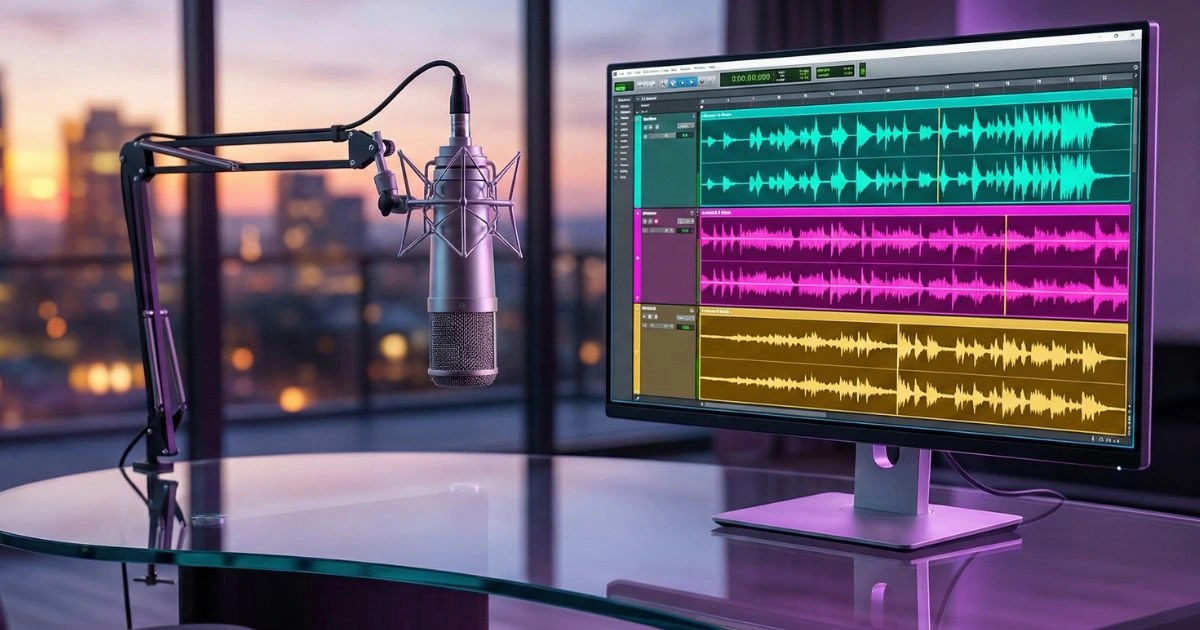
There is a specific kind of silence that settles over a writer when they finish a manuscript. It is a heavy, expectant quiet, the sound of three hundred pages waiting for a pulse. For years, the only way to break that silence was to sell your soul to a traditional publisher or drop five figures on a recording studio, a director, and a cast of temperamental actors who may or may not understand the subtext of your protagonist’s internal monologue. But the air in 2026 feels different. I recently watched a friend pull up a raw file of her latest thriller, a complex piece with a sprawling cast of characters, and transform it into a cinematic experience in a single afternoon. She didn’t hire a single human.
We are no longer talking about the era of the monotone, robotic narrator that mispronounces every third vowel. That world died somewhere in the mid-twenties. Today, AI Voice Synthesis has reached a point of uncanny emotional literacy. It is less about text-to-speech and more about the architecture of performance. When you look at a manuscript now, you aren’t just looking at words on a page, you are looking at a blueprint for a high-fidelity digital asset. In the finance world, we call this unlocking latent value. You have an intellectual property sitting in a drawer, and suddenly, the cost of entry to the most explosive segment of the publishing market has plummeted by ninety-nine percent.
The shift is visceral. You can hear it in the way a synthetic voice catches its breath before a reveal, or the way the pitch shifts slightly when a character is lying. It is a strange, beautiful, and slightly unsettling time to be a creator. We are moving toward a reality where the “theatre of the mind” is no longer a solo act, but a fully orchestrated production that lives on a hard drive.
The multi-cast audio revolution and the end of the solo narrator
The traditional audiobook was always a compromise. One voice, no matter how talented, trying to pitch their tone up for a child or down for a villain often pulled the listener out of the story. It felt like a bedtime story, not a drama. But as we move deeper into 2026, the expectation has shifted toward immersive, multi-voiced performances. This is where Audiobook production has found its new heartbeat.
I remember the first time I heard a digital multi-cast production that actually worked. It wasn’t just different voices, it was the spatial awareness of the audio. One character sounded like they were standing by a window, while another’s voice carried the muffled resonance of a hallway. The software now understands the “where” of the scene just as well as the “what.” For a writer, this means you can assign a unique digital DNA to every person in your book. You can pick a rasp for the old detective and a melodic, fast-paced cadence for the young witness.
This isn’t just about making things sound pretty, it is about the economics of attention. We are seeing a massive surge in listeners who treat audiobooks like Netflix series. They want the grit, the music, the foley, and the distinct vocal identities. In a market saturated with content, the “standard” narration is becoming a harder sell. By utilizing a 10-actor digital cast, you aren’t just publishing a book, you are launching a product that competes with high-budget podcasts and streaming dramas. The barrier to creating something that sounds like it cost fifty thousand dollars has evaporated, leaving only the quality of the story as the true differentiator.
Investing in the future of multi-cast audio as a digital asset
If you look at the charts, the growth of the audio sector is outstripping almost every other form of digital media. From a purely clinical, financial perspective, a manuscript is a static asset. It is a one-dimensional revenue stream. However, once you subject that manuscript to Multi-cast audio processing, it becomes a dynamic, multi-platform powerhouse.
I often talk to people who are hesitant about the “soul” of synthetic voices. They worry that something is lost when a machine interprets the grief or joy of a character. But then I show them a modern voice-clone project where the author’s own voice provides the base layer, and the AI expands that into an entire cast. The technology doesn’t replace the soul, it provides a larger canvas for it. We are seeing savvy investors move away from traditional stocks and toward “content-heavy” portfolios, buying up rights to backlist titles specifically to run them through these new audio pipelines.
The ROI on a voice-synthesized drama is startling because the overhead is almost entirely front-loaded into the software subscription and the time spent on “directing” the AI. There are no studio fees, no union disputes, and no scheduling conflicts. You can produce a fifteen-hour epic in the time it used to take to record a single chapter. This speed allows for a level of market testing that was previously impossible. Don’t like the way the lead sounds in the first three chapters? Change the voice profile and re-render. It is iterative, agile, and suited for a world that moves at the speed of a fiber-optic cable.
The real magic happens when you realize that these audio files are global. The same system that creates your English drama can, with a few clicks, produce the same 10-actor performance in Spanish, Mandarin, or French, maintaining the emotional core of the performance while shifting the language. You are no longer writing for a local bookstore, you are producing for a global ears-on audience.
The silence that follows the completion of a manuscript shouldn’t be a sign of a finished journey. It should be the quiet before the first take. We are standing at the edge of a new era of storytelling where the only thing stopping a 2026 manuscript from becoming a cinematic masterpiece is the willingness to embrace the tools that are already sitting on our screens. The characters are there, waiting in the margins. They are just waiting for you to give them a voice, or ten.
Where does that leave the person who still values the tactile feel of a pen? Perhaps in a better place than ever. Because when the technical hurdles are cleared away by the machines, all that remains is the one thing they cannot yet replicate: the initial spark, the human messiness, and the singular vision of the person who wrote the first word.

