I was sitting in a crowded terminal at Heathrow last Tuesday, watching a man struggle to balance a lukewarm espresso, a rolling suitcase, and a latest-generation e-reader. He looked miserable. Every time he wanted to turn the page, he had to perform a precarious thumb-dance that threatened to douse his trousers in caffeine. It struck me then that for all our talk about digital transformation in the publishing world, we are still remarkably tethered to the physical act of “holding” information. We have digitized the paper, but we haven’t yet fully liberated the experience.
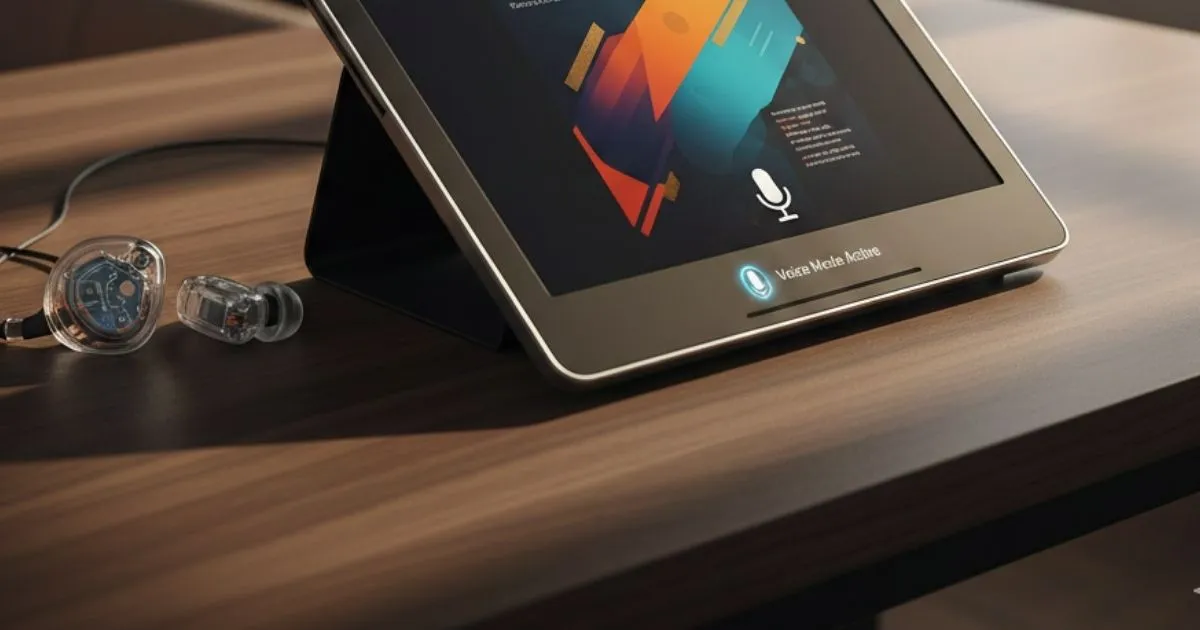
As we move deeper into 2026, the friction between our busy, mobile lives and our desire for deep consumption is sparking a quiet revolution. We are entering the era of voice-controlled e-readers, a shift that is less about gadgets and more about how we reclaim the dead time in our day. If 2024 was the year of the large language model and 2025 was the year of specialized AI agents, 2026 is the year where these technologies finally learn to sit down and read us a story, or rather, help us navigate one without lifting a finger.
The finance niche, always hungry for efficiency, is already sensing the shift. Portfolio managers and analysts who once squinted at PDFs on the subway are now looking for ways to “query” their reading material while walking to the office. They don’t just want a book to play like a podcast. They want to pause, ask for a summary of the last three pages, or bookmark a specific valuation metric with a simple spoken phrase. This is the future of Kindle and its competitors, moving from a passive display to a conversational partner.
The Architecture of Voice-Activated Books and Semantic Flow
Optimizing a book for a hands-free world requires a total rethink of structural hierarchy. In the old days, we worried about kerning and font weight. Today, we have to worry about how an AI “sees” the bones of our content. When a reader tells their device to skip to the section on emerging market volatility, the device relies on nested semantic metadata to find the right spot. If your book is just a flat file of text, the voice assistant is effectively blind.
We are seeing a move toward what some call liquid content. This means the text is no longer a static block but a series of interconnected nodes. To make voice-activated books truly functional, authors and publishers are starting to write with an “audio-first” ear. This doesn’t mean dumbing down the prose, but it does mean creating natural “exit and entry” points. Long, winding sentences that work on a printed page can become a nightmare when processed by a text-to-speech engine.
I recently spoke with a developer who is building a specialized interface for financial reports. He pointed out that the most successful “readable” assets in 2026 are those that use clear, descriptive headings as anchors. These headings act like GPS coordinates for the voice assistant. When a user says, “Go back to the part about the debt-to-equity ratio,” the device isn’t scanning for those specific words in a vacuum. It is looking for the nearest H2 or H3 tag that houses that concept. This is where the craft of the editor meets the precision of the coder.
Designing for an Audio-First Reading Experience in a Multi-Tasking World
The psychological barrier to “reading” with our ears is finally crumbling. For a long time, there was a snobbery attached to it, as if listening wasn’t really consuming. But the data from the early months of 2026 suggests otherwise. Retention rates for audio-first reading are skyrocketing, largely because the technology has moved past the robotic, monolinear drones of the past. We now have neural voices that can convey the skepticism of a short-seller or the optimism of a tech founder with eerie accuracy.
For those of us in the business of creating or acquiring digital assets, this shift is a massive opportunity. A book or a digital publication that is optimized for hands-free use is inherently more valuable because it fits into more parts of a person’s day. It can be consumed while driving, while at the gym, or while cooking dinner. It expands the “addressable minutes” of a reader’s life.
There is also the matter of interactivity. The most advanced e-readers hitting the market this year allow for real-time annotation via voice. You can literally tell your Kindle, “Highlight that sentence and add a note that this contradicts the Q3 earnings call,” and it happens. This turns the act of reading from a solo, passive journey into an active, productive workflow. It is no longer just about getting through the book. It is about what you extract from it while your hands are busy doing something else.
The reality is that we are moving away from devices that just “show” us things. We are moving toward environments that “understand” us. Whether you are an author looking to stay relevant or an investor looking for the next high-growth digital property, the signal is clear. The interface of the future isn’t a screen you touch. It is a conversation you have with the ideas that matter to you.
I often wonder if we will eventually look back on the era of “swiping” to turn a page with the same nostalgic pity we reserve for rotary phones. There is something fundamentally human about storytelling through sound, and we are finally building the tools to bring that ancient tradition into the hyper-efficient world of modern finance. The books are finally talking back, and for once, we should probably stop and listen.
Where do you see your own content strategy shifting as these hands-free habits become the baseline for your most valuable readers?