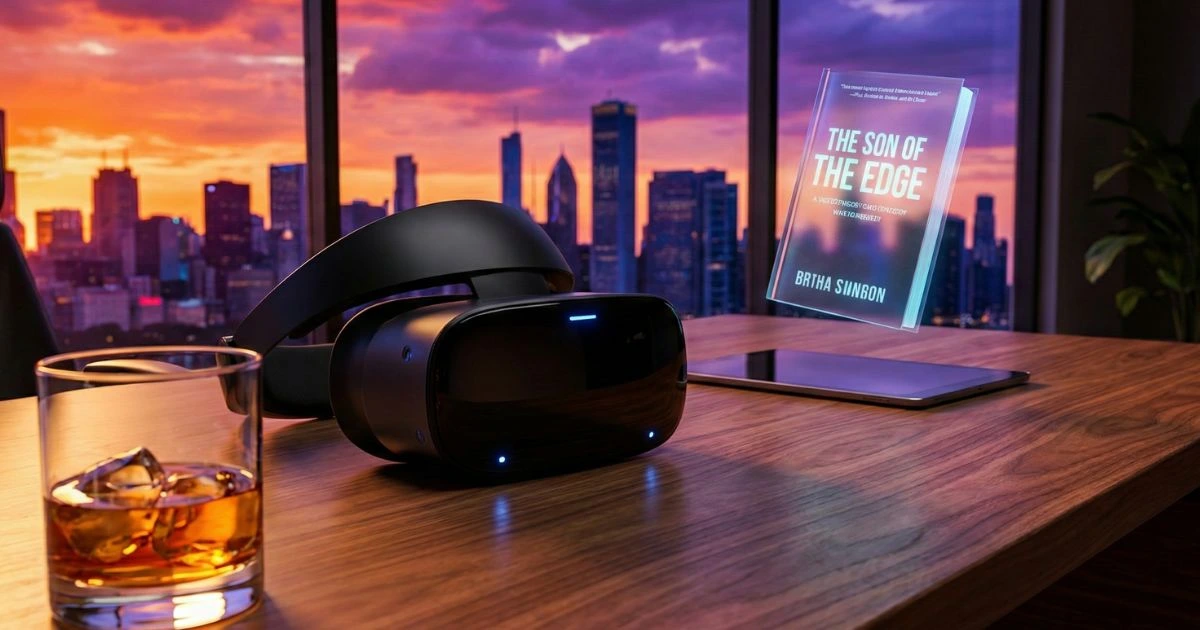
I remember the smell of stale coffee and the sound of squeaky folding chairs that used to define a successful book launch. You would sit in a half-lit corner of a bookstore, praying that the rainy Tuesday wouldn’t keep the five people who promised to show up at home. There was a certain gritty charm to it, sure, but as a business model, it was a disaster. Fast forward to the early months of 2026, and the landscape has shifted so violently that those old physical tours feel like sending a telegram in the age of neural links.
The first time I stepped into a VR Book Tour, I wasn’t in a bookstore at all. I was standing in a digital recreation of a 1920s jazz club, surrounded by avatars that looked remarkably like real people, because at this stage of the game, the haptics and rendering have finally caught up to our imaginations. There were readers from Seoul, London, and a small town in Ohio I can’t quite pronounce, all occupying the same thirty square meters of virtual floor space. It hit me then that the traditional gatekeepers of literary discovery hadn’t just moved the gates, they had removed the walls entirely.
In the finance world, we talk a lot about scale, but we rarely apply the concept to the intimacy of an author’s voice. We think of scale as a cold, numerical expansion. However, the reality of the current meta-publishing environment is that scale is now synonymous with presence. When you can look a reader in the eye, even if those eyes are being rendered by a headset in a high-rise Meta-office, the conversion from casual observer to loyal advocate happens in a way that a static Facebook ad could never replicate.
Navigating the Meta-Publishing Frontier Without Losing Your Soul
The transition hasn’t been without its bumps. There is a specific kind of vertigo that comes from realizes that your intellectual property is no longer just a collection of pages, but an environment. In the early days of this shift, people thought meta-publishing just meant putting a PDF in a 3D space. They were wrong. It is about the commodification of the “Author Event” as a high-yield asset.
When I look at the data coming out of the most successful launches this year, the authors who are winning aren’t necessarily the ones with the biggest traditional platforms. They are the ones who understand that a VR Book Tour is a bridge between the solitary act of writing and the communal act of world-building. We are seeing a massive influx of capital into agencies that specialize in these immersive rollouts because the ROI on a physical tour is often negative when you factor in the jet lag, the hotels, and the sheer physical exhaustion that kills a writer’s next three months of productivity.
There is something strangely liberating about sitting in your home office, perhaps still wearing your favorite worn-out slippers, while you present your life’s work to ten thousand people simultaneously. It changes the power dynamic. You aren’t a guest in a bookstore; you are the architect of the experience. You control the lighting, the acoustics, and the way your audience interacts with the narrative. In 2026, the savvy author is less of a traveling salesman and more of a digital sovereign.
The skeptics will tell you that it feels “fake,” but they said the same thing about paperbacks when they replaced leather-bound tomes. Authenticity isn’t found in the medium; it is found in the connection. If I can answer a reader’s question about a specific plot point while standing in a 3D render of the very room where that scene took place, that reader isn’t just a customer anymore. They are a witness. They have been inside the story. That kind of brand loyalty is the gold standard in a world where attention is the scarcest currency we have.
Scaling Author Events to Ten Thousand Monthly Active Readers
The math behind these events is what really keeps the finance guys up at night. If you host a physical event, you are capped by the fire marshal. In the meta-verse, your only cap is server bandwidth, and in 2026, bandwidth is cheap. When we talk about author events, we are no longer talking about one-off evenings that disappear into the ether. These sessions are recorded, spatialized, and turned into evergreen assets that continue to “meet” readers long after the author has logged off.
I have seen authors who were struggling to sell a hundred copies a month suddenly find themselves at the center of a viral storm because their virtual launch was “walkable.” People didn’t just hear about the book; they shared the link to the virtual space. It became a destination. This is the pivot from “selling a product” to “managing an ecosystem.”
We are moving into an era where the most valuable part of a book isn’t the ink, but the community that crystallizes around the creator. The agency models that are thriving right now are the ones that treat an author like a startup. You have a launch phase, a scaling phase, and a maintenance phase. The virtual reality component is the engine that drives that middle part. It allows for a level of high-touch engagement that was previously reserved for the top 0.1% of celebrities.
There’s a subtle irony in the fact that to reach this level of global connectivity, we had to retreat into our private offices. But perhaps that’s the point. The modern writer is a hybrid creature, part monk and part media mogul. You need the silence to create the world, but you need the headset to share it. The barrier to entry is dropping, and as it does, the quality of the “experience” becomes the only true differentiator.
I often wonder what the publishers of thirty years ago would think of this. They would probably be horrified by the lack of physical paper, but they would be salivating at the conversion rates. We are seeing a 40% higher retention rate for readers who engage with an author in a VR space compared to those who just watch a standard video interview. It’s the difference between watching a movie and living in it.
The future isn’t coming; it’s already parked in your driveway, and it’s wearing a VR headset. As we continue to refine these spaces, the line between the “real” world and the “digital” one will continue to blur until we stop asking which one is which. We will just be where the people are. And right now, the people are in the clouds, waiting for someone to tell them a story they can walk through.
It makes you think about what we actually value in the literary world. Is it the object, or is it the access? If I can give you the author’s undivided attention for ten minutes in a world we both helped build, does it matter if we never touched the same piece of paper? I suspect the answer is no. We are finding new ways to be human together, and as long as there are stories to tell, we will find a way to meet, regardless of the distance between our physical desks.