


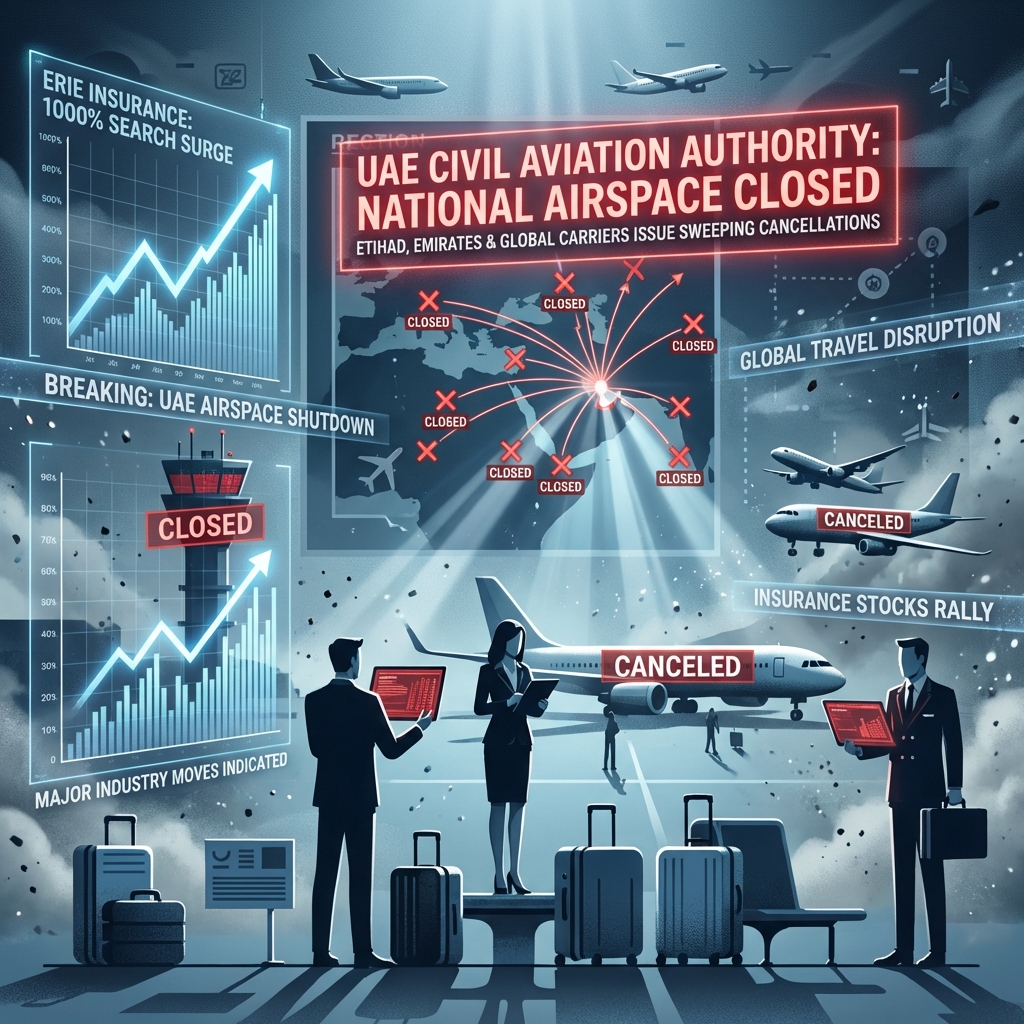
The financial world runs on predictable logistics, and nothing disrupts confidence faster than the sudden imposition of uncertainty in critical transit hubs. This week, the financial narrative has pivoted sharply towards the Gulf, following a drastic move by the UAE’s General Civil Aviation Authority (GCAA) to close the nation’s entire airspace. This wasn’t a delay; it was a complete shutdown, turning the Emirates, a linchpin of global trade and travel, into a temporary no-fly zone. The impact has been immediate and deep, manifesting not just in frustrating cancellations for millions of travelers but in tangible spikes across insurance markets and global logistics planning, sending a clear signal that regional tensions have now breached the vertical domain of commerce.
The core incident revolves around the GCAA declaring an ‘exceptional precautionary measure’ that halts all commercial arrivals, departures, and over-flights effective immediately, with initial suspensions stretching for days. For carriers like Etihad and the massive Emirates network, the directive meant grounding entire fleets, forcing cancellations stretching out until early next week, pending security assessments. The closure wasn’t limited to domestic carriers; it became a sovereign decree affecting every foreign airline utilizing the vast UAE Flight Information Region FIR for time-sensitive Asia-Europe connections. We are looking at a major recalibration of global aviation routes based on security advisories, specifically warnings noting an elevated ‘high-risk’ designation for civilian aircraft operating near the Gulf.
The Immediate Operational Freeze and The Cost Surge
When an airspace hub as congested and critical as the UAE goes dark, the operational ramifications cascade outwards instantly. Dubai International Airport, which cemented its status as a super-connector handling nearly 100 million passengers last year alone, effectively ceased functioning for the global stage. This stoppage isn’t merely about delayed baggage; it’s about complex fuel management, rigid crew duty limitations, and the immediate necessity of securing suitable long-term contingency airports for aircraft that cannot land.
Airlines relying on the shortcut across the Emirates FIR must now plot entire new routes, adding significant hours and thousands of miles to journeys between major European capitals and vital South-East Asian markets. This added distance translates directly into increased operational expenses—more fuel burn, higher crew costs, and the complication of meeting strict international flight time limitations for pilots and cabin staff. Furthermore, the market reaction amongst aviation insurers has been swift and brutal. Reports indicate war-risk premiums are being dramatically re-priced. This cost hike, stemming directly from the heightened perception of risk involving potential missile threats or broader conflict spilling into civilian sectors, will inevitably be absorbed by ticket prices once services normalize, squeezing both airline margins and consumer wallets.
The effect is also being felt profoundly by the corporate sector. Multinational companies utilizing rotational staff or high-frequency executive travel into the Gulf are activating emergency protocols. They are scrambling to verify complex multi-entry visa requirements for alternative Gulf nations—Saudi Arabia or Oman—as potential temporary bolt-holes. While immigration authorities have historically shown leniency regarding inadvertent overstays following such high-profile disruptions, the administrative relief does little to solve the immediate logistical nightmare of repositioning thousands of personnel and critical supply chain components.
Historical Echoes: Comparing This Closure to Past Crises
To grasp the gravity of this airspace lockdown, one needs only to look back at the major aviation disruptions of the last five years. The closure of Russian airspace following the 2022 escalation fundamentally altered long-haul travel, forcing European and Asian carriers to add hours onto flights traversing Northern Asia. However, the UAE closure affects a transit corridor arguably even more concentrated with high-value trade and passenger flow—the main arterial link between the West and the dynamic economies of Asia.
Consider the 2019 incident where tensions briefly flared following attacks in the Strait of Hormuz. While specific carrier routes were occasionally rerouted under threat advisories, the physical closure of an entire national FIR was unprecedented. This current situation magnifies that tension, layered on top of the existing stressor of ongoing Houthi drone activity over the Red Sea late last year, which already forced careful re-routing around the Bab el-Mandeb Strait. This pattern—the successive erosion of safe corridors—suggests a systemic increase in geopolitical risk impacting the physical movement of goods and people globally, something financial markets have not yet fully priced in.
The most telling historical comparison might be to the uncertainty experienced following major 9/11 security crackdowns, where the framework for air travel changed overnight. In 2001, the world adapted to enhanced security procedures. Here, the world must adapt to the possibility of an entire geographically concentrated airspace becoming instantly off-limits due to kinetic or near-kinetic threats. This mandates a deeper reckoning with the concept of ‘air sovereignty’ in times of regional conflict, moving beyond simple route avoidance to outright national airspace exclusion zones driven by perceived missile danger.
The Technical Logistics: FIR Management and Security Intelligence
The technical complexity of managing a national airspace—known as an FIR—cannot be overstated. It involves coordinating flight paths with neighboring FIR controllers to ensure safe vertical and lateral separation for hundreds of daily movements. When the UAE GCAA pulls the plug, they are essentially handing off all that traffic, demanding precise coordination with neighboring Saudi, Omani, and Iranian FIRs to absorb, redirect, or hold that traffic flow.
The decision to impose a blanket ban suggests the security intelligence received was immediate, high-confidence, and pervasive, necessitating a comprehensive halt rather than targeted restrictions. The government’s indication that re-opening is contingent upon ‘security intelligence and missile-defence assessments’ confirms that this is a security-driven crisis, not a technical failure or weather event. This reliance on real-time threat analysis highlights the vulnerability of modern aerial connectivity to localized but intense conflict spillover.
For airlines operating within the Gulf region, specifically carriers like Etihad and the expansive Emirates fleet, immediate fleet redeployment becomes a massive internal operation. Aircraft scheduled for long-haul routes must be accounted for, their positions optimized for minimum repositioning once clearance is granted. Furthermore, regulatory adherence is strict; crew scheduling must strictly honor duty limits, meaning planes sitting on the tarmac for extended periods necessitate expensive leasing of replacement crews or delaying service even after the airspace opens, simply because the original teams have timed out.
The dependence on official communiqués cannot be stressed enough for both operators and affected travelers. While consumer flight-tracking apps offer instant visibility, their data can lag official Notice to Airmen advisories by crucial hours. In a fluid security situation, relying on those official NOTAMs becomes the difference between compliance and violating international airspace regulations, a risk no major carrier is willing to take when high-value assets and passenger lives are at stake.
Scenario Planning: Three Paths for the Global Air Network
The market must now contend with three primary scenarios following this sudden grounding, each carrying distinct economic weight. The first, most optimistic scenario involves a rapid de-escalation driven by international diplomacy within 48 to 72 hours. In this path, the GCAA announces a phased re-opening, perhaps starting with lower-altitude domestic traffic before allowing international overflights and eventually full commercial operations. The consequence would be logistical backlog—a surge of delayed flights jamming the system for a week—but the long-term financial shock would be contained to high insurance premiums and minor schedule adjustments.
The intermediate scenario anticipates a protracted period of high tension, forcing the airspace closure to remain in effect for five to ten days. This forces carriers to fully commit to their detours around the Arabian Peninsula, either over the Arabian Sea or further west. For the global airline industry, this means locking in higher fuel budgets and significantly increased operating costs across nearly every Asia-Europe axis. Passenger fares, already battling inflationary pressures, would see a noticeable, non-transient jump as airlines embed this new baseline risk into their pricing models. Furthermore, neighboring Gulf states become overloaded, straining infrastructure and service levels at secondary hubs.
The most severe scenario involves the closure extending beyond two weeks, suggesting a significant escalation in regional kinetic activity that genuinely threatens the ability to safely monitor and defend the FIR. If this occurs, rerouting becomes permanent for the medium term. Carriers would begin auditing aircraft placement globally, prioritizing routes that do not depend on this corridor. This triggers a deep slowdown in global trade movements that utilize air freight flowing through hubs like Al Maktoum International. It also initiates a fundamental re-evaluation of long-term investment in Gulf aviation infrastructure, forcing carriers to hedge their bets by building parallel capacity elsewhere in South Asia or the Mediterranean region, marking a structural shift in global logistics pathways.
The immediate aftermath reveals the delicate web of modern connectivity. When one critical knot is tightened, the entire structure strains. The response from firms like VisaHQ, offering immediate clarity on immigration complexities for stranded travelers, underscores how infrastructure failure immediately translates into administrative and humanitarian challenges at the consumer level. Until the all-clear sounds officially, the global network remains held hostage to security assessments, a stark reminder that in 21st-century finance, airspace security is paramount economic security.
FAQ
What entity ordered the complete shutdown of UAE airspace?
The closure was mandated by the UAE’s General Civil Aviation Authority (GCAA) as an ‘exceptional precautionary measure.’ This applied to all commercial arrivals, departures, and over-flights. This indicated a heightened security assessment within the region.
How does the grounding of Emirates flights impact the global logistics chain?
The grounding affects the vital Asia-Europe connection, as the UAE Flight Information Region (FIR) is a primary shortcut for global trade and passenger flow. Rerouting adds significant flight hours and mileage, directly escalating operational expenses for carriers. This systemic disruption impacts the movement of high-value goods relying on air freight.
What financial consequence has been immediately observed in the insurance markets?
Aviation insurers have swiftly and drastically re-priced war-risk premiums in response to the threat perception. This cost hike stems from the elevated danger of conflict spilling into civilian sectors, such as potential missile threats. These increased costs will inevitably be passed on to consumers through higher ticket prices.
What is the operational nightmare faced by airlines when airspace is suddenly closed?
Airlines face immediate challenges in complex fuel management, adhering to rigid crew duty limitations, and securing contingency airports for grounded aircraft internationally. Furthermore, aircraft must be repositioned optimally once clearance is granted, which is complicated by crew scheduling timing out.
How is the current UAE closure historically compared to the Russian airspace shutdown in 2022?
While the Russian closure altered long-haul travel by forcing transits over Northern Asia, the UAE closure affects an even more concentrated corridor of high-value trade and passenger flow between the West and Asia. Both instances demonstrate the fragility of established aerial lifelines to geopolitical events.
What specific logistical hurdles are multinational companies facing due to the grounding?
Corporate sector difficulties involve activating emergency protocols for rotational staff and executive travel, requiring immediate verification of multi-entry visa requirements for alternative Gulf bolt-holes like Oman or Saudi Arabia. This administrative scramble does little to solve the immediate logistical nightmare of repositioning personnel.
What does the term ‘FIR’ refer to in the context of airspace management?
FIR stands for Flight Information Region, which is a designated area of airspace where flight information and alerting services are provided. Managing it requires precise coordination with neighboring FIRs to ensure safe separation for hundreds of daily movements.
Why did the GCAA impose a blanket ban rather than targeted restrictions?
The imposition of a comprehensive ban suggests that the security intelligence received was immediate, high-confidence, and pervasive. This necessitates a complete halt to eliminate risk rather than relying on targeted, potentially unreliable, restrictions in a fluid security situation.
What is the most optimistic scenario for the resumption of UAE aviation services?
The most optimistic scenario involves rapid de-escalation within 48 to 72 hours, leading the GCAA to announce a phased re-opening. This would result in a significant logistical backlog for about a week, but the long-term financial shock would be relatively contained.
What constitutes the intermediate scenario for the airspace closure duration and its financial implication?
The intermediate scenario projects the closure lasting for five to ten days, forcing carriers to commit fully to costly detours around the Arabian Peninsula. This forces airlines to lock in higher fuel budgets and embed a new baseline risk into consumer pricing models.
What structural shift in global logistics pathways could the most severe scenario trigger?
If the closure extends beyond two weeks, it suggests permanent rerouting, causing carriers to globally audit and prioritize routes not dependent on the Gulf corridor. This could trigger fundamental re-evaluation of long-term investments in Gulf infrastructure, potentially shifting capacity to South Asia or the Mediterranean.
How does the current crisis magnify the threat compared to the 2019 Strait of Hormuz tensions?
In 2019, only specific carrier routes were rerouted under advisory, but the current event involves the unprecedented physical closure of an entire national FIR. This magnifies the tension layered on top of previous threats like Houthi drone activity.
What is the main difference between adapting to the 9/11 crackdowns versus the current uncertainty?
The 9/11 adaptation involved implementing new, permanent security procedures worldwide. The current situation demands adaptation to the risk of an entire geographically concentrated airspace becoming instantly inaccessible due to kinetic or near-kinetic threats.
What role do official NOTAMs play during a rapid security-driven airspace closure?
Official Notice to Airmen (NOTAMs) advisories are crucial because consumer tracking apps can lag by several hours. Relying on official NOTAMs is necessary for carriers to ensure compliance with international airspace regulations and avoid severe violations.
Which neighboring FIRs must coordinate efforts when the UAE airspace is closed?
The GCAA demands precise coordination with neighboring FIR controllers in Saudi Arabia, Oman, and Iran to manage the redirected traffic flows. This redirection requires absorbing, redirecting, or holding the suspended flight movements.
What direct impact does adding thousands of miles to Asia-Europe routes have on crew management?
Adding significant transit time directly complicates adherence to strict international flight time limitations (FTLs) for pilots and cabin staff. This may necessitate expensive leasing of replacement crews if the original teams exceed their mandated duty hours while waiting for the airspace to reopen.
How is ‘air sovereignty’ being renegotiated in light of current kinetic threats?
This situation forces a reckoning with air sovereignty, moving beyond mere route avoidance to the possibility of outright national airspace exclusion zones driven by credible threats, such as perceived missile danger. This capability grants nations unilateral control over international transit paths.
Which major carrier mentioned in the text is facing extensive fleet grounding?
Both Etihad and the massive Emirates network were forced to ground entire fleets because of the GCAA directive, impacting their extensive international schedules. This grounding forces a major internal reallocation effort for positioning assets.
Why might secondary Gulf hubs become strained under the intermediate closure scenario?
If the closure persists for up to ten days, carriers must divert incoming and outgoing flights to alternative nations like Oman or Saudi Arabia. This sudden surge in traffic strains the infrastructure and service levels at these secondary aviation hubs.
How does the article suggest security intelligence dictates the duration of the shutdown?
The duration is explicitly contingent upon ‘security intelligence and missile-defence assessments’ provided by the government. This confirms the crisis is security-driven, meaning the threat level analysis, not technical issues, determines when flights can resume.
Besides flight costs, what non-aviation related complexity does infrastructure failure create?
Infrastructure failure immediately translates into administrative and humanitarian challenges at the consumer level, such as stranding travelers. Firms offering services like VisaHQ step in to provide clarity on immediate immigration complexities for affected personnel.

