
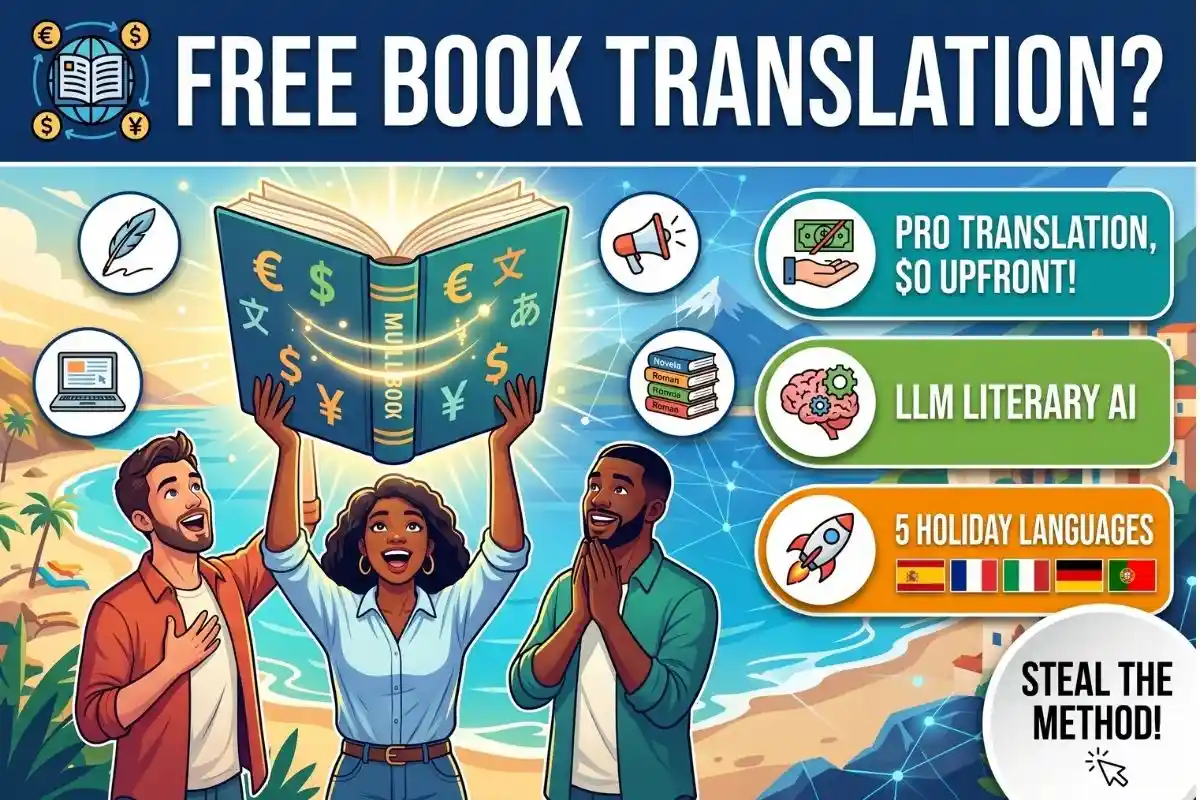
Imagine your gripping, plot-twisting thriller being devoured by a reader lounging on a sun-drenched beach in the Amalfi Coast, or keeping someone awake late into the night in a cozy Bavarian cabin. For decades, the dream of reaching a global audience was hidden behind the steep, often insurmountable paywalls of traditional translation services. Indie authors were forced to focus solely on the English-speaking market, leaving vast, voracious international audiences untapped. However, the rapid acceleration of technology has completely rewritten the rules of the game. In 2026, AI book translation is not just an experimental tool; it is a fundamental strategy for global publishing, allowing you to seamlessly localize your manuscript into the world’s most popular vacation languages without spending a dime upfront.
The Evolution of Global Publishing in 2026
The landscape of global publishing has undergone a seismic shift, fundamentally changing how authors manage their foreign rights in 2026. We are no longer living in the era of early, clunky machine translation that churned out awkward, literal interpretations of your prose. Today, advanced Large Language Models (LLMs) have shifted the paradigm from basic “draft translation” to sophisticated “multilingual content generation.” These AI systems are specifically trained on vast libraries of literature, allowing them to understand context, idiomatic expressions, and the crucial pacing required to make a thriller successful. They don’t just swap English words for their foreign equivalents; they restructure sentences to maintain the suspense and emotional impact of your original narrative. This democratization of technology means that independent authors now possess the same global reach as major traditional publishing houses. You can actively leverage your foreign rights, entering international markets and building a globally diversified readership, all powered by intuitive AI tools that respect the integrity of your storytelling.
Targeting the “Summer Holiday” Five
When we talk about rapid international expansion, strategy is just as important as technology. Translating your book into the five “Summer Holiday” languages—Spanish, French, Italian, German, and Portuguese—is a highly calculated move. These five languages represent the primary tongues spoken across Europe’s most densely populated and frequently visited vacation destinations. During the summer months, millions of tourists flock to the Mediterranean coasts, the Alps, and the Iberian Peninsula, and they invariably pack a “beach read.” Thrillers and suspense novels consistently dominate the bestseller lists in these regions during the holiday season. By utilizing AI book translation to target these specific languages, you are not merely localizing your text; you are strategically placing your intellectual property directly into the hands of a massive, captive audience eager for escapism. This targeted approach maximizes your visibility and taps into the established cultural habit of devouring fast-paced fiction while on holiday, turning seasonal tourism into a lucrative opportunity for your writing career.
How to Execute Your AI Book Translation for Free
The actual mechanics of translating your thriller for free in 2026 are surprisingly straightforward and highly accessible. You no longer need to be a tech expert to utilize these powerful platforms. Many industry-leading AI models and services now offer robust, free tiers specifically capable of handling large document files like entire manuscript PDFs or EPUBs. By utilizing the advanced document translation features natively built into comprehensive tools like Google Translate, or by accessing specialized open-source literary LLMs, you can process a full-length novel in a matter of minutes. The crucial step in this process is prompt engineering. To get the best results, you must prime the AI before it begins translating. By providing the system with a detailed brief about your thriller—including the specific sub-genre, the intended tone, the gritty nature of the dialogue, and the importance of maintaining rapid pacing during action sequences—you guide the AI to produce a nuanced, highly readable first draft that preserves your unique authorial voice across different languages.
Navigating Foreign Rights and Global Copyright
As you expand your reach across borders, a solid understanding of foreign rights and international copyright law becomes absolutely essential. While AI removes the financial barrier to entry for translation, it introduces new complexities regarding the ownership and registration of AI-generated or AI-assisted content. In 2026, navigating this legal landscape requires diligence. It is vital to understand that retaining control over your derivative rights—which include translations—is the cornerstone of a profitable global publishing strategy. You must ensure that the AI platforms you use do not claim ownership over the generated text and that your original intellectual property remains securely yours. Because global regulations are continuously evolving to catch up with AI advancements, staying informed is non-negotiable. For the most current, authoritative guidance on how AI-assisted literary works are registered, protected, and treated under the law, authors should regularly consult the official directives published by the United States Copyright Office. Additionally, understanding the historical framework of international protections, such as the Berne Convention, provides critical context for how your rights are enforced globally.
The Essential Post-Translation Polish
Despite the breathtaking capabilities of AI in 2026, it is important to recognize that an unedited, raw AI translation should rarely be considered the final, published product. A successful thriller relies entirely on tension, cultural nuances, localized slang, and rhythmic pacing—subtle elements that an AI might occasionally miss or misinterpret. Therefore, your free AI book translation should be viewed as an incredibly advanced, highly polished first draft rather than a finished manuscript ready for distribution. To ensure your book truly resonates with local readers and respects their cultural context, a “human-in-the-loop” approach is highly recommended. Engaging a bilingual beta reader, participating in language exchange communities, or utilizing collaborative author platforms for a low-cost human proofread can bridge the gap between a computationally accurate translation and an emotionally compelling one. This hybrid workflow perfectly marries the raw speed and zero-cost efficiency of AI with the irreplaceable touch of human empathy, resulting in a thriller that thrills in any language.
Data Table: The 2026 Translation Landscape
| Translation Method | Average Cost per Language | Turnaround Time (80k words) | Best Used For |
| Traditional Human Agency | $4,000 – $8,000 | 3 – 6 Months | High-budget traditionally published blockbusters. |
| Hybrid (AI + Paid Human Editor) | $500 – $1,500 | 2 – 4 Weeks | Authors investing in top-tier local market penetration. |
| Pure AI Translation (Free Tier) | $0.00 | Under 10 Minutes | Indie authors rapidly testing new global markets. |
| Open-Source LLM (Self-Hosted) | $0.00 (Requires Tech Setup) | Variable | Tech-savvy authors wanting complete data privacy. |
Frequently Asked Questions (FAQ)
1. Will AI accurately translate the specific slang and jargon used in my thriller? Advanced models in 2026 are highly capable of understanding context, but hyper-local slang can still be tricky. It is highly recommended to provide the AI with a “glossary prompt” before translation, defining your specific jargon so the model knows how to handle those terms in the target language.
2. Do I own the copyright to an AI-translated version of my book? This is a complex and evolving legal area. Generally, you retain the copyright to your original story (the underlying intellectual property). However, some jurisdictions may limit copyright claims on the specific translated text if it was generated entirely by AI without human modification. Always review the terms of service of your chosen AI tool and consult official copyright guidelines.
3. Will Amazon KDP or other retailers accept AI-translated books? Yes, as of 2026, major self-publishing platforms accept AI-translated books. However, most require you to disclose during the publishing process that the work was generated or assisted by artificial intelligence.
4. Why is formatting often lost during free translations, and how do I fix it? Older web-based translation tools stripped formatting to process plain text. To maintain your chapter headings, italics, and paragraph indents, you must use tools designed for document translation (like translating a finalized EPUB or PDF file) rather than copy-pasting raw text into a browser window.
5. How do I know if the translation is actually any good if I don’t speak the language? You can use a technique called “back-translation.” Take a translated chapter and run it through a different AI tool to translate it back into English. If the resulting English text retains the core meaning, tone, and pacing of your original writing, your initial translation is likely on the right track.
The Final Chapter: The Curiosity of the “Untranslatable”
As you prepare to launch your thriller across Europe, it is fascinating to note that the very concept of suspense varies linguistically. For example, the German language possesses incredibly specific compound words that beautifully capture complex emotions often found in thrillers—words that require entire sentences to explain in English. Consider the word Schadenfreude (pleasure derived from another’s misfortune), a perfect concept for a villain’s motivation, or Torschlusspanik (the fear that time is running out), which perfectly encapsulates the ticking-clock trope of a high-stakes suspense novel. When you utilize AI book translation to access global publishing and foreign rights in 2026, you aren’t just changing the words on the page; you are adapting your story’s soul to resonate with the unique psychological and cultural frameworks of readers worldwide. Your summer holiday bestseller awaits.
