
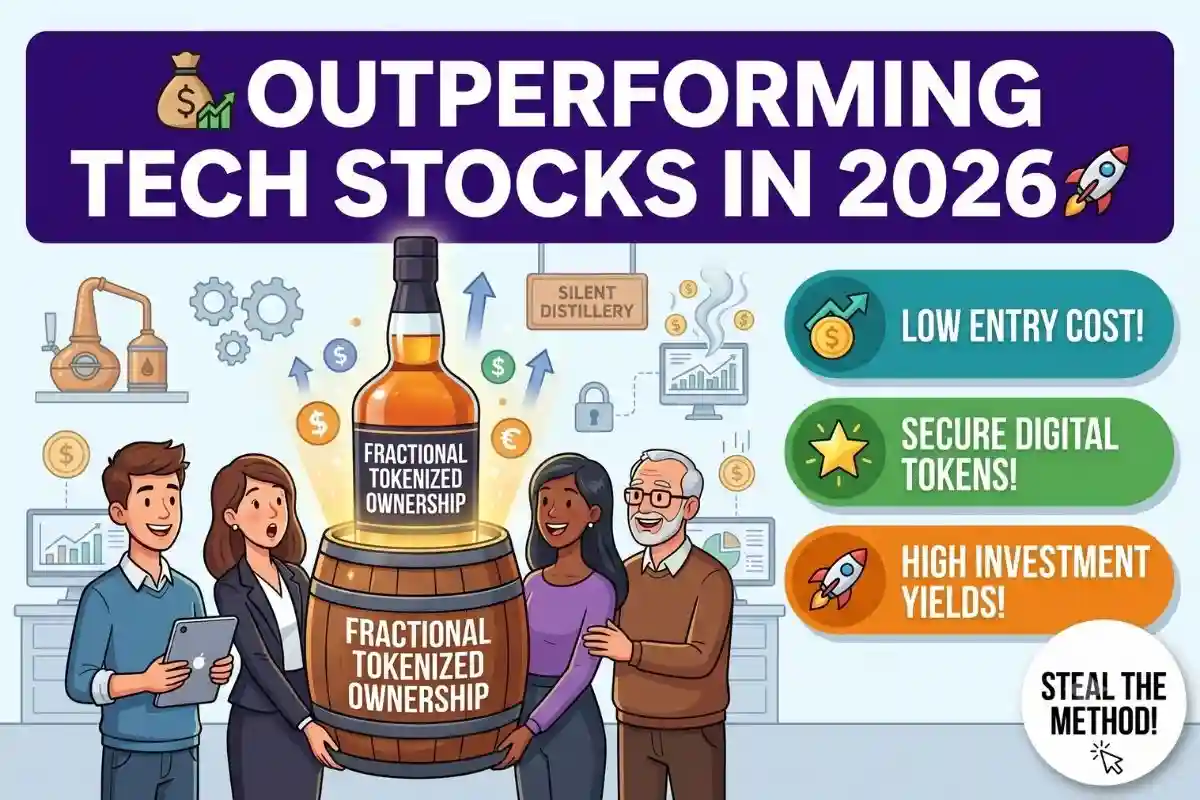
Imagine logging into your brokerage account in 2026. Right beneath your familiar tech stocks, index funds, and perhaps a small allocation of cryptocurrency, sits a highly unusual asset: a fraction of a 1978 Port Ellen Scotch whisky cask. Over the past few years, alternative investments have ventured far beyond art and vintage cars, but nothing has captured the financial zeitgeist quite like tokenized rare whisky. While traditional tech portfolios have faced a bumpy ride characterized by volatile earnings and fluctuating global ad revenues, this amber liquid quietly continues its steady ascent. Blending centuries of traditional craftsmanship with cutting-edge blockchain technology, tokenized whisky has officially crossed from a weird internet experiment into a legitimate, high-performing asset class.
The 2026 Market Correction and Maturation
Let’s step back into the recent past to fully understand exactly how we arrived at this fascinating financial intersection. During the early 2020s, the rare whisky market experienced an unprecedented, almost frantic speculative bubble. Prices for almost any limited-edition release skyrocketed, driven heavily by eager buyers interested in executing quick, profitable flips. However, as 2026 unfolds, the global whisky market has undergone a necessary, sobering, and ultimately healthy price correction. The wild speculative frenzy has cooled off, bringing the auction prices for average bottles back down to earth. This downturn frightened away casual speculators, but it simultaneously signaled a massive opportunity for serious investors. According to industry tracking platforms like WhiskyInvestDirect, the core foundational value of well-aged, premium spirit remains incredibly robust. Instead of blindly chasing marketing hype, smart money is now hyper-focused on genuine artisanal craftsmanship, permanently closed distilleries, and exceptionally long-maturation casks. It is exactly within this stabilized market environment that digital tokenization has found its perfect footing.
What is Tokenization and How Does It Work?
You might reasonably wonder how an ordinary person goes about investing in a digital piece of a physical beverage. The underlying concept of tokenization might sound complex, but the mechanics are actually remarkably straightforward. Essentially, a specialized financial firm purchases a highly valuable, verified cask of rare whisky. They then utilize a secure blockchain network to divide the legal ownership of that physical asset into thousands of individual digital “tokens.” When you purchase one of these tokens, you are buying a legally binding, fractional share of that specific, real-world cask. The physical whisky never actually moves; it remains safely resting in a highly secure, government-bonded warehouse, meticulously cared for by master distillers. Because the entire ownership ledger is permanently recorded on a decentralized blockchain network, the transaction history is fully transparent and incredibly easy to trade. Unlike the traditional method of buying a whole physical barrel, which requires navigating complex storage fees and specialized insurance, tokenized shares can be traded quickly on digital marketplaces.
The Assets: Exactly What Whiskies Are Being Tokenized?
It is important to understand that not just any standard bottle off the supermarket shelf gets the luxurious tokenization treatment. The specific whiskies meticulously chosen for these digital investment platforms represent the absolute pinnacle of the global spirit world. Astute investors are primarily hunting for what the industry refers to as “silent distilleries”—historic production facilities that permanently closed their doors decades ago, making their remaining liquid utterly finite. Legendary names like Brora, Port Ellen, and the revered Karuizawa heavily dominate the high-end space simply because their available supply shrinks every single time a collector opens a bottle. Additionally, platforms are tokenizing long-term maturation casks from established blue-chip brands. Perhaps the most fascinating aspect of this alternative asset is that the underlying physical product actually improves while you hold ownership of it. The continuous chemical process of the raw spirit interacting with the charred oak wood fundamentally changes the liquid, making it significantly smoother, vastly more complex in flavor, and therefore substantially more valuable over time.
Why It Is Outperforming Traditional Tech Stocks Right Now
The current performance metrics of this highly unusual asset class in 2026 are aggressively turning heads across traditional Wall Street circles. While conventional technology stocks have recently struggled under the heavy weight of rising global interest rates and unpredictable regulatory crackdowns, rare whisky offers investors something entirely different: tangible, drinkable scarcity combined with an explosively growing global luxury consumer market. The ravenous demand for ultra-premium, aged spirits in rapidly emerging economic markets continues to surge significantly faster than traditional distilleries can physically produce the aged stock. You simply cannot artificially rush a 30-year-old Single Malt Scotch; by the undeniable laws of time, it takes exactly thirty years to create. As outlined in consumer advisories by the U.S. Securities and Exchange Commission (SEC) regarding alternative asset regulations, tokenized commodities can offer a unique portfolio diversification strategy because their core value remains fundamentally uncorrelated with the stock market. If a major Silicon Valley tech giant shockingly misses its quarterly earnings report, your fractional share of a meticulously aged cask simply doesn’t care.
Navigating the Inherent Risks and Market Realities
Despite the glowing financial returns and the romantic allure of owning a piece of distilling history, it is absolutely crucial for any potential investor to approach tokenized whisky with their eyes wide open. This remains a highly specialized, niche commodity market that requires careful navigation. First and foremost, investors face significant platform and counterparty risks. You are relying entirely on a third-party technology company to properly store the physical asset, maintain adequate insurance policies, and accurately manage the complex blockchain ledger. Secondly, underlying consumer tastes and cultural trends can be notoriously fickle. While high-end whiskies are currently enjoying a massive global boom, a significant generational shift in global alcohol consumption habits could theoretically dampen future demand and stall prices. Finally, while digital tokenization undeniably creates far more liquidity than physically owning a barrel, it is still nowhere near as effortlessly liquid as selling a standard stock. Therefore, cautious financial advisors consistently recommend that alternative assets like tokenized rare whisky should only represent a small, highly diversified fraction of a portfolio.
Comparing Alternative Assets: A 2026 Snapshot
| Asset Class | Liquidity | Barrier to Entry | Storage Costs | Market Correlation |
| Traditional Tech Stocks | Very High | Very Low | None | High |
| Physical Rare Whisky | Very Low | Very High | High | Low |
| Tokenized Whisky | Medium | Low | Included in Token | Low |
Frequently Asked Questions About Tokenized Whisky
What exactly happens to my digital tokens if the physical whisky cask is eventually bottled and consumed?
When a tokenized cask reaches its peak maturation point, the managing platform usually orchestrates a liquidation event. The whisky is either sold as a whole cask to an independent bottler, or it is bottled and sold individually to luxury consumers. Once the physical asset is sold, the fiat currency profits are distributed proportionately to the token holders based on their fractional ownership, and the digital tokens are subsequently burned or retired from the blockchain.
Is the tokenized whisky market currently regulated by financial authorities?
The regulatory landscape is rapidly evolving in 2026. Because tokenized whisky represents a fractional investment in a centralized asset with the expectation of profit, many jurisdictions classify these tokens as securities. Therefore, reputable platforms focus heavily on compliance, requiring strict Know Your Customer (KYC) and Anti-Money Laundering (AML) checks before allowing investors to trade. It is crucial to use platforms that openly operate within the strict regulatory frameworks of their respective home countries.
Can I eventually choose to drink the whisky that I own through a token?
This depends entirely on the specific terms of the platform you use. Some platforms are purely financial instruments designed strictly for trading and monetary profit, meaning you will never see the physical bottle. However, an increasing number of premium platforms offer a “redemption” feature. If you manage to acquire enough fractional tokens to equal one full bottle, you can burn those tokens to have the physical bottle shipped directly to your front door to enjoy.
The Final Pour: A Curiosity of the ‘Angel’s Share’
As we summarize the rise of tokenized whisky in 2026, it is worth remembering that despite the high-tech blockchain infrastructure, this investment is still tethered to the whimsical laws of nature. One of the most poetic realities of investing in a maturing cask is a phenomenon known as the “Angel’s Share.” Every single year a cask sits in a Scottish warehouse, roughly 2% of the liquid evaporates through the porous oak wood and vanishes into the atmosphere. Distillers joke that this portion goes to the angels. When you invest in a tokenized barrel, your actual volume of liquid is slowly shrinking year over year, even as the remaining liquid concentrates in flavor and climbs in value. It is a beautiful paradox: you are paying money to own an asset that is actively evaporating into thin air, yet outperforming some of the largest tech conglomerates on Earth. In the modern landscape of alternative assets, sometimes the best investments are the ones you can truly savor.
