


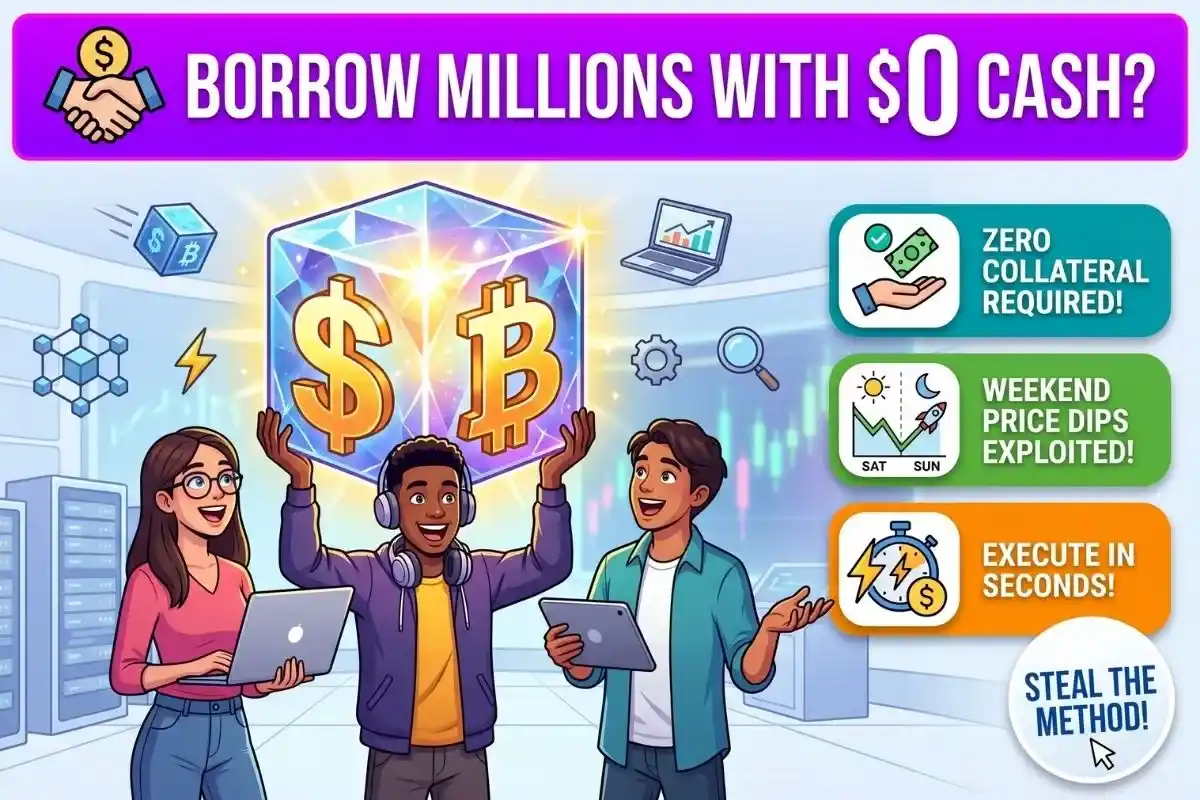
Imagine walking into a high-end art gallery, noticing a painting priced at $1,000, and knowing for a fact that a collector across the street is currently offering $1,200 for that exact piece. In the physical world, you’d need your own $1,000 to buy it first, or a very trusting friend to lend you the cash. But in the world of decentralized finance, or DeFi, there is a “secret” mechanism that allows you to act as the middleman even if your bank account is empty. This is the world of Crypto Flash Loans, a unique financial tool that feels like a cheat code for the digital economy. It allows users to borrow millions of dollars in cryptocurrency without any collateral, provided the money is returned within the exact same “block” of transactions on the blockchain.
The Magic of Atomic Transactions
To understand how you can borrow millions without a credit check, you have to understand the “atomic” nature of blockchain technology. In a standard bank, if you borrow money, the bank hopes you’ll pay it back over months. In the crypto world, a flash loan happens within a single transaction. If the borrower doesn’t use the funds to generate enough profit to pay back the loan plus a small fee, the entire transaction “reverts.” It’s as if the loan never happened in the first place, and the money never left the lender’s vault. This lack of risk for the lender—because the software literally won’t let the money disappear—is why platforms like Aave or Uniswap can offer such massive sums to anyone with a clever idea. According to Wikipedia, this innovation is a cornerstone of the rapidly evolving DeFi ecosystem, turning traditional lending on its head by replacing trust with immutable code.
Mastering DEX Arbitrage
The most common way people use these temporary fortunes is through DEX arbitrage. In the fragmented world of crypto, different Decentralized Exchanges (DEXs) often have slightly different prices for the same token. For instance, Ethereum might be selling for $3,000 on one platform and $3,010 on another. While a $10 difference seems small, if you use a flash loan to buy 1,000 ETH, that tiny gap suddenly turns into a $10,000 profit. The “weekend” secret often lies in the fact that during Saturdays and Sundays, traditional institutional trading slows down and liquidity can thin out, leading to larger price discrepancies between platforms. By spotting these gaps, traders use borrowed capital to “level out” the market prices across the globe, pocketing the difference as a reward for providing this balancing service. It is a high-speed game of digital “find the gap” where the person with the fastest smart contract wins.
The Role of Smart Contract Trading
You can’t simply click a button on a website to execute a flash loan; it requires smart contract trading. A smart contract is a piece of self-executing code that lives on the blockchain. To pull off a successful arbitrage, you write a script that says: “Borrow 1 million USDC, buy Token X on Exchange A, sell Token X on Exchange B, pay back the 1 million USDC plus fee, and send the profit to my wallet.” If the math doesn’t add up at any point in that sequence, the code fails, and the only thing the trader loses is the “gas fee” (the cost of trying to use the network). This is why the barrier to entry is technical rather than financial. You don’t need a million dollars, but you do need to understand how to talk to the blockchain. As the SEC and other regulatory bodies continue to monitor the space, the emphasis remains on the transparency and the “code is law” philosophy that governs these rapid-fire financial maneuvers.
Why the Weekend Matters
The weekend is a fascinating time in the crypto markets because it acts as a “Wild West” period for volatility. While the stock market sleeps, crypto never stops, but the “smart money” from big banks is often less active. This results in lower trading volumes, which means a single large buy or sell order can move the price on one exchange significantly more than on another. For a flash loan hunter, these “inefficiencies” are the bread and butter of their strategy. They look for moments when a whale might sell a large amount of a token on a smaller exchange, causing a temporary price dip that hasn’t hit the larger exchanges yet. By using a flash loan to buy the dip on the small exchange and sell at the normal price on the large one, the trader uses the weekend’s natural turbulence to their advantage, all while their own personal savings remain untouched in their wallet.
Risks and the Reality Check
While the idea of “risk-free” money is enticing, flash loan arbitrage is far from a guaranteed payday. The biggest hurdle is something called “front-running.” Because blockchain transactions are visible in a “mempool” before they are confirmed, sophisticated bots can see your profitable trade and “outbid” you on the gas fee to jump in front of you and take the profit for themselves. Furthermore, if the profit from your trade isn’t enough to cover the Ethereum network’s transaction costs, you can actually lose money on the gas fees even if the loan itself is canceled. It is a highly competitive, technical arms race where developers spend their weekends refining their code to be milliseconds faster than the competition. It’s not just about having the loan; it’s about having the most efficient “vessel” to carry that loan through the digital marketplace.
Comparison: Traditional vs. Flash Loans
| Feature | Traditional Bank Loan | Crypto Flash Loan |
| Collateral Required | Yes (House, Car, Cash) | None |
| Credit Check | Yes | No |
| Approval Time | Days to Weeks | Seconds (Instantly) |
| Duration | Months to Years | One Transaction (~12 seconds) |
| Risk to Lender | High (Default risk) | Zero (Transaction reverts if not paid) |
| Primary Use | Consumption/Investment | Arbitrage/Refinancing |
FAQ: Common Questions About Flash Loans
1. Can I really borrow money with zero dollars in my pocket? Technically, yes. You don’t need collateral for the loan itself. However, you do need enough cryptocurrency in your wallet to pay for the “gas fees” (network transaction costs) to execute the smart contract. These fees can range from a few dollars to hundreds depending on how busy the network is.
2. Is this legal? Yes, flash loans are a legitimate feature of decentralized finance protocols. They are used for arbitrage, liquidations, and swapping collateral between different lending platforms. However, like any tool, they can be used for “exploits” if a smart contract has a bug, which is why the industry focuses heavily on security audits.
3. Do I need to be a programmer? Mostly, yes. While some “no-code” tools are emerging to help people build flash loan paths, the most successful arbitrageurs write their own custom smart contracts in languages like Solidity to ensure they are as fast and efficient as possible.
4. What happens if I can’t pay the loan back? The beauty of the flash loan is that if you can’t pay it back within the same transaction, the blockchain simply “undoes” the whole thing. The money returns to the lender, your trades are canceled, and it’s as if you never borrowed the money. You only lose the cost of the gas you spent to try.
A Curiosity to Leave You With
Did you know that the largest flash loans ever recorded involve hundreds of millions of dollars? In some instances, traders have borrowed over $200 million to execute a single series of trades that lasted less than 15 seconds. It is a testament to the power of code that a person sitting in a coffee shop with a laptop can briefly wield more financial power than a mid-sized regional bank, all thanks to a few lines of logic and the “weekend” gaps in the global crypto market. While it sounds like science fiction, it’s just another Sunday in the world of decentralized finance.

