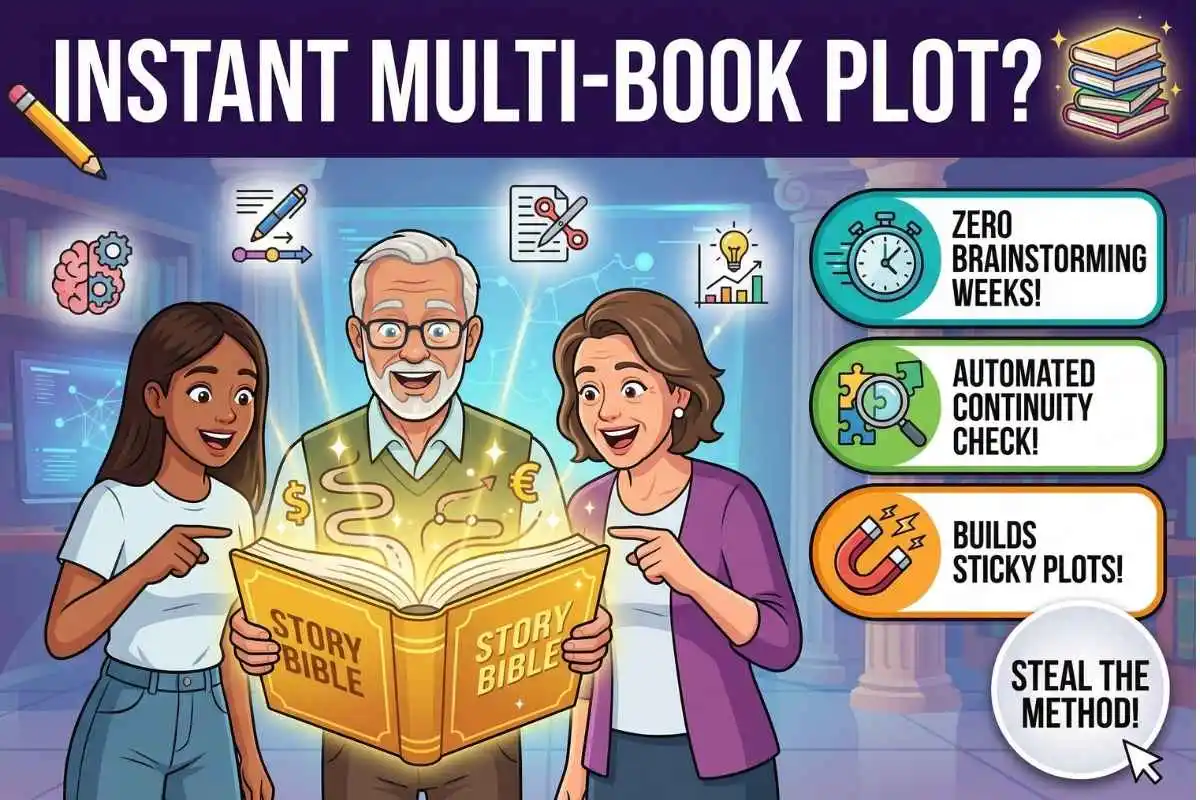
Imagine staring at a blank screen, wanting to write a multi-book epic, but feeling completely overwhelmed by the project’s massive scale. Every author knows this terrifying expanse, especially when trying to weave a narrative that spans hundreds of thousands of words across several novels. But what if you had a brilliant, tireless assistant who could hold your entire fictional universe in its memory, track every character’s motivation, and instantly alert you when a plot thread starts to fray? In 2026, artificial intelligence has evolved far beyond generating clunky, robotic sentences; it has become the ultimate structural architect for modern fiction. Welcome to the era of the “Sticky Plot” formula, where writers are leveraging advanced AI not to cheat the creative process, but to build rock-solid blueprints for series that keep readers eagerly turning pages late into the night.
The Anatomy of a Meticulous Sticky Plot
At its core, a sticky plot is a narrative that practically glues the reader to the page through an expert balance of pacing, emotional resonance, and constantly escalating stakes. Think of the most binge-worthy television series or the massive fantasy epics that demand to be read in a single sitting. These stories share a common, powerful DNA: they understand precisely how to manipulate narrative tension. Traditionally, authors mapped these arcs using physical index cards, messy whiteboards, or sprawling spreadsheets, hoping they wouldn’t lose a crucial detail along the way. They relied on classical frameworks like the hero’s journey or the three-act structure, which have guided storytellers for millennia. For a deeper understanding of these foundational elements, you can explore the rich history of Narrative structure on Wikipedia, which details how plots have been organized from ancient mythologies to modern blockbusters. Today, the sticky plot formula takes these age-old principles and turbocharges them, ensuring that every chapter ends on a compelling question, every character arc intersects meaningfully, and the overarching mystery remains perfectly balanced to maximize reader engagement.
Enter the 2026 AI Co-Pilot
The true breakthrough in modern publishing isn’t that AI writes the story for you. In fact, purists will be happy to know that AI-generated prose still lacks the nuanced, soul-stirring touch, and emotional depth of a real human author. Instead, the magic lies in the AI’s unprecedented ability to act as a brilliant developmental editor and an interactive sounding board during the crucial outlining phase. Imagine sitting down with a master storyteller who never gets tired, never judges your bad ideas, and has an encyclopedic knowledge of genre tropes. It can instantly flag structural weaknesses, such as a sagging middle in book two, or point out that your protagonist hasn’t faced a genuine, crushing setback in over fifteen chapters. This is the true essence of AI-assisted outlining: it handles the heavy lifting of narrative logistics. By organizing your chaotic brainstorms into a cohesive, chronological timeline, the AI frees up your mental energy to focus on what you do best—breathing life into the characters and writing beautiful, evocative prose. It is like having a reliable GPS for your imagination, guiding you safely through the dark woods of writer’s block.
Building the Series Arc and Managing Continuity
Writing a single, standalone novel is a monumental achievement, but crafting a compelling multi-book series introduces a staggering level of complexity that can easily break even seasoned authors. You have to juggle the micro-arcs of individual books while simultaneously advancing the macro-arc of the entire series. Continuity errors quickly become the bane of your existence; a character’s eye color changing between book one and three is embarrassing, but forgetting a vital magical rule or a political alliance can shatter the reader’s suspension of disbelief forever. This is where 2026 AI tools truly shine, acting as a dynamic, interactive “series bible.” These advanced models can ingest your world-building rules, character histories, and intricate timelines, locking them into a secure, perfectly organized memory bank. When you sit down to outline book four, the AI can gently remind you of a forgotten prophecy introduced in chapter two of the first book, suggesting a brilliant way to bring it back into play. This meticulous tracking ensures that the overarching Story arc remains robust, logically sound, and incredibly satisfying for the reader. The AI acts as a dedicated continuity editor, allowing authors to weave complex, heavily foreshadowed mysteries that span thousands of pages.
Practical Steps to Implementing the Formula
So, how exactly does a modern writer execute the sticky plot formula using these advanced AI tools? The process usually begins with a conversational “brain dump.” The author dictates or types out their messiest, most chaotic ideas—fragments of action scenes, snippets of dramatic dialogue, or vague feelings about how a character should evolve over time. The AI then steps in to categorize and synthesize this raw material. From there, the author prompts the AI to generate a high-level beat sheet for the entire series. They might ask, “Map out a five-book urban fantasy arc where the stakes escalate from a local murder mystery to a realm-ending war, ensuring the romantic subplot peaks in book three.” The AI provides a detailed skeleton, which the author then aggressively edits, twisting the AI’s suggestions, rejecting the obvious clichés, and injecting their unique voice. Once the series skeleton is approved, they zoom in on book one, asking the AI to break down the narrative chapter by chapter. The author sets strict parameters for pacing, requesting alternating high-action and quiet reflective scenes. The result is a bulletproof outline that eliminates the fear of the blank page, providing a clear roadmap while leaving plenty of room for spontaneous creativity.
Comparing Outlining Eras: Traditional vs. 2026 AI
To truly appreciate the paradigm shift in narrative planning, it helps to compare the traditional outlining methods of the past with the AI-assisted workflows of 2026. The differences highlight why so many authors are adopting the sticky plot formula to increase their productivity and reduce creative burnout.
| Feature | Traditional Outlining Methods | 2026 AI-Assisted Outlining Workflow |
| Brainstorming Speed | Can take weeks of solitary thought, pacing, and frustration. | Instant, conversational idea generation and rapid expansion. |
| Continuity Tracking | Manual updates to sprawling spreadsheets, notebooks, or wikis. | Automated, memory-persistent series bible monitoring. |
| Pacing Analysis | Relies heavily on author intuition and delayed beta reader feedback. | Instant algorithmic analysis of tension peaks and emotional beats. |
| Plot Hole Detection | Often discovered painfully during the second or third draft. | Flagged proactively during the initial, high-level outlining phase. |
| Writer’s Block Resolution | Walking away, staring at walls, or forcing uninspired words. | Prompting the AI for five possible, creative ways out of a corner. |
Frequently Asked Questions
Will using AI to outline my book make my story feel robotic, generic, or derivative? Not if you use the technology correctly. The AI is a tool, much like a sophisticated calculator designed for narrative math. If you blindly accept its first, most generic suggestions, your story will undoubtedly be boring. The secret is to use the AI as a creative sparring partner. Reject its obvious ideas and deliberately push it to give you unusual, highly specific scenarios that you then adapt with your own unique human empathy, life experience, and voice.
Do traditional publishers in 2026 accept books that were outlined using artificial intelligence? Yes, publishers generally focus entirely on the quality, originality, and marketability of the final manuscript. While fully AI-generated prose is highly discouraged and routinely flagged by modern publishing houses, using AI for structural planning, world-building organization, and outlining is widely considered a standard, acceptable part of the modern author’s workflow. It is viewed no differently than using advanced word processors, digital dictionaries, or spell-checkers.
How do I protect my original ideas when feeding them into an AI model? This is a crucial concern for any creator. Professional authors in 2026 use premium, private AI workspaces that strictly do not train their foundational models on user inputs. Always read the terms of service. Opt for platforms that guarantee data privacy and offer clear “opt-out” features to ensure your intellectual property remains exclusively yours.
The Curiosity Corner: The Future of Storytelling
The concept of a “sticky plot” is ultimately about human connection, something an algorithm can analyze but never truly feel or experience. Did you know that the word “author” stems from the Latin word auctor, meaning “originator” or “promoter”? Even with the most incredibly advanced 2026 AI acting as your structural architect, you remain the sole originator of the story’s emotional core and thematic depth. The machine may help you build the house faster, ensuring the walls are perfectly straight and the foundation is solid, but you are the one who decorates the rooms, lights the fire, and warmly invites the reader inside. By embracing these modern tools, writers aren’t losing their art; they are simply clearing away the logistical clutter, allowing their purest, most captivating stories to finally hit the page.