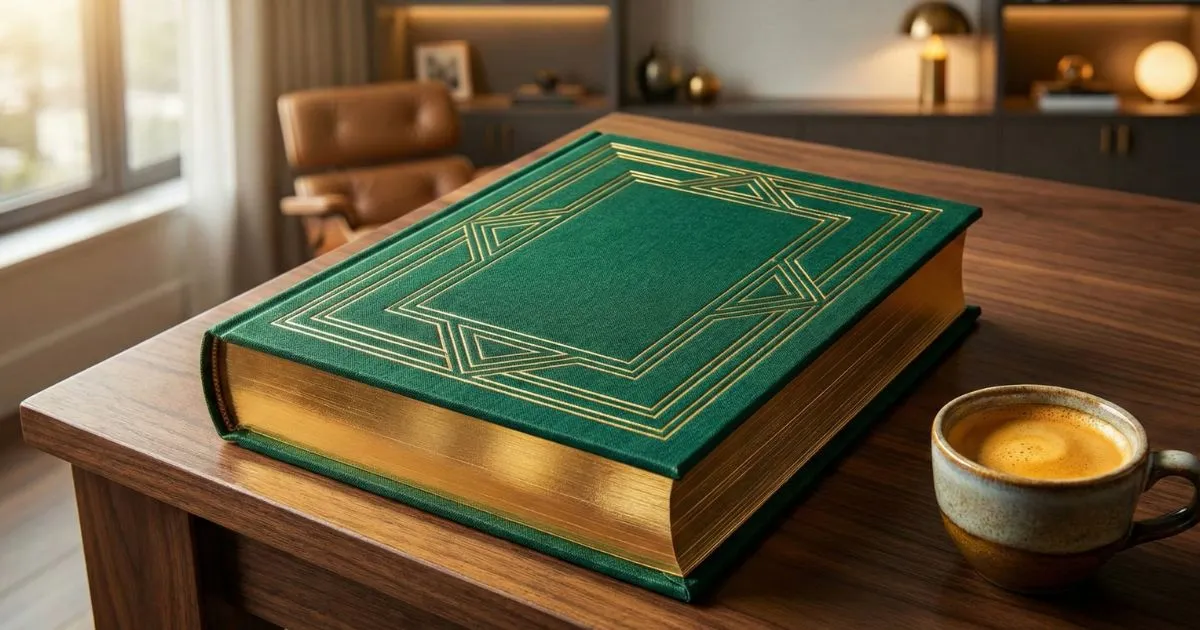
The air in my local independent bookstore smells like a curious mixture of vanilla, old dust, and, increasingly, very expensive glue. It is a scent that shouldn’t feel revolutionary in 2026, yet here we are. I watched a young woman yesterday, likely a digital native who has spent her life swiping through glass, reach for a volume on the central display. It wasn’t just a book. It was a heavy, linen bound artifact with edges so vibrantly sprayed they looked like a sunset trapped in a stack of paper. She didn’t look at the price tag until she was already halfway to the register. When she saw the fifty dollar mark, she didn’t flinch. She simply ran her thumb over the gold foil stamping on the spine and kept walking.
We have reached a tipping point where the convenience of a thousand books in a pocket has finally lost its luster against the sheer, unadulterated gravity of a single, beautiful object. For years, the industry pundits whispered about the death of print, predicting a world where every word would be rendered in cold pixels. They were wrong. They failed to account for the human desire for permanence. In an era where digital content is often ephemeral, a high quality hardcover represents a stake in the ground. It is a declaration of value.
Readers today are not just paying for the information contained within the pages. They can get that for a few dollars on a subscription service or even for free if they look hard enough. They are paying for the way the paper feels against their fingertips, the specific resistance of a well made hinge, and the knowledge that this object will still exist in fifty years without needing a software update. This shift toward Premium Publishing is more than a trend. It is a fundamental realignment of how we perceive ownership. We are seeing a bifurcation of the market where digital is for consumption, but print is for curation.
Curating the Personal Library as a Financial Asset and Hardcover Book Trends
I spent an afternoon last week with a collector who manages a portfolio of rare assets. He showed me a shelf of modern first editions, many of them self published or from small boutique imprints, that have tripled in value over the last eighteen months. He isn’t looking at them as just stories. He sees them as limited run commodities. The rise of hardcover book trends like hand numbered editions and artist signed endpapers has turned the humble bookshelf into a legitimate gallery. It is a fascinating psychological pivot. When everything is accessible, nothing feels rare. By introducing scarcity through physical craftsmanship, creators have rediscovered the lever of luxury.
The most successful authors in 2026 have figured this out. They aren’t just selling manuscripts. They are designing experiences. I’ve noticed that the books commanding the highest prices aren’t necessarily the ones with the most marketing spend behind them. They are the ones that lean into the “analog” nature of the medium. We are seeing a surge in textured dust jackets, hidden illustrations under the “naked” hardback, and even custom tip-in sheets that provide a bridge between the author and the reader. It is an intimate, almost tactile conversation that a screen simply cannot facilitate.
This movement has also birthed a new wave of luxury self-publishing that rivals the biggest houses in New York or London. I know an author who bypassed traditional routes entirely to produce a five hundred copy run of a leather bound memoir. Each book cost him nearly thirty dollars to produce, but he sold every single one for eighty dollars within forty eight hours. His readers weren’t buying a book. They were buying a piece of him. They wanted the weight. They wanted the smell. They wanted the signature. In a world of infinite copies, the original becomes the ultimate prize.
There is also a quiet, almost subversive financial logic at play here. When a reader spends fifty dollars on a premium edition, they are making a micro-investment. They are betting that the cultural capital of the physical object will outlast the fleeting relevance of a social media post. This is why we see high end books becoming centerpieces of interior design. A bookshelf is no longer just storage. It is a visual resume of one’s intellectual and aesthetic taste. The vibrant colors and bold typography found on modern covers are designed to be seen from across a room, signaling a specific kind of literacy that digital formats lack.
It is worth noting that this isn’t just about nostalgia. We aren’t trying to return to the nineteenth century. We are using twenty first century technology to perfect a centuries old craft. Digital printing has advanced to a point where short runs of museum quality books are finally economically viable for independent creators. We can now produce embossed, foiled, and deckle edged volumes that would have required a massive industrial operation only a decade ago. This democratization of quality has shifted the power dynamic. The gatekeepers no longer control the means of beauty.
I often wonder where this leaves the casual reader. Perhaps they will continue to thrive in the digital ecosystem, enjoying the speed and ease of e-readers. But for those of us who still find joy in the physical world, the “Print-First” revival is a welcome homecoming. It reminds us that some things are worth the extra cost, the extra weight, and the extra space on the shelf. As I watch the lady at the bookstore leave with her fifty dollar hardcover tucked under her arm, I realize she isn’t just carrying home a story. She is carrying home a legacy.
The question for those on the business side of this equation is no longer whether people will pay for print, but rather how much beauty they are willing to fund. The appetite for the exquisite is growing, and the margins are following suit. It is a brave new world of old fashioned things, and I suspect we are only just beginning to see how far this tactile rebellion will go. After all, you can’t pass down a login and password to your grandchildren, but a well worn, gold flecked spine is a gift that carries the weight of history in every ounce of its binding.