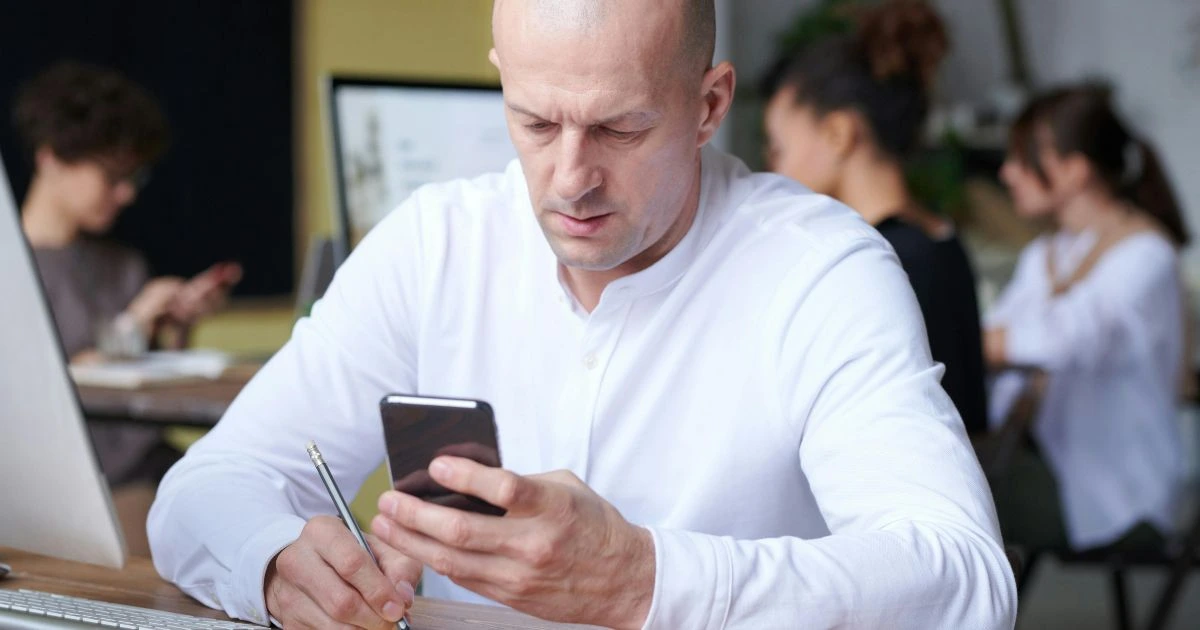
There was a time, maybe five or six years ago, when the idea of running a multi-million dollar company from a device that fits in your pocket felt like a gimmick or a desperate attempt at “digital nomad” performance art. We all saw those photos of people pretending to code on a beach in Bali while squinting through the glare on their screens. It looked exhausting and, frankly, a bit fake. But something shifted while we weren’t looking. The clunky laptops stayed in their bags, the glass-and-steel offices in places like Austin or Palo Alto started feeling like expensive anchors, and the mobile-first business stopped being a compromise. It became the ultimate competitive advantage.
I was sitting in a crowded coffee shop in Brooklyn last Tuesday, watching a guy who couldn’t have been older than twenty-two. He wasn’t typing. He was gesturing, tapping, and occasionally whispering into his earbuds with a level of intensity that usually requires a boardroom and a mahogany table. Later, I found out he manages a logistics network that spans three continents. He doesn’t own a desk. He doesn’t want one. He’s part of a generation of founders who realized that speed isn’t about how fast you can type, but how quickly you can react to a stream of data that never stops flowing.
The shift toward this decentralized reality isn’t just about the hardware getting better, though the haptics and neural processing on modern phones are bordering on the absurd. It’s a psychological break from the 20th-century obsession with “presence.” We used to equate physical infrastructure with stability. If a company had a lobby with a fountain and a receptionist, we trusted it. Now, that looks like overhead. It looks like a slow death. The geniuses of 2026 look at a long-term lease as a confession of failure. They’d rather have a lean startup 2026 model where the only “property” they own is a set of high-converting algorithms and a direct line to their audience.
The quiet evolution of the lean startup 2026 philosophy
If you look back at the original lean methodologies, they were obsessed with cycles. Build, measure, learn. It was a great theory, but in practice, it often got bogged down in the friction of collaboration tools that were designed for desktop computers. You had to wait until you were “at work” to make the big pivots. That delay is gone. In the current landscape, the lean startup 2026 is less about a formal process and more about an instinctive, real-time pulse.
I’ve noticed that the most successful founders right now are those who treat their businesses like an extension of their social lives. They aren’t “switching” to work mode. They are living in a continuous stream of execution. This sounds like burnout to the old guard, but for the people thriving in it, it feels like freedom. There is no longer a barrier between the spark of an idea and the deployment of a campaign. When your entire supply chain is accessible via an app that feels as intuitive as Instagram, the friction of “doing business” evaporates.
This isn’t about working more hours. It’s about the quality of those hours. A founder might spend four hours hiking in the hills outside of Los Angeles, answering critical prompts and approving designs while moving. The movement seems to help the thinking. By the time they get back to their car, they’ve cleared more hurdles than a mid-level manager in 2019 could clear in a week of meetings. The efficiency is almost frightening because it’s so quiet. There’s no clacking of keyboards, just the soft haptic buzz of a world being reshaped in the palm of a hand.
We are seeing the death of the “productivity hack.” You don’t need a complex system of colored folders when your OS prioritizes your most urgent human interactions. The software has finally caught up to how our brains actually function. It’s messy, it’s non-linear, and it’s deeply personal. The tools we use now aren’t just utilities; they are cognitive exoskeletons.
How remote work tech finally stopped being a pale imitation of the office
For years, the biggest complaint about working away from a central hub was the “loss of culture” or the “difficulty of spontaneous brainstorming.” We tried to fix it with video calls that made everyone look like they were trapped in a grid of postage stamps. It was miserable. But the current wave of remote work tech has moved past trying to replicate the physical world. It’s creating something entirely different.
Instead of trying to simulate a meeting, the new tools focus on asynchronous high-fidelity presence. I can see what my partner is thinking because I can see the trail of their decision-making in real-time, regardless of where they are. We aren’t “calling” each other. We are co-existing in a shared digital workspace that feels as tactile as paper. The haptics and spatial audio in the latest mobile interfaces make it feel like your team is a whisper away, but only when you want them to be.
The genius of this setup is the autonomy it grants. In a traditional office, your time is rarely your own. Someone is always “popping by.” In the mobile-first era, you are the gatekeeper of your own attention. You can be deeply involved in a project while sitting in a park in Georgia, surrounded by actual trees instead of those sad office ferns. The tech has become invisible. It doesn’t scream for your attention with bright red notification dots; it hums in the background, surfacing only what matters.
I often wonder if we’ll look back at the era of the open-plan office as a strange collective fever dream. Why did we think putting a hundred people in a room with bad lighting and stale coffee would produce brilliance? The “No-Office” empire is built on the realization that brilliance is a solitary spark that needs a social oxygen to grow, and that oxygen doesn’t have to be shared in the same ZIP code. It can be shared through a high-bandwidth connection that values your time more than your physical presence.
The scale of what can be achieved now is staggering. I know a woman who runs a global fashion brand with zero full-time employees and no warehouse. She uses a network of on-demand manufacturers and AI-driven logistics. She handles the entire operation from her phone during her commute or while she’s waiting for her kids at soccer practice. Her margins would make a Fortune 500 CEO weep. She’s not “working from home.” She’s working from everywhere.
There is a certain raw honesty in this way of building. You can’t hide behind a fancy address or a fleet of assistants. Your brand is either resonant or it isn’t. The mobile interface forces a kind of minimalism on the business owner. You have to strip away the fluff. If a process is too complicated to manage on a six-inch screen, it’s probably too complicated for the customer, too. This forced simplicity is the secret sauce of the modern empire. It creates a user experience that is frictionless because the creator felt every bit of friction during the build.
We’re left with a world where the power has shifted from the institutions to the individuals who can navigate the digital currents the fastest. It’s a bit chaotic, sure. There’s a loss of that “nine-to-five” structure that gave people a sense of rhythm. But in its place is something more organic. We are returning to a kind of digital cottage industry, but on a global scale. The phone isn’t a distraction anymore. It’s the loom, the forge, and the storefront all rolled into one.
Where does this leave the traditional structures? They’ll survive, I suppose, for the things that absolutely require physical mass. You can’t build a bridge from a phone, not yet anyway. But for the world of ideas, commerce, and connection, the walls are coming down. We are entering an era of the “invisible titan,” where the person sitting next to you on the bus might be quietly managing a tectonic shift in a global market, and you’d never know it because they’re just scrolling. Or so it seems.
It makes me think about the nature of ambition. We used to measure it by the height of the skyscraper. Now, maybe we should measure it by the breadth of the network. The most powerful people I know don’t have corner offices. They have full batteries and a good signal.
FAQ
It refers to a business that operates without any physical headquarters, utilizing mobile technology to manage all operations, from supply chains to marketing.
The article suggests they may remain for tasks requiring “physical mass,” but their role as the default “home of work” is over.
Significantly. The elimination of rent, utilities, and office-specific insurance allows for much higher profit margins.
The article posits that “digital cottage industries” create a different, perhaps more organic, form of global connection than traditional offices.
With stylus support and high-fidelity creative suites, the gap between “consuming” and “creating” on mobile has almost entirely closed.
AI acts as a force multiplier, handling the “heavy lifting” of data analysis and routine admin, allowing the founder to lead via high-level mobile inputs.
The convergence of 6G-style connectivity, advanced AI assistants, and a post-pandemic shift in corporate real estate values has reached a “tipping point.”
Surprisingly, yes. Relationship management and sales are increasingly happening via direct messaging and mobile-optimized CRM tools.
Most use “Product-as-a-Service” platforms where complex back-end work is distilled into simplified dashboards accessible via mobile.
Maintaining deep focus amidst notifications and the lack of a physical “boundary” between life and work are the most cited hurdles.
Not necessarily, but the “mobile-first” approach ensures that every critical business function is optimized for the smallest screen, making the desktop secondary.
They typically rely on decentralized, cloud-native security protocols and biometric authentication that are native to high-end mobile devices.
While difficult for heavy manufacturing, many service, digital product, and logistics-heavy firms are scaling to millions in revenue using purely mobile interfaces.
While younger generations are early adopters, the shift is more about a mindset of mobility that is being adopted by veteran entrepreneurs looking for efficiency.
Culture shifts from being “place-based” (happy hours and office layout) to “intent-based” (shared values and digital interaction styles).
Yes, modern management platforms are designed for “triage-style” leadership where approvals and feedback happen in short, frequent bursts.
It’s less about the specific brand and more about the ecosystem of apps and the processing power to handle multi-threaded professional tasks.
While the article mentions cities like Austin and Los Angeles, the trend is global, though the U.S. remains a major hub for the development of the underlying technology.
Advanced haptic feedback, spatial audio, AI-driven task prioritization, and high-bandwidth asynchronous collaboration tools that go beyond simple video calls.
The 2026 iteration focuses on real-time execution and mobile-centric workflows rather than desktop-based development cycles, emphasizing speed and immediate market feedback.
The article suggests that while the lines are blurred, the autonomy and lack of “office theatre” can actually lead to higher quality of life for those who master the transition.