


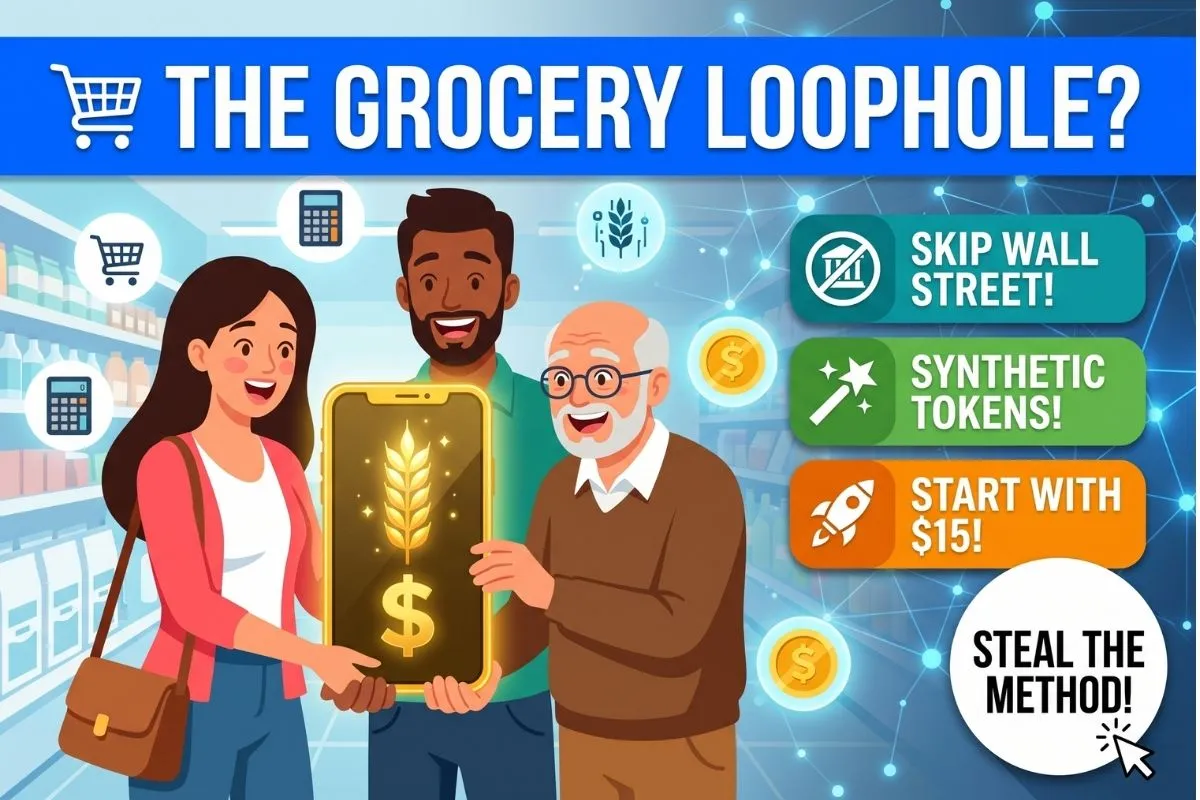
If you have walked down a supermarket aisle at any point this year, you already know the story. The numbers on your grocery receipt seem to have a mind of their own, creeping upward with every passing month. While headlines debate the macroeconomic policies driving these price hikes, the reality hits you right in your own kitchen pantry. For decades, the everyday consumer has had to simply absorb these rising costs, watching their purchasing power shrink while institutional investors on Wall Street use complex financial instruments to protect their wealth. But the financial landscape of 2026 is shifting dramatically. Thanks to the evolution of decentralized finance, a radical new strategy is emerging for the everyday shopper. It is casually being referred to as the “Grocery Hedge,” and it represents a profound shift in how we might protect our household budgets against the relentless tide of food inflation.
The Uneven Playing Field of Rising Food Costs
Picture this familiar scenario: you are standing in the middle of the baking aisle, staring at a bag of flour that costs twenty percent more than it did just a few seasons ago. When global supply chains face disruptions, or extreme weather events impact crop yields, the price of basic raw materials like wheat, corn, and soybeans skyrockets. Historically, the only people who benefited from these price spikes were massive agricultural conglomerates and wealthy commodity traders. These financial elites have long used the traditional commodity market to buy futures contracts, effectively locking in prices or profiting from the upward trend of global food costs. For the average family trying to balance a monthly budget, participating in that traditional system was practically impossible. You needed specialized brokerage accounts, deep pockets to meet high minimum investment thresholds, and a sophisticated understanding of complex trading regulations. The everyday consumer was left with no choice but to act as the final shock absorber for a volatile global economy, paying the ultimate premium at the checkout counter while institutional traders built effective barriers against economic instability. That fundamental imbalance is exactly what the modern “Grocery Hedge” aims to fix, offering a vital food inflation hedge to the very people who need it the most.
Demystifying Synthetic Commodities for the Everyday Consumer
Enter the fascinating and rapidly growing world of Synthetic Commodities. If the phrase sounds like something out of a science fiction novel, the underlying concept is actually wonderfully straightforward when you break it down. A synthetic commodity is essentially a digital mirror. Through the use of advanced blockchain technology and specialized software known as smart contracts, developers can create digital tokens that perfectly track the real-world price of a physical asset. If the global market price of a bushel of wheat goes up by five percent, the value of the synthetic wheat token goes up by exactly five percent. You are not buying actual, physical grain, and you absolutely do not have to worry about a dump truck delivering tons of soybeans to your driveway. Instead, you are buying a digital representation of that value, secured by cryptography. Regulators, including agencies like the Commodity Futures Trading Commission (CFTC), have been actively monitoring and adapting to these digital derivatives to ensure market integrity. By holding these digital mirrors, ordinary people can participate in the price movements of global food supplies, gaining access to the exact same economic forces that dictate the price of their weekly groceries without dealing with the logistical nightmares of physical storage or traditional brokerage bureaucracy.
The Magic of Tokenized Assets and Fractional Ownership
The secret engine making this entire system accessible to the general public is the widespread adoption of Tokenized assets. In the old financial world, if you wanted to invest in an agricultural fund or a traditional commodity contract, you might need to commit thousands of dollars upfront. Tokenization shatters those financial barriers by breaking massive assets down into tiny, affordable, digital pieces. Imagine a towering grain silo worth millions of dollars; tokenization allows that total value to be divided into millions of individual digital tokens, each worth just a few cents. This means you can log into a digital wallet on your smartphone and buy exactly fifteen dollars’ worth of synthetic corn or twenty dollars’ worth of synthetic sugar. This level of accessibility democratizes the financial tools that were previously gatekept by Wall Street. It allows you to tailor your investment to match your specific grocery budget. You are no longer required to be a high-net-worth individual to protect your purchasing power; tokenized assets allow anyone with an internet connection and a few spare dollars to build a customized, hyper-local defense against the macro-economic forces driving up the cost of living.
Putting the “Grocery Hedge” into Daily Practice
So, how does a normal family actually implement this strategy in 2026? The logic behind the “Grocery Hedge” is a brilliant exercise in financial self-defense. Let us say your family consumes a large amount of grain-based products—bread, pasta, and cereals. You notice that your monthly grocery bill is steadily climbing because global wheat prices are surging. To execute the hedge, you take a small portion of your savings and purchase tokenized synthetic wheat on a digital exchange. As the inflation hits your local supermarket and forces you to pay more for your weekly loaves of bread, the synthetic wheat tokens in your digital portfolio are simultaneously rising in value. When you are ready, you can sell those digital tokens for cash. The profit you make from your synthetic commodities effectively cancels out the extra money you had to spend at the grocery store checkout lane. You are essentially using the global agricultural market to subsidize your own pantry. While it does require a bit of digital literacy to set up a secure wallet and navigate these new exchanges, the peace of mind that comes from knowing you have a mathematical counter-balance to inflation is proving to be incredibly attractive to a new generation of proactive consumers.
Comparing the Markets: Traditional vs. Synthetic
To truly understand why this shift is happening, it helps to see the differences laid out side-by-side. Here is a comparison of how traditional agricultural investing stacks up against the new synthetic token model:
| Feature | Traditional Commodity Futures | Synthetic Farm Tokens |
| Minimum Investment | Extremely high (often thousands of dollars) | Very low (can buy fractions of a token for pennies) |
| Market Accessibility | Restricted by trading hours and brokerage rules | Global, 24/7 access via blockchain networks |
| Storage & Logistics | Contracts may require physical delivery if not sold | Purely digital; no physical storage ever required |
| Fees & Middlemen | High brokerage fees, account maintenance costs | Lower transaction fees, direct peer-to-peer trading |
| Speed of Settlement | Days to clear through traditional banking systems | Near-instant settlement directly to a digital wallet |
Frequently Asked Questions (FAQ)
Is buying synthetic commodities the same thing as buying cryptocurrency like Bitcoin? While synthetic tokens run on the same underlying blockchain technology as Bitcoin, their purpose and value structure are completely different. Bitcoin’s value is determined by market demand and speculative trading. Synthetic farm tokens, however, are specifically designed to “peg” or mirror the real-world, real-time price of a physical asset like corn, wheat, or coffee. They are digital derivatives rather than standalone digital currencies.
Are these tokenized assets legally regulated? The regulatory environment is maturing rapidly. In 2026, many synthetic asset platforms require strict identity verification (KYC) and operate under the watchful eyes of global financial regulators. However, because decentralized finance is a global technology, the level of consumer protection can vary wildly depending on the specific platform you use. It is crucial to use established, audited platforms rather than obscure, unregulated exchanges.
Can I ever trade my digital token for actual, physical food? No. Synthetic commodities are purely financial instruments designed for price exposure, not delivery. They are created using software algorithms and collateralized by other digital assets or cash reserves to maintain their price peg. If you want actual physical food delivered to your house, you still need to go through a traditional grocer or agricultural supplier.
What happens if the price of food actually goes down? Just like any investment or hedge, it moves in both directions. If global agricultural prices plummet and your groceries become significantly cheaper, the value of your synthetic farm tokens will also decrease. The purpose of a hedge is to stabilize your costs, meaning you trade the potential for massive gains (if food prices dropped) for the security of not being financially devastated if food prices spike.
A Final Curiosity: The Era of the “Programmable Pantry”
We are standing on the edge of what economists are starting to call the era of the “programmable pantry.” The true innovation here is not just that we have digitized the price of wheat or soybeans; it is that we have made the basic cost of human survival programmable and accessible to anyone with a smartphone. In the future, we may see smart-wallets that automatically buy micro-fractions of synthetic commodities every time you swipe your credit card at the grocery store, creating an automated, invisible shield against inflation. While the “Grocery Hedge” might sound like an extreme measure today, it represents a fascinating evolution in personal finance. It proves that as technology advances, the most sophisticated financial tools in the world are slowly migrating out of the glass skyscrapers of Wall Street and directly into the hands of the everyday consumer, helping us all weather the storm of an unpredictable global economy.

