
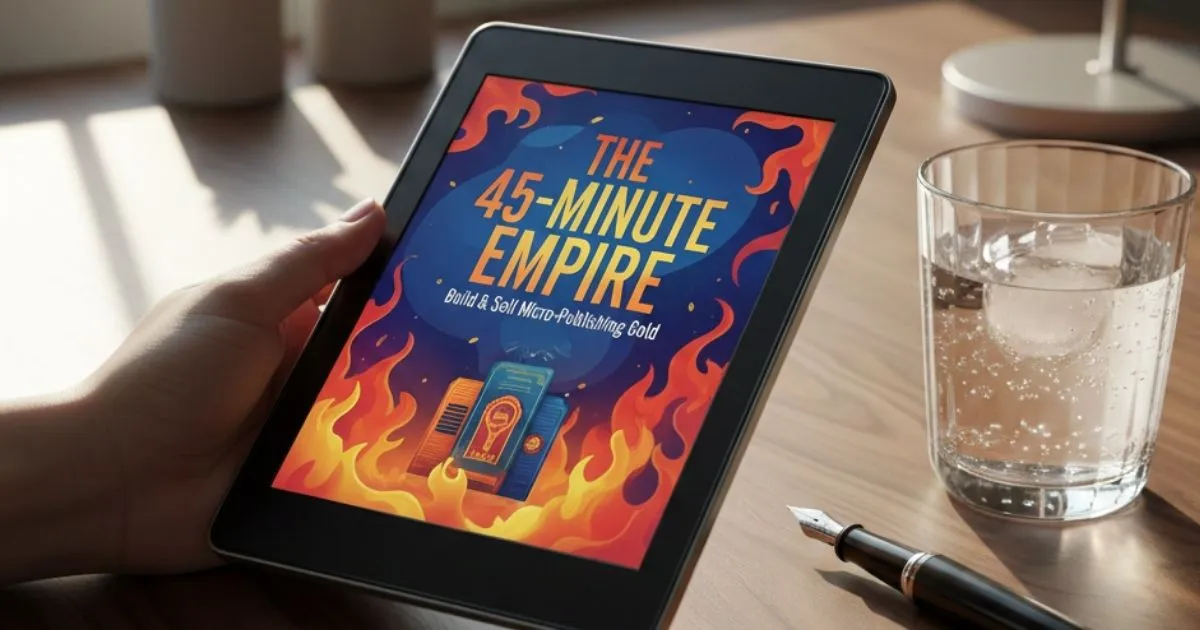
I was sitting in a terminal at O’Hare last Tuesday, watching a woman across from me devour a book on her Kindle. Her thumb was a blur, flicking the screen every twenty seconds. I checked my watch. By the time her flight was called fifteen minutes later, she had finished the entire thing, closed the cover with a look of visible satisfaction, and walked toward the gate. She didn’t look like a casual reader. She looked like someone who had just checked a high-priority item off a to-do list. That is the face of the modern consumer. We are no longer in the era of the sprawling 400-page epic, at least not for the masses who move the needle on Amazon’s daily charts. We have entered the age of the Quick-read books, where the value is measured by the density of the experience rather than the weight of the paper.
For those of us looking at the digital landscape through the lens of asset acquisition and cash flow, this shift is more than just a change in literary taste. It is a fundamental restructuring of how digital real estate is valued. In 2026, the velocity of consumption has become the primary driver of algorithmic favor. Amazon does not just care that a book was bought. It cares that it was finished. When a reader completes a book in one sitting, the “read-through” signals sent to the A9 algorithm are deafening. It tells the system that this product is high-satisfaction, low-friction, and high-conversion. For a portfolio manager, a stable of these short-form assets is often more resilient than a single blockbuster novel that takes six months to write and three weeks for a customer to finish.
Capitalizing on Publishing Trends Through High Velocity Assets
The data from the first quarter of 2026 confirms what many of us suspected: the “middle” of the market is falling out. On one side, you have the prestige, leather-bound special editions that people buy for their shelves. On the other, you have the rapid-fire digital shorts that people buy for their commute. This bifurcation has created a massive opening for indie authors and savvy digital publishers who understand that publishing trends are currently favoring efficiency. We are seeing a surge in what I call “snackable” non-fiction and “pulp” fiction serials. These aren’t low-quality throwaways. In fact, the market is currently punishing low-effort AI content more harshly than ever. Readers want a human voice, but they want it delivered in a 45-minute window.
I recently spoke with a colleague who manages a high-six-figure KDP account. He isn’t looking for the next Great American Novel. He is looking for “niche dominance.” He finds a specific, underserved pocket of the market—perhaps something as granular as “sustainable urban balcony gardening for retirees”—and he floods it with three or four high-quality, 15,000-word guides. Because they are Quick-read books, his customers often buy the entire set in a single weekend. The cost of production for these assets is lower, the lead time is shorter, and the ROI is significantly more predictable than traditional publishing models. It is a volume game, but it is a volume game played with a surgeon’s precision.
The beauty of this model lies in the compounding nature of the Amazon ecosystem. Every time a reader finishes one of these shorts, Amazon’s recommendation engine immediately suggests the next one. This creates a closed loop of consumption. In a world where attention is the scarcest commodity, being able to capture a reader’s focus for an hour is often more profitable than trying to capture it for a month. We are seeing private equity groups and independent investors increasingly moving away from volatile “hit-driven” media and toward these steady, algorithmically-stable digital storefronts. It is about building a machine, not just a book.
Scaling Revenue with Amazon Short Reads and Strategic Positioning
Success in this space requires a shift in mindset from “writer” to “asset manager.” If you are looking at Amazon Short Reads as just a shorter version of a book, you are missing the point. These are tactical tools. In the current 2026 climate, a short read functions as a lead magnet, a brand builder, and a cash-flow engine all at once. The most successful players in the game right now are those who treat their Amazon presence like a diversified portfolio. They have “loss leaders” that are priced low to capture data and reviews, and “premium shorts” that solve specific, high-value problems for their audience.
I’ve noticed that the most resilient accounts—the ones that survive the inevitable algorithm shifts—are those that have professionalized every aspect of their operation. They aren’t just uploading Word docs. They are using high-end cover designers who understand mobile-first aesthetics. They are employing editors who specialize in “pacing,” ensuring that there is a hook on every page to prevent the dreaded “close-book” event. When you look at the backend of a top-performing short-read store, it looks less like a library and more like a high-conversion e-commerce site. The metrics they track—Amazon-attributed sales, page read velocity, and organic keyword ranking—are the same metrics any serious business owner would use to evaluate a physical storefront.
There is a certain quiet satisfaction in owning an asset that works while you sleep. I remember the first time I saw a niche KDP account go from a few hundred dollars a month to mid-four figures simply by shortening the content and increasing the publishing frequency. It wasn’t about working harder. It was about aligning with how people actually live their lives in 2026. People are busy. They are stressed. They are looking for quick wins. If you can provide that win in 10,000 words, they will reward you with their loyalty and, more importantly, their recurring spend.
As we look toward the latter half of the year, the barriers to entry are rising. The “gold rush” phase of simple uploads is over. The winners now are the ones who can marry high-quality content with professional-grade business systems. Whether you are building these stores from scratch or looking to acquire established, cash-flowing listings that already have the “flywheel” spinning, the direction of the market is clear. The future is short, it is fast, and it is incredibly profitable for those who know where to look.
We are standing at a crossroads where the traditional media world is struggling to keep up with the sheer speed of digital consumption. For the agile investor or the focused creator, this isn’t a crisis. It’s an invitation. The woman at the airport wasn’t just reading a book. She was participating in a multi-billion dollar shift in the global economy. I watched her walk away, already reaching for her phone, likely looking for the next title in the series. That’s the kind of customer I want. That’s the kind of asset I want to own.
The question isn’t whether the short-read market is viable. The question is how much of that market share you are willing to let someone else claim while you wait for the “perfect” time to enter. The best time was yesterday. The second best time is right now, while the algorithms are still hungry for more.
