
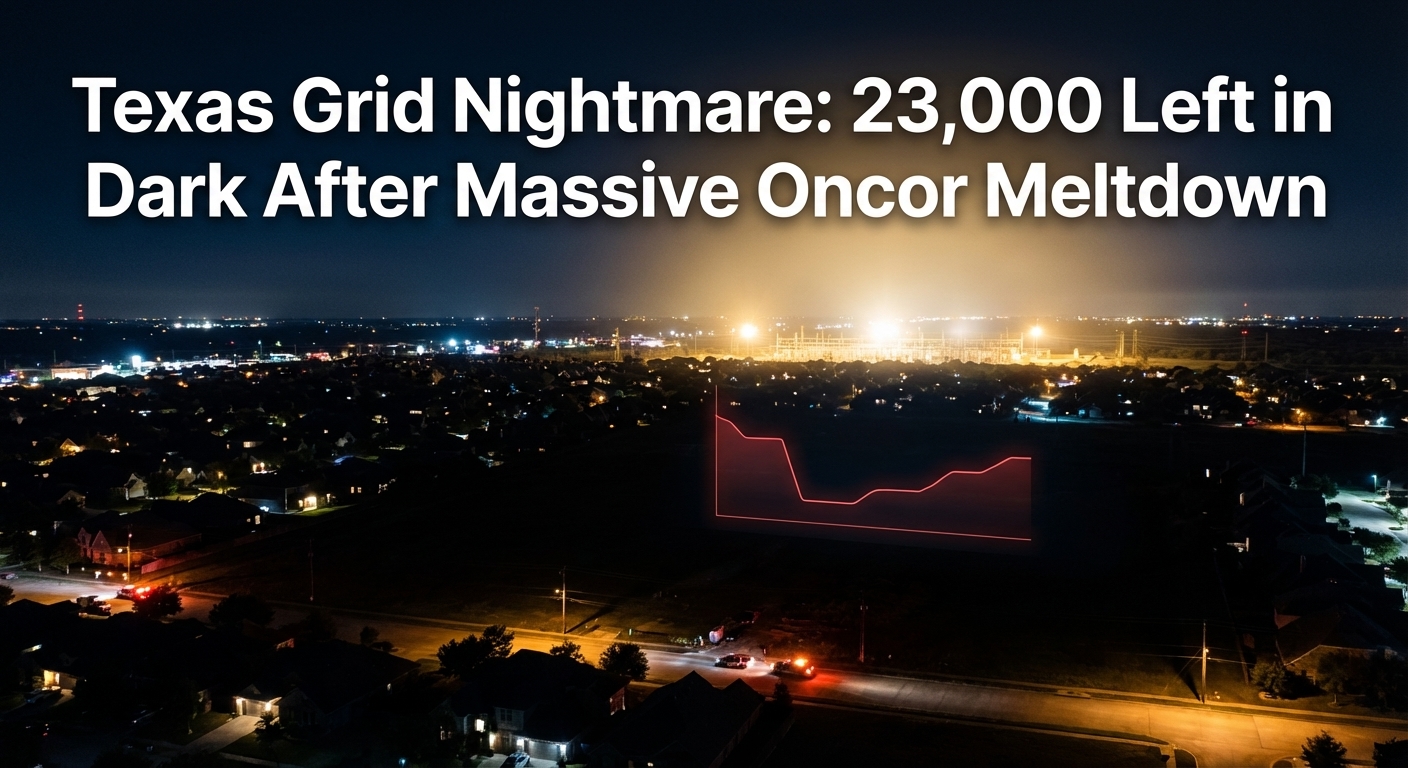
The Sudden Blackout Sweeping Across Dallas and Rockwall Counties
It’s the Sunday morning nightmare scenario for millions across Texas: the lights go out without warning. This past weekend, residents in Garland, Rockwall, and particularly the city of \*\*Rowlett\*\*, experienced this stark reality when a major power failure struck, crippling service for over 23,000 Oncor customers. This wasn’t a localized flicker caused by a squirrel on a transformer; this was a system-level shockwave tracing back to a critical fault on a main transmission line, an infrastructure vulnerability that always sends shivers down the spines of energy market watchers. The sheer scale of the disruption, hitting the heart of the densely populated Dallas-Fort Worth metroplex area on a weekend when families rely on consistent power for everything from air conditioning to cooking, underscores the fragile balance the Texas electric grid maintains, especially during periods of high demand or operational stress.
The initial impact reports were alarming. While Oncor’s official tracking initially suggested a high number across Dallas County, the consolidated picture painted by local authorities, including the city of \*\*Rowlett\*\*, placed the total affected customer count at a staggering 23,279 souls plunged into darkness. This rapid escalation from localized issue to regional crisis highlights the interconnected nature of modern electrical distribution. When a main transmission line fails due to what Oncor cited as an equipment issue, the resulting cascade effect forces immediate, often difficult, load shedding or complete circuit shutdowns to protect other parts of the aging infrastructure. The lack of an immediate Estimated Time of Arrival for restoration only amplifies consumer anxiety, transforming a temporary inconvenience into a genuine crisis of confidence in utility providers.
What makes this particular incident noteworthy for financial observers is its origin point: a primary transmission line failure. Distribution-level outages are common. Failures higher up the supply chain, closer to the generation or major substation nexus, signal deeper, more systemic problems within the network’s robustness. The fact that Oncor crews had to focus on immediate rerouting—a highly technical and time-sensitive maneuver designed to bypass the faulty segment—before full physical repairs could commence, demonstrates the razor’s edge the system operates on. Power restoration creeping back around noon suggests a successful, albeit delayed, isolation and successful grid reconfiguration, but the questions about preventative maintenance linger heavily.
Echoes of Past Failures: Comparing the Oncor Incident to Grid Vulnerabilities
To truly grasp the significance of Sunday’s outage affecting \*\*Rowlett\*\* and its neighbors, one must contextualize it against the backdrop of Texas’s recent energy history. We cannot discuss major power failures in the Lone Star State without acknowledging the catastrophic Winter Storm Uri in early 2021\. That event was fundamentally about generation capacity failure under sustained, extreme cold. This recent event, however, appears to be a pure infrastructure and maintenance failure under what were likely far more moderate weather conditions, making it a distinctly different, yet equally worrying, type of grid stress test. Uri was a test of scale and winter readiness; this is a test of daily operational reliability.
Consider the post-Uri regulatory environment. Billions of dollars were supposed to have been injected into hardening the grid, weatherizing power plants, and improving transmission resilience. When a high-profile equipment failure on a main transmission line causes such widespread disruption outside of a major weather event, it forces the conversation back to where that capital expenditure went. Was it prioritized incorrectly? Did the focus remain too heavily on generation winterization, neglecting crucial distribution and high-voltage transmission maintenance schedules? Investors and ratepayers alike are scrutinizing whether the lessons learned during the deep freeze have stuck when the weather pressure is off.
We have also seen smaller, yet significant, localized failures over the past few years related to aging equipment under high-summer cooling loads. This Sunday’s incident, occurring outside peak heat in the shoulder season or winter, suggests that equipment degradation or unforeseen catastrophic failure is a persistent systemic risk across the Oncor service area. The speed at which power returned—mostly by noon—is a slight positive indicator of the rerouting capabilities, but the initial 23,000 homes left hanging speaks volumes about the potential points of failure lurking in the network, silent until they inevitably decide to trip.
The Technical Why: Equipment Issues and Transmission Line Physics
When Oncor attributes a widespread outage to an “equipment issue on the transmission level,” they are signaling a problem far more complex than a downed tree branch. Transmission lines operate at extremely high voltages, moving massive amounts of power over long distances from generation sources to substations. The equipment here includes major circuit breakers, large power transformers, disconnect switches, and the conductor lines themselves. A failure in any of these components can necessitate a widespread shutdown of that entire line segment, as tripping safety mechanisms prevent uncontrolled arcing or equipment meltdowns which are significantly more hazardous and expensive to fix than a simple downed wire.
The process of electrical rerouting, which the spokesperson highlighted as their immediate strategy, is akin to emergency surgery on a complex circulatory system. Crews must manually or remotely operate switches across vast geographic areas to reassign the power flow to parallel lines that were previously running at a lower capacity or serving different zones. This requires precise real-time data mapping and coordination between control centers. The success of restoring power by noon indicates supreme competence in this emergency protocol, but the fact that the initial problem required such a massive reroute suggests the primary line segment was completely compromised, likely due to catastrophic insulator failure, conductor damage, or a major substation protection relay malfunction.
Furthermore, the widespread nature across Garland, Rockwall, and Dallas County implies that the faulted transmission line served as a major artery feeding multiple secondary substations which then distribute power to the affected regions. If that main artery shuts down, all downstream customers reliant solely on that feeder immediately lose service. This highlights the lack of complete redundancy in certain critical feed paths within the regional network topology. True grid resilience demands multiple, independently sourced paths to every major distribution point, and this incident suggests at least one path proved insufficiently redundant.
Market Psychology and Investor Scrutiny Post-Outage
The immediate fallout of an event like this extends beyond neighborhood disruption; it impacts investor confidence in the utility holding companies that own these assets. While \*\*Oncor\*\* is regulated, systematic reliability issues translate directly into increased regulatory risk, potential fines, and negative sentiment among Environment, Social, and Governance focused investors. These large infrastructure plays rely on predictable operational records to justify their valuation multiples. Each significant unscheduled outage forces analysts to recalculate the operational risk premium associated with owning shares in the parent companies.
For competitive energy markets like ERCOT, these reliability failures inject uncertainty, which is poison to long-term capital investment decisions. Developers looking to build new solar farms or battery storage installations need stability assurance. If the primary transmission network shows high volatility during non-crisis periods, it signals bottlenecks upstream of new generation interconnection points, potentially slowing down or increasing the cost of integrating cleaner energy sources into the grid—a strategic priority for Texas’s long-term economic development.
The transparency, or lack thereof, surrounding the specific equipment failure is also a watch item. While Oncor provided a general description, investors require specifics on asset age, maintenance logs, and preventative replacement schedules for the component that failed. If the equipment was near the end of its designed lifecycle, this outage becomes a predictable outcome, signaling poor capital planning. If it was brand new, the failure points toward catastrophic manufacturing defects or severe installation errors, which carry different, but equally serious, legal and operational repercussions.
Forecasting the Next Three Scenarios for Grid Reliability
Moving forward, there are three distinct paths the Texas grid reliability narrative attached to this incident could take. The first, and most optimistic scenario, involves immediate, decisive action. Oncor quickly identifies the root cause—say, a faulty batch of insulators—and mandates an accelerated replacement program across all similar equipment sets throughout the service territory. This proactive capital deployment satisfies regulators and stabilizes investor perception, leading to a swift recovery in confidence, perhaps bolstered by slightly higher but justified rate recovery applications for infrastructure hardening.
The second, middle-ground scenario involves bureaucratic inertia and delayed response. Fixing the immediate component is done, but the comprehensive audit and mandatory replacement schedules are slowed by regulatory review cycles or competing infrastructure demands. In this case, we continue to see smaller, sporadic outages in the following months in areas served by similar vintage equipment. The market incorporates a persistent, low-grade reliability discount into utility stock pricing, reflecting ongoing operational uncertainty, and consumer frustration remains high, leading to increased political pressure on the Public Utility Commission.
The third, most troubling scenario is that the equipment failure points to a deep, fundamental flaw in the design or maintenance philosophy of the wider aging transmission network that impacts multiple utility territories beyond Oncor’s immediate control. This opens the door for massive, multi-year, multi-billion-dollar mandated grid overhaul projects across ERCOT. While this ensures long-term stability, it guarantees significant short-term rate hikes which will become a major political and economic wedge issue in Texas, potentially slowing industrial expansion due to anticipated rising operational costs for energy-intensive businesses now eyeing the region.
Ultimately, while the lights came back on for those 23,000 customers, reminding Texans how quickly modern comforts can vanish remains the core lesson. The performance of the utility sector, under the constant gaze of regulators and the demanding expectations of a rapidly growing populace, hinges on these moments of crisis. The success in rerouting averted a multi-day disaster, but the underlying condition of the critical infrastructure remains the central, unresolved financial mystery of the Texas power landscape.
FAQ
How many Oncor customers were initially left without power during the recent massive outage?
Over 23,000 Oncor customers were plunged into darkness across the impacted service areas. The precise consolidated number reported by local authorities reached 23,279 affected accounts.
Which specific counties or cities were primarily affected by this widespread power failure?
The primary disruption swept across Garland, Rockwall County, and notably impacted the city of Rowlett. The initial impact reports also cited widespread issues within Dallas County before consolidation.
What was the primary cited reason for the large-scale power disruption, according to Oncor?
Oncor attributed the failure to a critical fault on a main transmission line, specifically citing an equipment issue at the transmission level. This indicates a problem higher up the supply chain than typical localized distribution faults.
How does this recent incident functionally differ from the catastrophic Winter Storm Uri event in 2021 analyzed in the article?
Winter Storm Uri represented a failure of generation capacity under sustained extreme cold, whereas this incident appears to stem from infrastructure and maintenance failure under seemingly more moderate weather conditions.
What immediate, short-term strategy did Oncor utilize to begin restoring power to the affected 23,000 homes?
Oncor’s immediate focus was on electrical rerouting, a highly technical maneuver to isolate the faulty segment and shift power flow onto parallel transmission lines. This process protects the wider grid while physical repairs are organized.
Around what time did the power restoration efforts begin to bring service back to the majority of the affected customers?
Power restoration efforts began creeping back around noon after the initial blackout occurred. This suggests the emergency rerouting procedures were largely successful in isolating the fault.
What specific equipment failures are suggested when transmission-level outages occur, as opposed to simple distribution issues?
Transmission-level faults often involve major components like large power transformers, circuit breakers, or catastrophic insulator failures. These failures necessitate wide shutdowns to prevent uncontrolled arcing or equipment meltdowns.
What critical concept related to grid reliability does the initial power failure highlight regarding Texas’s network topology?
The widespread nature of the outage suggests a lack of complete redundancy in certain critical feed paths serving the regional network. True resilience requires multiple independently sourced paths to every major distribution point.
What impact might this reliability failure have on investor sentiment regarding utility holding companies?
Systematic reliability issues translate directly into increased regulatory risk, potential fines, and negative sentiment among ESG-focused investors. Analysts must recalculate the operational risk premium associated with utility stock ownership.
For energy market watchers, what does a failure on a main transmission line signal about the grid’s current status?
It signals deeper, more systemic problems concerning the network’s robustness compared to common distribution-level outages. It forces scrutiny on the health of high-voltage infrastructure.
How does the performance of utility providers during non-crisis outages affect decisions regarding new energy generation integration?
High volatility in the primary transmission network signals upstream bottlenecks, potentially increasing the cost or slowing down interconnection for new solar farms or battery storage projects.
What is the most optimistic forecasting scenario for grid reliability following this specific equipment failure?
The optimistic path involves Oncor immediately identifying the root cause (e.g., a faulty batch of insulators) and mandating an accelerated, proactive replacement program across similar equipment sets.
What constitutes the ‘middle-ground’ scenario regarding the regulatory and market response in the coming months?
This involves bureaucratic inertia delaying comprehensive audits and mandatory replacement schedules, leading to sporadic smaller failures and a persistent low-grade reliability discount on utility stock pricing.
What is the most troubling long-term scenario suggested by this type of failure for Texas ratepayers?
The most troubling scenario is that the failure reveals a deep, fundamental flaw in the wider aging transmission design that necessitates massive, multi-year, multi-billion-dollar mandated overhauls. This guarantees significant short-term rate hikes.
Why did the lack of an immediate Estimated Time of Arrival (ETA) for restoration amplify consumer anxiety?
The lack of a confirmed restoration timeline transforms a temporary inconvenience into a genuine crisis of confidence in utility providers. It signals uncertainty about the scope of the required fix.
What information are investors particularly scrutinizing regarding the failed equipment after the incident?
Investors require specifics on asset age, maintenance logs, and preventative replacement schedules for the component that failed. This determines if the outage was predictable capital planning failure or a catastrophic defect.
If the failure was traced to brand-new equipment, what different operational repercussions might that imply for Oncor?
New equipment failure points toward severe issues such as catastrophic manufacturing defects or significant installation errors. These carry distinct legal and operational liabilities compared to aging asset failure.
What risks does the fragile balance of the Texas grid maintain, especially during periods of high demand?
The fragile balance means that the system is highly susceptible to operational stress, where an unexpected infrastructure fault can trigger cascading failures impacting major metropolitan areas.
What is the purpose of the emergency protocol requiring crews to isolate and reroute power flow on a transmission line?
This protocol is designed to prevent uncontrolled damage to the entire segment and protect other vital parts of the aging infrastructure from secondary failures caused by the initial trip.
How does the concept of load shedding relate to the protective measures taken during the Oncor transmission line fault?
Load shedding might be a necessary step if rerouting cannot immediately compensate for the lost capacity, forcing the utility to intentionally cut power to specific segments to stabilize the rest of the system.
Beyond immediate repair competence, what larger question does this event force regulators and the public to address?
The performance forces a review of whether mandated capital expenditures post-Uri were prioritized correctly, specifically questioning if transmission and distribution maintenance were neglected in favor of generation winterization.
