
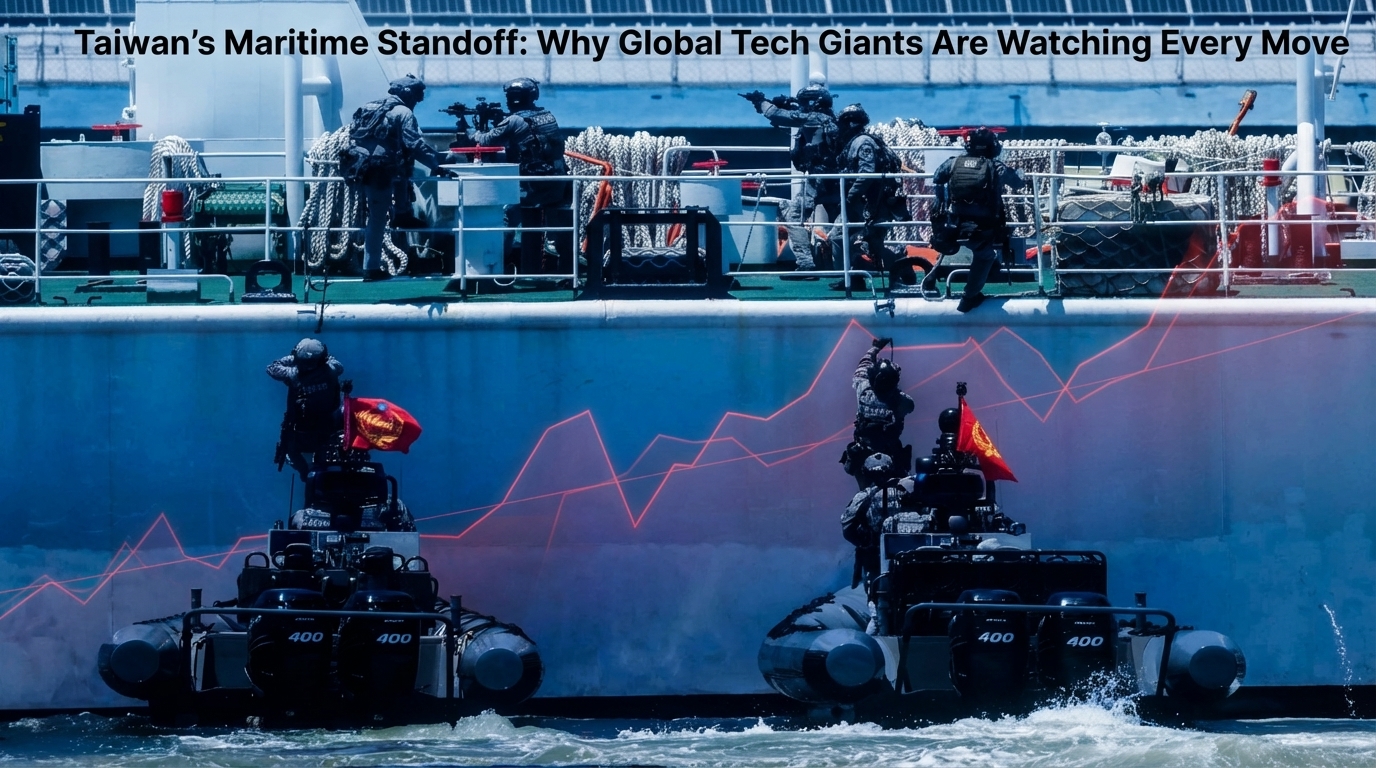
The global economy hinges on stability in the Taiwan Strait, a fact that often gets lost amid quarterly earnings reports and interest rate whispers. But right now, the tension is palpable, translating not just into geopolitical risk premiums on stocks, but into tangible, high-stakes military preparations. What is bubbling beneath the surface of diplomatic communiqués is a very real, very serious escalation in maritime readiness. As Beijing runs sophisticated drills mimicking a full naval encirclement, the quiet pivot happening within Taiwan’s own maritime defenses is the story that financial markets are willfully ignoring, perhaps until it is too late to absorb the shock.
The real news here is not the shadow boxing of the superpowers, but the determined, boots-on-the-water response from the island’s law enforcement backbone—the Coast Guard. We are seeing a strategic transformation, moving this agency from maritime policing duties into a credible, integrated component of national defense. Deputy Minister Sung Chen-En of the Ocean Affairs Council has been explicit: the perception of a slow, soft encroachment by China’s increasing gray-zone tactics is dangerously misleading. The rehearsal for a blockade is not hypothetical; it is operational practice. This realization forces every sector reliant on the free flow of goods through the Strait—from semiconductors to consumer electronics—to face an uncomfortable truth about their supply chain fragility.
The Gray Zone Meets the Hard Reality of Maritime Law
China’s strategy relies on applying constant, low-level strategic pressure, utilizing its Coast Guard vessels—often larger and better armed than those of neighboring nations—to enforce administrative control without officially crossing the threshold into open warfare. This gray zone strategy seeks to normalize coercion, slowly extending Beijing’s maritime claims until international maritime law becomes effectively irrelevant around Taiwan’s territorial waters. This is where the stakes become intensely financial. If Taiwan’s Coast Guard cannot effectively assert its presence against encroaching Chinese vessels, the de facto effective sovereignty of the waters surrounding key industrial hubs and shipping lanes changes overnight.
Taiwan’s response, as detailed by high-level officials, is focused on capability boosting and deep integration. This means more than just new patrol boats. It involves rigorous, combined training exercises with the Taiwanese military itself, blurring the line between coast guard operations and military maritime defense. This co-ordination ensures that in a crisis scenario—where the traditional rules of engagement during peacetime policing might not apply—the response is unified, immediate, and professional. This shift is critical because it raises the cost for any aggressive maneuver by Beijing, however subtle.
Furthermore, the outreach to allies is significant. Cooperation with the U.S., Japanese, and Philippine counterparts signals the creation of an interlocking security network around vital sea lanes, countering the narrative of isolation Beijing seeks to impose. For traders watching the TAIEX, this international commitment represents a crucial backstop. The markets might be pricing in geopolitical risk conservatively now, but a demonstrable security pact enhances investor confidence—or reveals the lack thereof—in Taiwan’s ability to maintain external access during a crisis.
Historical Parallels: Remembering Blockades That Changed the World
To understand the severity of the present moment, one must look back at historical precedents where maritime exclusion successfully crippled economies. The Suez Crisis of 1956 serves as a stark example. While political, the physical blockage of the canal immediately halted global oil transport, sending energy prices skyrocketing and fundamentally altering international trade routes and insurance markets for years. Taiwan, which sits adjacent to one of the world’s busiest shipping chokepoints, faces a scenario where the waterway itself becomes inaccessible, not due to a sunken vessel, but due to intentional legalistic and physical enforcement.
Consider also the post-World War II history of contested sea lanes in the South China Sea. Decades of slow militarization and administrative enforcement by dominant powers eventually led to the establishment of new norms, often detrimental to smaller nations. Taiwan’s current effort is a determined pushback against this historical pattern, an attempt to establish high-cost deterrence before a fait accompli is achieved through relentless, low-consequence gray-zone activities. The readiness displayed by the Coast Guard on March 16 and beyond is a direct response to observing how previous geopolitical actors successfully asserted control through persistence rather than mass kinetic force.
The Cuban Missile Crisis, while a land-based confrontation, featured a naval “quarantine”—a blockade rebranded for political palatability. The key lesson was how quickly escalating tension around maritime access can lead to an immediate, global economic panic. The preparation being undertaken by the Taiwanese Coast Guard is intended to make any attempt at a similar quarantine prohibitively difficult, raising the probability of miscalculation and confrontation early in the process. Financial markets must reckon with the fact that readiness often preempts conflict, but the road to readiness is inherently unstable.
The Semiconductor Lifeline: Why This Defense Matters to Silicon Valley
The entire global semiconductor industry runs on the assumption of secure transit through the Taiwan Strait. TSMC, the world’s leading contract chipmaker, does not just supply chips; it supplies the foundational technology for artificial intelligence, advanced computing, and modern defense systems globally. Any disruption, even a temporary blockade, would cause an immediate, catastrophic supply shock far exceeding the COVID-era chip shortage.
The economic modeling around a full blockade reveals frightening figures. Analysts estimate that the immediate shutdown of major semiconductor fabrication plants due to shipping disruptions, coupled with the inability to import critical materials like neon gas or advanced lithography components, would erase trillions of dollars from global GDP within six months. This financial implication transforms the Taiwanese Coast Guard’s mission from a domestic security issue into a systemic risk event for every major global index, including the Dow, the FTSE, and the Nikkei.
The Coast Guard’s training in intercept and deterrence directly safeguards the physical pathway for specialized crews, engineers, and the necessary consumables required to keep those fabrication facilities running. Imagine an emergency shipment of specialized chemicals needed to prevent a $20 billion factory line from overheating. If Beijing’s blockade attempt successfully impedes even a small, nimble Coast Guard vessel carrying that high-priority cargo, the resulting economic damage dwarfs the cost of decades of military modernization efforts across the region. This readiness is preventative medicine for the global tech spine.
The cooperation with the U.S. Navy and the Japan Coast Guard in joint exercises sends a clear signal: this maritime security effort is viewed by key Western allies as an extension of vital strategic infrastructure protection. For investors betting on the resilience of technology stocks, the subtle, non-headline grabbing activities of maritime law enforcement along this critical seam are far more predictive of future market stability than any pronouncements made in political capitals.
Scenario Planning: Three Futures Beyond March 16
Financial analysts charting geopolitical risk must model several distinct outcomes stemming from this increasing maritime tension. The first scenario, the “Managed Deterrence” path, relies on the success of Taiwan’s dual strategy: improving its Coast Guard capabilities while solidifying international legal and operational frameworks with partners. In this outcome, Beijing finds the cost-benefit analysis of aggressive gray-zone action turning negative. Encounters remain tense, but they remain below the threshold of kinetic conflict, leading to elevated but manageable risk premiums in the TAIEX. Global markets settle into a state of wary acceptance of heightened tension.
The second scenario, the “Accidental Escalation,” is perhaps the most dangerous for immediate market stability. As both sides practice maneuvers in close proximity, the margin for error shrinks dramatically. A momentary lapse in communication, a misidentified radar signal, or an aggressive push by a heavily armed Chinese vessel against a heavily integrated Taiwanese Coast Guard patrol—especially around the crucial dates like March 16—could lead to a low-level collision or the deployment of force not intended for escalation. This event, while perhaps not leading to full war, would trigger an instant flight to safety reminiscent of early 2020, freezing credit markets and causing energy futures to spike violently as blockade risks materialize instantly.
The third and darkest outcome projections leads to the “Effective De Facto Blockade.” This unfolds not with warships sinking vessels, but with Beijing successfully using bureaucratic, legal, and sheer force-of-presence tactics—backed by its large Coast Guard fleet—to effectively choke off non-military traffic. Insurance costs skyrocket to prohibitive levels; many commercial shipping insurers simply refuse coverage. Global logistics firms reroute entirely, bypassing the region. This immediately halts high-tech exports and crucial imports, triggering a recessionary shock across Asia and Europe dependent on those inputs. Taiwan’s economy, critically reliant on maritime trade, would enter a severe contraction, forcing global conglomerates to rapidly onshore or nearshore essential production chains in a chaotic, expensive rush.
The preparation underway by Taiwan’s maritime forces is a desperate, necessary gamble to prevent the third scenario from materializing. Their success hinges on capability, coordination, and the credibility of international support. Every analyst covering Asian supply chains is now watching the waves around the island, paying closer attention to coast guard maneuvers than to central bank commentary.
FAQ
What is the primary focus of Taiwan’s current, often overlooked, military buildup?
The primary focus is a strategic transformation of the Taiwanese Coast Guard, moving it from routine policing duties into a credible, integrated component of national defense.
What specific tactic is China employing that poses the greatest risk to Taiwan’s maritime control?
China is utilizing a ‘gray-zone strategy,’ which involves constant, low-level strategic pressure and using its Coast Guard to enforce administrative control without officially triggering warfare.
How does Deputy Minister Sung Chen-En characterize the threat posed by China’s gray-zone tactics?
He explicitly states that the perception of slow, soft encroachment is dangerously misleading and that the rehearsal for a blockade is already an operational practice.
What historical event does the article cite as an example of a maritime exclusion crippling a global economy?
The Suez Crisis of 1956 is cited, where the physical blockage of the canal immediately halted global oil transport and fundamentally altered international trade routes.
Why is the Taiwanese Coast Guard’s pivot particularly significant regarding international maritime law?
China’s gray-zone strategy aims to normalize coercion until international maritime law effectively becomes irrelevant around Taiwan’s specified territorial waters.
What practical response is Taiwan implementing to counter China’s gray-zone pressure?
Taiwan is focusing on capability boosting and deep integration, involving rigorous, combined training exercises with the Taiwanese military itself.
Besides internal integration, what external strategy is Taiwan employing to bolster its maritime position?
Taiwan is actively pursuing outreach and cooperation with allies, including the U.S., Japan, and the Philippines, to create an interlocking security network.
What specific economic sector faces the most catastrophic supply shock risk from a Taiwan Strait disruption?
The global semiconductor industry is at highest risk, as disruption would immediately halt the supply of foundational technology for AI and advanced defense systems.
According to analysts cited, what is the estimated financial impact of a full blockade on global GDP within six months?
Modeling suggests that the immediate shutdown of fabrication plants and shipping halts could erase trillions of dollars from global GDP within six months.
What is the crucial logistical link that the Coast Guard’s enhanced readiness is directly intended to safeguard?
The Coast Guard’s deterrence directly protects the physical pathways for the specialized crews, engineers, and critical consumables needed to keep semiconductor fabrication facilities operational.
What is the key lesson drawn from the Cuban Missile Crisis regarding maritime access?
The crisis demonstrated how quickly escalating tension around maritime access—rebranded as a ‘quarantine’—can lead to immediate, worldwide economic panic.
If the ‘Managed Deterrence’ scenario succeeds, what immediate effect should investors expect in the TAIEX?
Risk premiums are expected to remain elevated but manageable, settling the global markets into a state of wary acceptance of the heightened tension.
What defines the ‘Accidental Escalation’ scenario as the most dangerous for immediate market stability?
This scenario hinges on a momentary lapse in communication or misidentification during practice maneuvers, leading to a low-level collision that instantly validates blockade risks.
What happens in the ‘Effective De Facto Blockade’ scenario if warships are not involved?
Beijing successfully uses bureaucratic and force-of-presence tactics to choke off non-military traffic, causing insurance companies to refuse coverage for commercial shipping.
How will commercial insurers react if a de facto blockade is established around Taiwan?
Insurance costs will skyrocket to prohibitive levels, leading many commercial shipping insurers to simply refuse to provide coverage for passage through the Strait.
What strategic narrative is China attempting to impose through its maritime actions?
Beijing seeks to impose a narrative of isolation around Taiwan, which Taiwan is attempting to counter through international security cooperation.
What is the significance of the date March 16 mentioned in the article?
March 16, along with other critical dates, represents a point where the readiness displayed by the Coast Guard is a direct response to observing how assertiveness can create geopolitical facts-on-the-ground.
How is Taiwan attempting to raise the ‘cost’ for Beijing’s aggressive maneuvers?
By blurring the line between Coast Guard duties and military defense through combined training, Taiwan ensures the response to any aggressive act is immediate, unified, and professionally escalated.
Why are current Coast Guard activities considered more predictive of market stability than political capital pronouncements?
The subtle, non-headline grabbing activities along the Strait are directly protective of the physical infrastructure and trade routes upon which technology stocks depend.
What historical pattern is Taiwan attempting to actively push back against with its readiness efforts?
Taiwan is pushing back against historical patterns seen in the South China Sea where dominant powers established detrimental new norms through relentless, low-consequence gray-zone activities.
What is the core difference between the Coast Guard’s traditional role and its current defensive integration?
Traditionally focused on maritime policing, the Coast Guard is now deeply integrated with the military to ensure a unified, immediate response capability during crisis scenarios where peacetime rules of engagement may fail.
What is the primary focus of Taiwan’s current, often overlooked, military buildup?
The primary focus is a strategic transformation of the Taiwanese Coast Guard, moving it from routine policing duties into a credible, integrated component of national defense.
What specific tactic is China employing that poses the greatest risk to Taiwan’s maritime control?
China is utilizing a ‘gray-zone strategy,’ which involves constant, low-level strategic pressure and using its Coast Guard to enforce administrative control without officially triggering warfare.
How does Deputy Minister Sung Chen-En characterize the threat posed by China’s gray-zone tactics?
He explicitly states that the perception of slow, soft encroachment is dangerously misleading and that the rehearsal for a blockade is already an operational practice.
What historical event does the article cite as an example of a maritime exclusion crippling a global economy?
The Suez Crisis of 1956 is cited, where the physical blockage of the canal immediately halted global oil transport and fundamentally altered international trade routes.
Why is the Taiwanese Coast Guard’s pivot particularly significant regarding international maritime law?
China’s gray-zone strategy aims to normalize coercion until international maritime law effectively becomes irrelevant around Taiwan’s specified territorial waters.
What practical response is Taiwan implementing to counter China’s gray-zone pressure?
Taiwan is focusing on capability boosting and deep integration, involving rigorous, combined training exercises with the Taiwanese military itself.
Besides internal integration, what external strategy is Taiwan employing to bolster its maritime position?
Taiwan is actively pursuing outreach and cooperation with allies, including the U.S., Japan, and the Philippines, to create an interlocking security network.
What specific economic sector faces the most catastrophic supply shock risk from a Taiwan Strait disruption?
The global semiconductor industry is at highest risk, as disruption would immediately halt the supply of foundational technology for AI and advanced defense systems.
According to analysts cited, what is the estimated financial impact of a full blockade on global GDP within six months?
Modeling suggests that the immediate shutdown of fabrication plants and shipping halts could erase trillions of dollars from global GDP within six months.
What is the crucial logistical link that the Coast Guard’s enhanced readiness is directly intended to safeguard?
The Coast Guard’s deterrence directly protects the physical pathways for the specialized crews, engineers, and critical consumables needed to keep semiconductor fabrication facilities operational.
What is the key lesson drawn from the Cuban Missile Crisis regarding maritime access?
The crisis demonstrated how quickly escalating tension around maritime access—rebranded as a ‘quarantine’—can lead to immediate, worldwide economic panic.
If the ‘Managed Deterrence’ scenario succeeds, what immediate effect should investors expect in the TAIEX?
Risk premiums are expected to remain elevated but manageable, settling the global markets into a state of wary acceptance of the heightened tension.
What defines the ‘Accidental Escalation’ scenario as the most dangerous for immediate market stability?
This scenario hinges on a momentary lapse in communication or misidentification during practice maneuvers, leading to a low-level collision that instantly validates blockade risks.
What happens in the ‘Effective De Facto Blockade’ scenario if warships are not involved?
Beijing successfully uses bureaucratic and force-of-presence tactics to choke off non-military traffic, causing insurance companies to refuse coverage for commercial shipping.
How will commercial insurers react if a de facto blockade is established around Taiwan?
Insurance costs will skyrocket to prohibitive levels, leading many commercial shipping insurers to simply refuse to provide coverage for passage through the Strait.
What strategic narrative is China attempting to impose through its maritime actions?
Beijing seeks to impose a narrative of isolation around Taiwan, which Taiwan is attempting to counter through international security cooperation.
What is the significance of the date March 16 mentioned in the article?
March 16, along with other critical dates, represents a point where the readiness displayed by the Coast Guard is a direct response to observing how assertiveness can create geopolitical facts-on-the-ground.
How is Taiwan attempting to raise the ‘cost’ for Beijing’s aggressive maneuvers?
By blurring the line between Coast Guard duties and military defense through combined training, Taiwan ensures the response to any aggressive act is immediate, unified, and professionally escalated.
Why are current Coast Guard activities considered more predictive of market stability than political capital pronouncements?
The subtle, non-headline grabbing activities along the Strait are directly protective of the physical infrastructure and trade routes upon which technology stocks depend.
What historical pattern is Taiwan attempting to actively push back against with its readiness efforts?
Taiwan is pushing back against historical patterns seen in the South China Sea where dominant powers established detrimental new norms through relentless, low-consequence gray-zone activities.
What is the core difference between the Coast Guard’s traditional role and its current defensive integration?
Traditionally focused on maritime policing, the Coast Guard is now deeply integrated with the military to ensure a unified, immediate response capability during crisis scenarios where peacetime rules of engagement may fail.
