
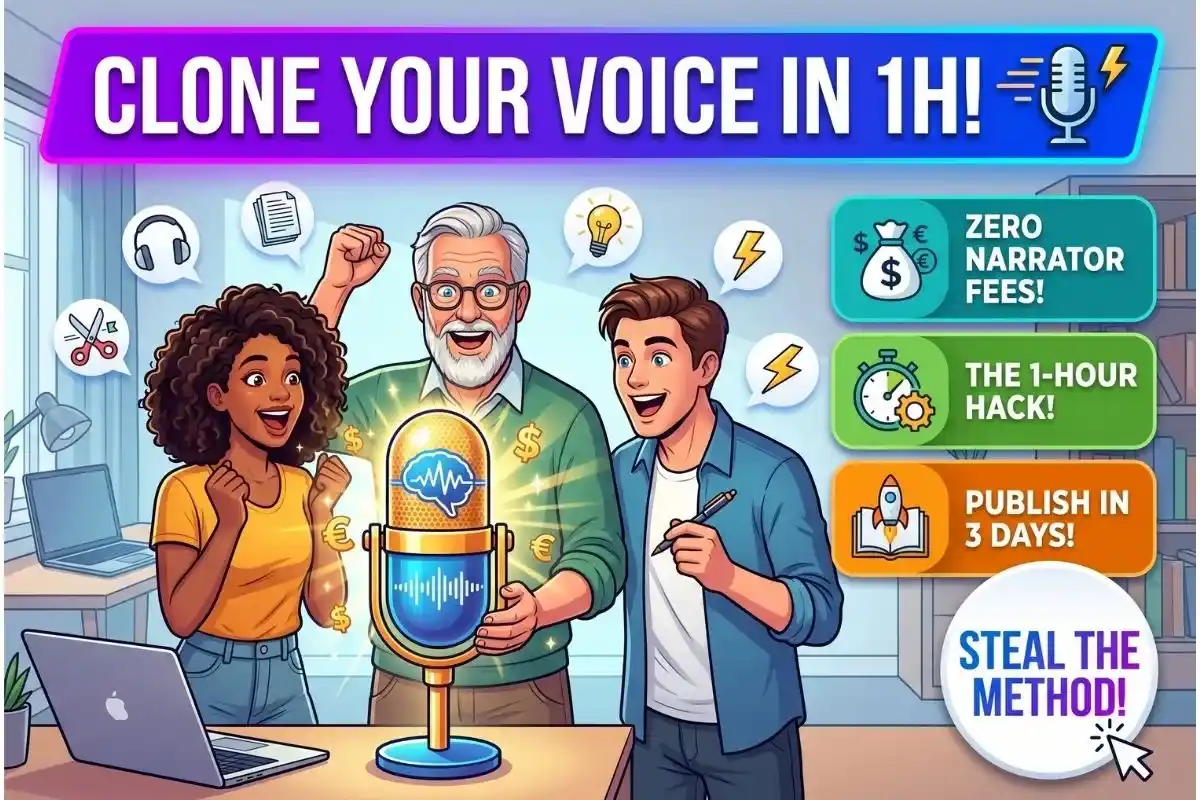
Imagine pouring your heart and soul into writing a novel, spending countless nights refining every sentence, only to hit a massive financial wall when you want to share it with listeners. For decades, authors have faced this exact dilemma. Transforming a written manuscript into a captivating audiobook traditionally meant shelling out thousands of dollars for professional voice actors, booking expensive studio time, and hiring specialized sound engineers to polish the audio. It was an elite club, often locking independent creators entirely out of the fastest-growing segment of the publishing industry. But what if you could narrate your entire book using your own voice, without spending weeks locked in an isolated sound booth? Today, the landscape of storytelling is undergoing a seismic shift. Welcome to the era where cutting-edge technology allows you to digitize your vocal cords. This isn’t science fiction anymore; it is the reality of modern publishing. Through a process that feels almost like magic, you can now create a perfect digital replica of your voice, ready to read your masterpiece aloud flawlessly.
The Magic and Mechanics of AI Voice Cloning
At the heart of this incredible revolution is AI Voice Cloning, a technology that sounds incredibly futuristic but is becoming remarkably accessible to everyday users. To understand how this works, picture a highly advanced computer program that listens to you speak—not just to hear the basic words, but to map the unique cadence, pitch, breath patterns, and emotional resonance of your personal sound. In the past, computer-generated speech sounded clunky, robotic, and completely devoid of human warmth, reminding us of old automated weather broadcasts.
However, modern artificial intelligence utilizes complex deep learning algorithms to analyze the microscopic nuances of human speech. By feeding the software a sample of your voice, the system actively learns your specific vocal fingerprint. It captures the way you naturally breathe between sentences, the subtle vocal fry at the end of your words, and the unique emphasis you place on certain syllables depending on the context. Once this digital clone is seamlessly generated, you simply upload your text, and the artificial intelligence speaks it back to you exactly as you would. The best part is that your digital clone never experiences vocal fatigue, never stutters, and completely eliminates the need for frustrating retakes.
Transforming Audiobook Production for Independent Authors
For independent authors and small publishing houses, the traditional process of audiobook production has always been a daunting endeavor fraught with logistical nightmares and steep expenses. Hiring a reputable, professional narrator can easily cost anywhere from two hundred to over four hundred dollars per finished hour of audio. When you consider that a standard fantasy or thriller novel might run fifteen hours or more, the upfront financial barrier quickly becomes insurmountable for many self-published writers trying to build a career from the ground up.
Furthermore, managing the scheduling, coordinating the back-and-forth for corrections, and dealing with the sheer time it takes to get a polished product can delay a highly anticipated book launch by several months. The introduction of synthetic voice technology completely bypasses this agonizing bottleneck. Authors are no longer dependent on the busy schedules or high hourly rates of professional voice actors. You can essentially become your own narrator, preserving the deeply authentic connection between the creator and the audience. If your nonfiction book requires your particular tone of personal authority, your cloned voice can deliver it perfectly, democratizing the entire storytelling process.
The Reality of Cheap Audio Publishing
When we discuss the rising trend of cheap audio publishing, it is crucial to emphasize that a dramatically lower cost no longer equates to a lower quality experience for the end listener. In the early days of synthetic narration, discerning listeners could easily spot the robotic monotone, leading to harsh reviews and poor sales for the authors who attempted to cut corners. However, today’s high-fidelity voice models are virtually indistinguishable from organic human speech to the untrained ear, complete with appropriate pacing and lifelike emotional inflection.
This highly cost-effective approach allows authors to experiment with audio formats for works that might not have previously justified a massive financial investment, such as short story collections, novellas, or episodic serialized fiction. By utilizing modern subscription-based platforms, an author can generate an entire, professional-grade audiobook for a mere fraction of the cost of traditional methods. This newfound affordability opens up a vast world of possibilities for reaching busy audiences who strongly prefer to consume their content while commuting or working out. Moreover, making literature easily available in audio format is a crucial step for global accessibility, ensuring visually impaired readers can enjoy the exact same stories as everyone else.
The One-Hour Process and Legal Considerations
Perhaps the most astonishing aspect of modern voice synthesis is the blinding speed at which it operates. You no longer need to spend weeks reading into a microphone to provide enough data for the machine to understand your speech patterns. Most leading, state-of-the-art platforms only require about sixty minutes of high-quality audio recording to get started. You simply sit in a quiet room equipped with a decent USB microphone, read a dynamically generated script designed to cover a wide array of phonetic sounds, and hit submit.
The AI works its computational magic in the background, crunching millions of data points to build your voice model. However, this immense power brings significant legal and ethical considerations to the forefront of the publishing industry. The ability to clone a voice so quickly has raised valid red flags regarding consent, privacy, and copyright infringement. As agencies like the U.S. Copyright Office continue to closely examine the complex intersection of artificial intelligence and intellectual property, creators must ensure they act responsibly. Reputable platforms enforce strict verification steps, often requiring the user to read a specific legal disclaimer aloud on camera to prove they are present and consenting to the clone.
The Future of Narration and Human Artistry
Despite the incredible, undeniable advancements in this audio technology, it is incredibly important to acknowledge the ongoing, passionate debate regarding the future of human voice actors and traditional performers. Will artificial intelligence completely replace the need for professional narrators in the near future? The general consensus among seasoned industry experts is a nuanced, reassuring “no.”
While an AI clone is absolutely perfect for straightforward nonfiction, educational materials, and independent authors operating on a shoestring budget, human narrators still possess a unique, irreplaceable artistic spark when it comes to highly dramatic fiction. A computer can mimic the sound of sadness, but an experienced stage actor brings a lifetime of genuine human experience, empathy, and raw emotion to a tearful monologue. Therefore, the rapid rise of synthetic voices should primarily be viewed as an exciting expansion of the audio market rather than a complete, dystopian replacement of human artistry. It provides an essential, powerful tool for those who previously had no options available to them, while the premium market for artisanal, human-narrated dramatic performances will undoubtedly continue to thrive.
Comparing the Formats: Traditional vs. AI
To truly understand the shift in the publishing landscape, it helps to look at the raw data. Here is a breakdown of what authors can expect when choosing between traditional narration and modern AI voice synthesis.
| Feature | Traditional Audiobook Production | AI Voice Cloning |
| Average Cost | $3,000 – $6,000+ per book | $20 – $100 per month (Subscription) |
| Production Time | 2 to 4 months | 1 to 3 days |
| Voice Creation | Casting and hiring actors | 1 hour of personal voice training |
| Revisions | Costly and requires re-booking studio time | Instant text edits at no extra cost |
| Best Used For | High-emotion fiction, full-cast dramas | Non-fiction, indies, rapid-release series |
Frequently Asked Questions (FAQ)
- Is AI voice cloning actually legal to use for my books? Yes, provided you are cloning your own voice or have explicit, documented legal permission from the person whose voice you are cloning. Distributing a cloned voice of someone else without their consent violates platform terms of service and various privacy laws.
- Will listeners be able to tell that a computer is reading to them? Technology has advanced to the point where casual listeners usually cannot distinguish a high-quality AI clone from a human reading standard prose. However, heavily dramatic or emotionally complex dialogue may still lack the nuanced performance of a trained human actor.
- Do I need an expensive recording studio to clone my voice? No. You only need a quiet room without echo and a decent quality microphone (many standard USB podcaster microphones work perfectly). The software is designed to filter out minor background noise and focus entirely on your vocal patterns.
The Final Curiosity: Your Voice as Data
It is a fascinating thought: the sound you use every single day to communicate with loved ones, order coffee, and express your deepest thoughts can now be translated into a mathematical equation. When an AI analyzes your speech during that single hour of recording, it extracts over millions of distinct audio features per second. It maps your pitch, the specific resonance of your nasal cavity, and the exact way your tongue strikes your teeth. By turning the most human part of us—our voice—into data, we aren’t losing our humanity; we are simply finding entirely new, highly efficient ways to share our personal stories with the entire world.
