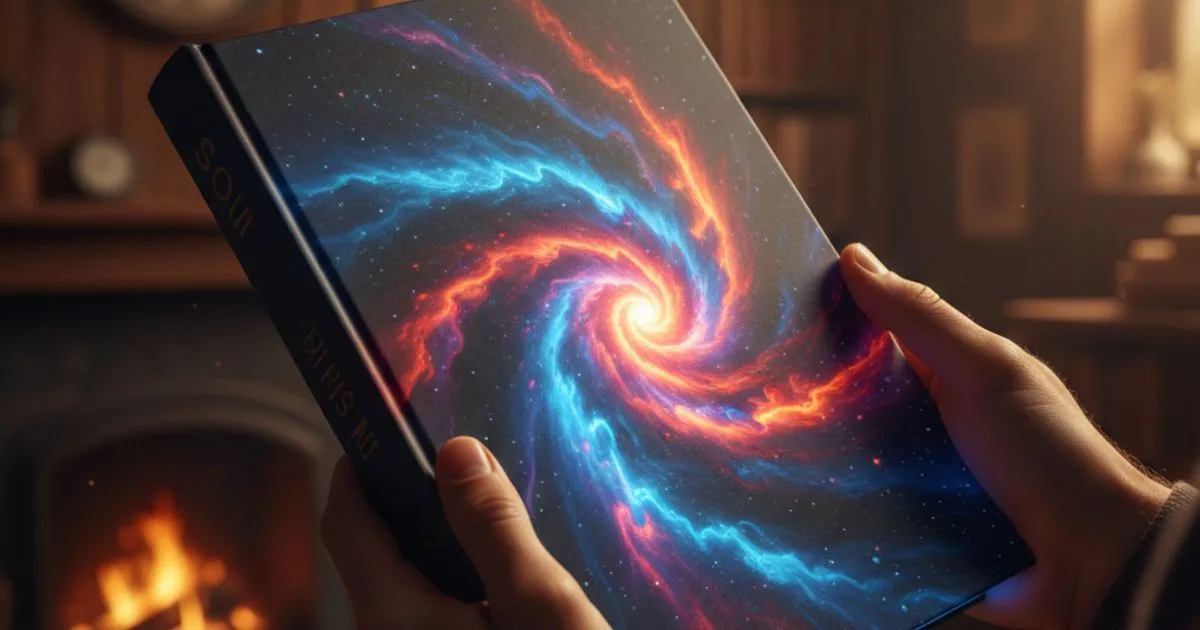
I spent last Tuesday standing in a crowded terminal, watching a stranger hold a copy of a thriller that seemed to be bleeding. Not literally, of course, but as the woman gripped the spine, the deep navy blue of the jacket began to swirl into a bruised, pulsing violet where her palms met the paper. It was my first real-life encounter with the new wave of Smart Book Covers, and it felt less like a gadget and more like a conversation. We have spent decades hearing that the physical book is a dying medium, a stubborn relic of a pre-digital age, yet here we are in 2026, and the book has finally learned how to feel. It is a strange, beautiful shift in the publishing world, where the inanimate object in your lap is now capable of reflecting the storm of chemicals currently firing in your brain.
This is not just a gimmick for the sake of novelty. In the world of high-end publishing and the high-stakes finance of intellectual property, the book cover has evolved into a sophisticated piece of visual real-time data. We are seeing a merger of bio-reactive materials and ultra-thin displays that allow a story to market itself based on the atmosphere of the room. It makes the static, glossy paper of five years ago look like a museum piece. When a book can sense the heat of your hand or the subtle shift in the ambient light of a subway car, it ceases to be a product and starts to become an experience.
The Evolution of Interactive Book Art and Bio-Reactive Aesthetics
The shift began quietly with experimental indies, but by early 2026, the major houses started pouring capital into what we now call Interactive Book Art. The technology relies on a sophisticated sandwich of layers. At the base, you have standard stock, but it is topped with a microscopic film of thermochromic and photochromic inks that respond to the most minute changes in temperature and UV exposure. If you are anxious, your hands are likely colder, or perhaps they are damp with sweat. The cover knows. I have seen memoirs that shift from a cold, clinical grey to a warm, sun-drenched amber as the reader settles into a comfortable chair and their body temperature stabilizes.
For the investor or the agency owner, this is where the narrative gets interesting. We are no longer just selling a flat image on a screen or a shelf. We are selling a kinetic asset. The psychological pull of a book that changes as you read it creates a level of engagement that traditional marketing could never touch. It is a feedback loop. The reader provides the emotion, and the book provides the visual validation. Some of the most successful listings I have tracked this year are those that utilize these tactile, living designs to command a premium price point. People are willing to pay for the “lived-in” feeling of a physical object that seems to share their mood. It creates a scarcity of experience that digital files simply cannot replicate, which is why we are seeing such a massive resurgence in the value of physical book-based brands.
E-Ink Covers and the Future of Visual Marketing 2026
If the reactive inks are the soul of this movement, then e-Ink covers are the brain. We have moved past the era where e-ink was restricted to the gray-scale screen of a tablet. The 2026 iterations are flexible, paper-thin, and capable of displaying vibrant, albeit slightly muted, colors that require almost zero power to maintain. These covers allow for what the industry calls “Atmospheric Adaptation.” Imagine walking through a bookstore where the covers are not static. As the afternoon sun dips and the store lights dim, the covers subtly shift their saturation to remain legible and enticing. It is a masterclass in Visual marketing 2026, where the product optimizes its own appearance based on the environment.
This tech has changed the way we look at book assets as a whole. An author or a publisher is no longer locked into one static design. I recently spoke with a designer who creates “scheduled” covers. In the morning, the book looks professional and clean, fitting for a commute. By 8:00 PM, the e-ink shifts to a darker, more experimental aesthetic, signaling that it is time for the reader to unwind. It is a subtle nudge, a psychological trigger that keeps the user coming back to the physical object. From a business perspective, the data suggests that these interactive elements increase the “dwell time” of a customer by nearly four hundred percent. When a person picks up a book and sees it react to them, the likelihood of them putting it back down drops significantly.
We are living in an era where the line between the digital and the physical is not just blurred, it is being actively erased. These smart covers are the first step toward a more integrated world of physical assets that carry the intelligence of software. It makes me wonder about the future of other physical goods. If a book can sense your mood, why not your office walls? Why not the very desk you sit at? The financial implications of this kind of “smart” physical branding are massive, and we are only seeing the tip of the iceberg.
The beauty of it, though, remains in the quiet moments. There is something profoundly human about a book that turns a deeper shade of blue when the room gets cold, or a spine that glows faintly when it hasn’t been touched in a week, as if it is lonely. It reminds us that even in a world dominated by high-frequency trading and digital dominance, there is still a deep, visceral hunger for things we can touch, things that touch us back. Whether this is a fleeting trend or the new standard for the industry remains to be seen, but for now, I find myself looking at my old, static bookshelf with a bit of pity. Those books are silent. The new ones are starting to whisper.