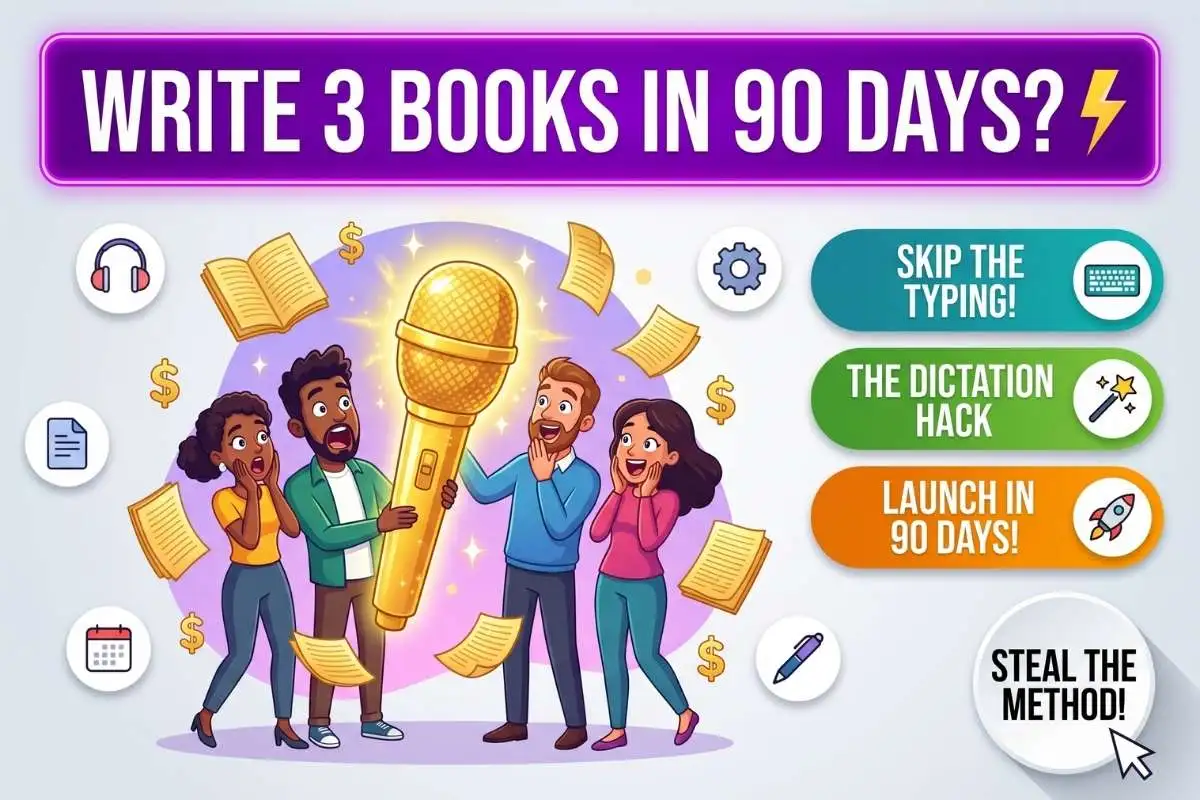
Imagine sitting on your porch as the leaves begin to turn in late August, sipping a cool drink, and realizing you have completely transformed your author career in just three months. For many writers, the idea of publishing a single book in a year feels like a monumental achievement. But what if you could write, edit, and publish three books over the course of a single summer? Welcome to the Rapid-Release Author Strategy 2.0. Releasing books in quick succession is a proven method to keep readers hooked, appease the algorithms of major online retailers, and significantly boost your income. However, the original rapid-release model left many writers exhausted, creatively drained, and swearing off keyboards forever. The 2.0 version is remarkably different. It relies on smart systems, unshakeable boundaries, and a profound respect for your own mental health, ensuring you cross the finish line with your sanity perfectly intact. Let us explore exactly how you can achieve this remarkable feat.
The Blueprint of Success: Aggressive Pre-Production
The foundation of any successful rapid-release strategy is not actually writing; it is aggressive, meticulous planning before a single word of your manuscript is ever typed. Think of yourself as an architect who must draw up every single blueprint before the construction crew is allowed to pour the concrete foundation. If you sit down at your desk on day one of your summer sprint and ask yourself what should happen in chapter one, you have already lost the battle against time.
To execute the 2.0 strategy, you need to spend the weeks leading up to your summer sprint creating detailed, comprehensive outlines for all three books. This means knowing your character arcs, plotting out every major twist, and having a clear resolution already written in stone. When you separate the heavy cognitive load of creative plotting from the mechanical act of drafting, you free your brain to simply follow the map you have already drawn. This technique, commonly known as “batching,” keeps your narrative cohesive across a series and turns daily writing into a smooth, frictionless exercise in execution rather than a painful struggle for inspiration.
Mastering the Art of the Sprint and Dictation
Once your blueprints are finalized, the actual writing phase demands a major shift in how you produce words. Staring at a blinking cursor for eight hours a day is a guaranteed recipe for physical fatigue and eventual burnout. Instead, modern prolific authors rely heavily on time-boxed writing sprints and the increasingly popular method of dictation. A writing sprint involves setting a timer for twenty to thirty minutes and typing as fast as you possibly can, completely ignoring typos, grammar mistakes, and awkward phrasing.
When combined with dictation software, this process reaches an entirely new level of efficiency. By speaking your story aloud, you can easily triple your hourly word count while simultaneously saving your wrists from the repetitive strain of typing. If you are curious about the mechanics of how speech-to-text technology has evolved to support seamless dictation, you can explore its history on the Speech recognition Wikipedia page. Speaking your story allows you to bypass your inner critic, tapping directly into the narrative flow. Taking a walk in nature while dictating your daily chapters not only accelerates your production but also provides much-needed physical exercise, which is an essential component of keeping your brain sharp all summer.
The Automated Editing Ecosystem
A common trap for ambitious writers is attempting to write and edit simultaneously, a habit that severely disrupts the creative flow and practically guarantees you will miss your summer deadlines. The 2.0 strategy treats drafting and editing as two entirely distinct professions that must never be allowed to mix. As you finish the first draft of book one, it must be immediately handed off to an external editing ecosystem while you dive straight into writing book two.
This requires booking your developmental editors, copy editors, and proofreaders months in advance, locking in dates that align with your aggressive summer schedule. You are essentially operating a manufacturing assembly line; as one product moves to the polishing stage, the next product begins assembly. For those working with tighter budgets, integrating advanced software tools into your self-editing phase can do the heavy lifting for grammar and pacing before you pass it to a professional. You can learn more about the formal standards of professional clarity via resources like the official Plain Language guidelines provided by the US government. Trusting your team and your tools to handle the refinement process allows your brain to stay entirely focused on generating new ideas.
Marketing and Launching on Autopilot
Writing three books in a single summer is an incredible achievement, but the entire effort will fall flat if your marketing strategy requires manual, exhausting labor on launch day. The key to rapid release without burnout is front-loading your marketing efforts so that the actual release days feel like an absolute breeze. Before the summer writing sprint even begins, your covers should be designed, your blurbs should be written, and your pre-order pages should be live on all major retailer platforms.
Your email newsletters announcing the upcoming releases should be written, beautifully formatted, and scheduled to send automatically. Social media posts, countdown graphics, and promotional advertisements can all be queued up in batch-scheduling software weeks ahead of time. This unprecedented level of automation means that when release day finally arrives for book one in July, book two in August, and book three in September, you do not have to lift a single finger. You can simply watch the sales roll in while you continue to focus on your writing or, more importantly, take a well-deserved break to rest and recover. Automation is the unseen hero of the rapid-release strategy.
Guarding Your Mental Health and Boundaries
The most critical update in the Rapid-Release Author Strategy 2.0 is its uncompromising focus on the author’s mental and physical well-being. The old strategy treated writers like machines, demanding endless hours and sacrificing sleep for the sake of publishing velocity. The 2.0 method recognizes that you are the golden goose; if you collapse from exhaustion, the entire production line grinds to a permanent halt.
Setting strict boundaries around your writing time is non-negotiable. This means communicating with your family and friends about your summer goals and clearly defining when you are “at work” and cannot be disturbed. Just as importantly, it means deliberately scheduling mandatory downtime. You must treat your rest days, your eight hours of sleep, and your healthy meals with the exact same level of professionalism and dedication as your daily word count goals. If you feel the early signs of burnout creeping in—such as dreading the keyboard, chronic fatigue, or creative apathy—you must be willing to adjust your schedule. Pushing through the pain might get the book out faster, but it will cost you your long-term career. True prolific writing is a marathon composed of well-managed sprints.
Timeline Comparison: Traditional vs. Rapid-Release 2.0
To truly understand the efficiency of this method, let’s look at how the 2.0 strategy compresses the traditional publishing timeline by overlapping different phases of production.
| Publishing Phase | Traditional Timeline | Rapid-Release 2.0 Timeline |
| Plotting & Planning | 1 to 3 months per book | 3 to 4 weeks batched for all 3 books |
| Drafting Phase | 6 to 12 months per book | 1 month per book (sprinting/dictation) |
| Editing & Revisions | 3 to 6 months per book | 2 to 3 weeks (outsourced parallel pipeline) |
| Marketing Setup | Done manually on release | Automated before summer begins |
| Total Time (3 Books) | 3 to 5 years | 4 to 5 months (including pre-prep) |
Frequently Asked Questions
Do I need a massive audience to make a rapid release work? Not necessarily. While having an established audience certainly helps build early momentum, the rapid-release strategy is actually a fantastic tool for audience building. Frequent releases train retail algorithms to favor your books, naturally increasing your visibility to new readers over the summer.
How long should the books be for this strategy? For a summer sprint, it is highly recommended to stick to standard commercial lengths rather than massive epic tomes. Aiming for 50,000 to 70,000 words per book makes the daily writing targets manageable and ensures your editing team can keep up with your pace.
What happens if I miss a self-imposed deadline? The 2.0 strategy prioritizes your mental health above all else. If you miss a deadline due to illness or fatigue, simply push the release dates back. Modern publishing platforms offer flexibility with pre-orders precisely for this reason.
A Final Curiosity: The Dictation Masters of History
If dictating and outlining three books in a single summer sounds like an impossible modern feat, history proves otherwise. The prolific romance author Barbara Cartland wrote an astounding 723 books during her lifetime, eventually holding the Guinness World Record for the most novels published in a single year. Her secret? She didn’t type them. Cartland dictated her stories to a team of secretaries while lounging on a sofa, proving that writing fast does not have to mean working physically hard.
In the end, the Rapid-Release Author Strategy 2.0 is about working smarter, heavily protecting your creative energy, and setting yourself up for long-term financial success. By plotting fiercely, embracing dictation, automating your marketing, and unapologetically prioritizing your rest, dropping three books this summer is not just a dream—it is an entirely achievable reality. Grab a notebook, start outlining, and prepare for the most productive summer of your life.