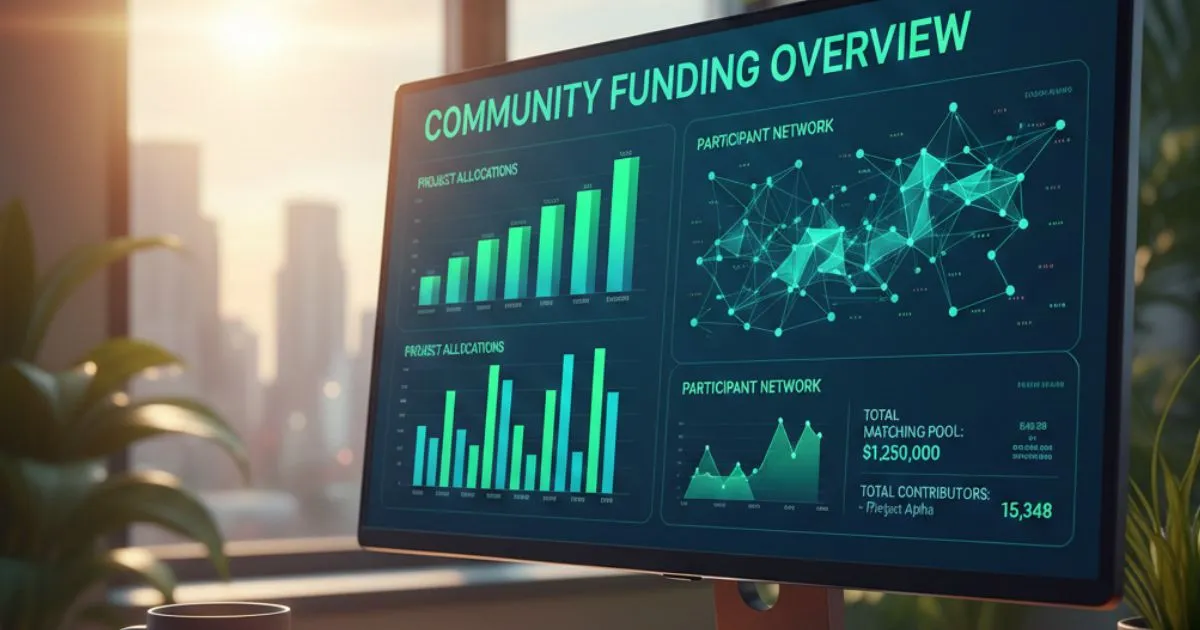
The first time I saw a small open-source project pull six figures from a treasury that seemed locked tight, I assumed it was a glitch or a very clever hack. It was early 2026, and the digital landscape was already shifting away from the old guard of venture capital. We were sitting in a dimly lit office, watching a dashboard refresh, when a tiny library for privacy-preserving transactions suddenly jumped to the top of the leaderboard. This was not a whale move. It was the result of three hundred individual contributors, most giving less than the price of a coffee, triggering a massive wave of capital. This is the era of Quadratic Funding, and if you are still looking at traditional grants or top-down investment models, you are essentially trying to trade on a dial-up connection while the rest of the world has moved to fiber.
The math behind it is elegant, almost poetic in how it punishes greed and rewards consensus. In the past, if you had a million dollars to give away, you gave it to the person you liked most or the one with the loudest pitch. Now, the math does the talking. It is a system where the number of contributors matters significantly more than the total amount they bring to the table. If one person gives ten thousand dollars, they get a certain amount of influence. But if ten thousand people give one dollar each, the matching pool explodes. It creates a democratic resonance that I have seen transform stagnant ecosystems into vibrant, self-sustaining economies almost overnight. It is the secret to how community projects are getting rich in 2026, and it is fundamentally changing the way we perceive value in the finance niche.
Balancing the DAO treasury through democratic math
Managing a DAO treasury used to be a nightmare of politics and hidden agendas. I remember the long nights spent in Discord channels, listening to delegates argue over whether a project deserved fifty thousand or a hundred thousand dollars, while the actual users of the protocol sat on the sidelines, ignored. Those days are largely behind us. By implementing a system where the community decides the allocation through their own micro-donations, the treasury becomes a reflection of actual utility rather than executive whim. It is a shift from subjective governance to mathematical proof of demand. When a project captures the imagination of the crowd, the treasury responds with surgical precision, magnifying the impact of every single participant.
What makes this particularly potent in 2026 is the maturity of the infrastructure. We are no longer dealing with experimental code that might break if too many people click a button. The integration of identity layers has made it much harder for bad actors to game the system through sybil attacks. I have watched several groups try to split their own funds across hundreds of wallets to fake community support, only to be caught by the underlying reputation protocols. It is a fascinating arms race, but the result is a much cleaner, more honest distribution of wealth. For a project founder, this means that your primary job is no longer schmoozing with high-net-worth individuals at conferences. Your job is to build something that people actually want to use, because in this model, a thousand happy users are worth infinitely more than one bored billionaire.
This shift in power dynamics has created a new class of digital assets. These are not just tokens with a speculative price, they are proofs of community alignment. When a project receives a large allocation from a matching pool, it is a signal to the entire market that there is a deep, committed user base behind it. I often find myself looking at these funding rounds as the new primary research. Instead of reading a whitepaper that promises the world, I look at who is putting their own capital on the line, even if it is just a few dollars. It is the most honest metric we have left in a world full of noise and synthetic engagement.
Navigating the new landscape of community crypto and growth
The psychological impact of this funding model is perhaps its most underrated feature. There is a specific kind of loyalty that forms when a user knows that their small contribution helped a project unlock a life-changing amount of capital. It turns passive observers into active stakeholders. In my conversations with developers over the last few months, the recurring theme is one of relief. They finally feel like they can focus on the product rather than the pitch deck. However, this does not mean the work is easier. In fact, the competition for attention has never been more intense. You have to be able to tell a story that resonates across cultures and time zones, and you have to do it with a level of transparency that would make most traditional hedge funds sweat.
I was talking to a friend who runs a small agency specializing in decentralized growth, and he mentioned how his entire strategy has flipped. They no longer focus on getting a project listed on a major exchange as the first step. Instead, they focus on building the initial “seed” community that can dominate a funding round. It is about creating a groundswell. If you can get five hundred people to care enough to donate five dollars, you have already won. The matching pool will take care of the rest. This is the beauty of community crypto in this cycle. It is the ultimate equalizer. It allows the underdog to outspend the incumbent simply by being more useful to more people.
Of course, there are pitfalls. The “marketing problem” is real. If you have two projects and one is a technical marvel with zero personality, while the other is a mediocre tool with a world-class hype machine, the hype machine will often win the funding round. I have seen this happen, and it is a bitter pill to swallow for the purists. But even this is self-correcting over time. The community eventually realizes when they have been sold a lemon, and the next round of funding reflects that loss of trust. It is a living, breathing market that rewards longevity and consistent delivery over short-term spikes.
As we move deeper into 2026, the boundaries between different types of funding are blurring. We are seeing traditional companies start to experiment with these models for their own internal R&D budgets. Imagine a corporation where the employees get to decide which projects get funded using a quadratic formula. It sounds radical, but the efficiency gains are hard to ignore. We are moving away from the era of the “all-knowing” executive and into the era of collective intelligence. It is a chaotic, noisy, and occasionally frustrating transition, but it is also the most exciting time to be involved in finance. The gatekeepers are losing their keys, and the people who understand how to mobilize a crowd are the ones who will define the next decade.
I often wonder where this ends. Will we see entire cities funded this way? Will public infrastructure be decided by the same math that currently funds a privacy-preserving wallet? The signs are already there. The experiments are scaling, and the results are consistently outperforming the old ways of doing things. It is no longer a question of if this will become the standard, but when. For those of us who have been watching this evolve since the early days of simple grants, the current state of play feels like a hard-earned victory. The secret is out, the tools are ready, and the capital is flowing to the people who are actually building the future.