
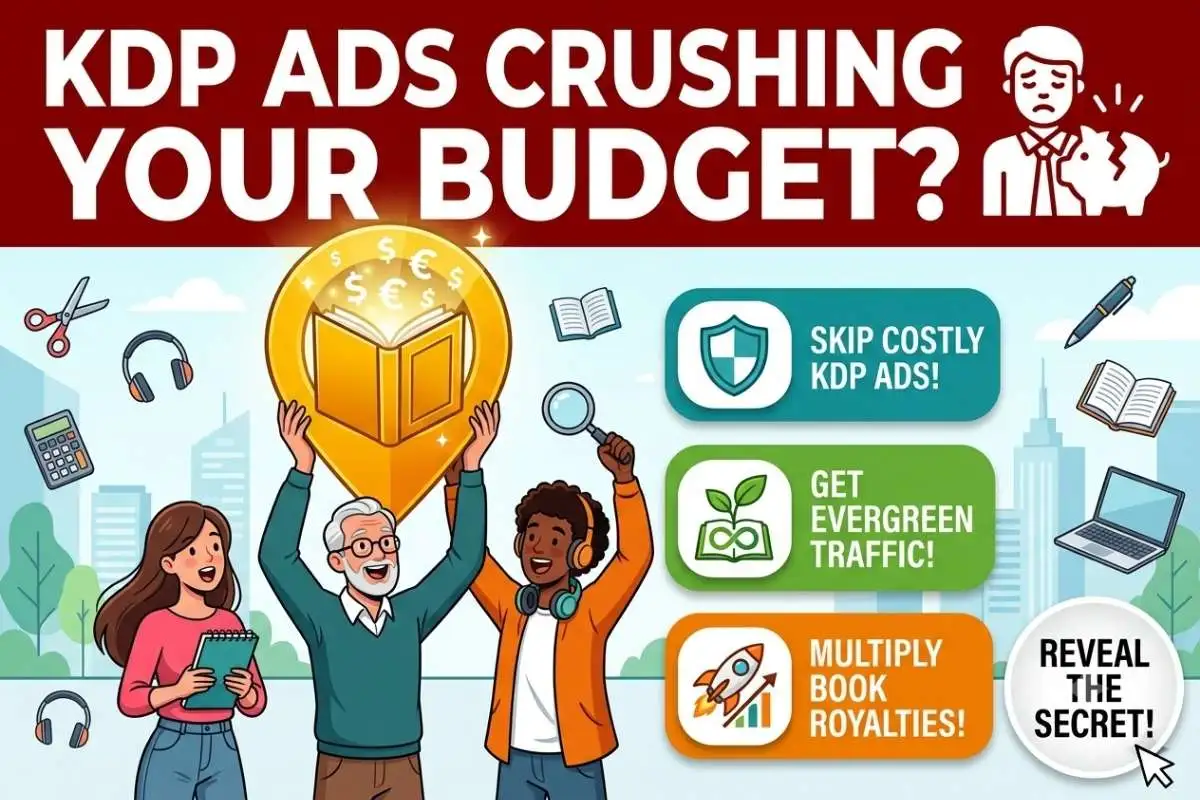
The landscape of self-publishing is undergoing a massive shift in 2026, and many authors are feeling the financial squeeze of traditional marketing. If you have been publishing books on Amazon Kindle Direct Publishing (KDP), you already know the harsh reality: the cost of Amazon KDP ads has skyrocketed, making it nearly impossible for new authors to break even. But while the masses fight over expensive clicks on Amazon, a quiet revolution is happening elsewhere. Pinterest visual book SEO has emerged as the ultimate untapped traffic source for authors, offering a sustainable alternative to paid ads. Instead of draining your budget, this strategy leverages the power of visual discovery to put your book directly in front of readers actively looking for their next favorite read.
For years, the standard advice for self-published authors was simple: set up your Amazon KDP dashboard and run sponsored product ads. However, as the platform became saturated with millions of low-content books and novels, the bidding wars intensified. In 2026, relying solely on Amazon’s advertising ecosystem exhausts your marketing budget quickly. This is where Pinterest steps in as a massive disruptor. Unlike social media platforms where content has a fleeting lifespan, Pinterest functions fundamentally as a visual search engine. Users log on with high commercial intent, seeking inspiration and products to buy. When you optimize your marketing materials for visual search, you tap into an audience primed to make a purchase, bypassing the costly competition on Amazon entirely.
Understanding how Pinterest ranks content is the first step toward building a successful organic marketing machine for your books. Because the platform relies heavily on its search algorithm, mastering basic search engine optimization principles is absolutely crucial. Pinterest scans not only your pin descriptions but also uses advanced optical character recognition (OCR) to read the text overlaid on your images. Every visual element must communicate exactly what the product is. By conducting thorough keyword research—typing broad terms into the search bar and noting the long-tail suggestions—you can integrate high-converting phrases into your board titles and profile. This alignment signals to the algorithm that your book is the perfect match for a user’s specific query.
Creating a pin that effectively converts a casual browser into an Amazon KDP customer requires more than simply uploading a flat image of your book cover. The most successful authors in 2026 treat their pins like highly optimized digital billboards. Since most users browse on mobile devices, pins must be formatted with a vertical aspect ratio to dominate screen real estate. Furthermore, you must incorporate bold, readable text overlays highlighting the core hook or benefit of your book. For instance, the text overlay might read, “The gripping psychological thriller with a twist you won’t see coming.” Savvy publishers also utilize bridge pages on their own websites to capture email addresses before redirecting the user to Amazon, securing a long-term asset.
Perhaps the most extraordinary advantage of utilizing Pinterest visual book SEO over Amazon KDP ads is the compounding nature of the traffic. When you stop paying for a click on Amazon, your visibility immediately drops to zero. In contrast, a well-optimized pin on Pinterest is an evergreen asset that continues to drive consistent traffic for months or even years. As users discover your pin, save it to their personal boards, and share it, its authority and reach organically multiply. This long-tail advantage means the effort put into designing a pin today pays dividends far into the future. Authors embracing this strategy are reporting that pins created two years ago remain their top drivers of daily sales.
One of the common misconceptions among authors is that Pinterest traffic does not convert as efficiently as bottom-of-the-funnel Amazon searches. However, the data emerging in 2026 paints a highly profitable picture. Because Pinterest users log on with the explicit intent to plan purchases and discover new products, their mindset is inherently transactional. When an author successfully aligns their book’s visual aesthetic with precise keywords, the friction between discovery and purchase is nearly eliminated. When a reader clicks on your pin, they are transported directly to your book’s sales page, free from the distraction of dozens of sponsored competitors flashing underneath your title. This singular focus drastically improves conversion rates and ultimately leads to higher, more consistent book royalties.
Comparing the ROI: Pinterest Visual SEO vs. Amazon KDP Ads
| Feature / Metric | Amazon KDP Ads | Pinterest Visual Book SEO |
| Traffic Cost | Pay-per-click (Costly & rising) | 100% Free organic traffic |
| Asset Lifespan | Disappears when budget ends | Evergreen (Lasts months to years) |
| User Intent | Immediate buying, high competition | Discovery and planning, low friction |
| Competition | Placed directly next to rivals | Exclusive visual focus on your pin |
| Setup Difficulty | Steep learning curve for bidding | Simple graphic design & keyword focus |
Frequently Asked Questions
Do I need to be a professional graphic designer to succeed on Pinterest?
Absolutely not. You do not need a degree in graphic design or expensive software to create pins that drive massive amounts of traffic to your books. The most effective pins on Pinterest often rely on simple, clean templates that prioritize readability and clear messaging over complex artistry. Free or low-cost design tools provide thousands of pre-made, highly optimized templates specifically formatted for Pinterest’s ideal vertical dimensions. The secret to success is consistency and testing; by using high-contrast colors, bold typography that clearly states the book’s hook, and an attractive image of your cover, you can easily capture a scroller’s attention. A straightforward design with excellent SEO will always outperform a beautiful but poorly optimized image.
How long does it take to see book sales from Pinterest SEO?
Unlike paid advertising on Amazon where you can essentially buy immediate visibility, Pinterest operates as a long-term search engine. When you first begin pinning your book marketing materials, it can take anywhere from three to six months for the algorithm to fully index your content, understand your niche, and begin distributing your pins to a wider audience. This initial incubation period requires immense patience and a very consistent pinning schedule. However, once your pins gain traction, the compounding effect is truly remarkable. A pin that takes a few months to take off can continue to drive daily sales for years without any additional effort on your part, acting as a self-sustaining ecosystem of free traffic.
Should I link my pins directly to Amazon or use my own website?
While linking directly to your Amazon KDP sales page is the fastest way to get started, the most profitable strategy in 2026 involves sending Pinterest traffic to a bridge page on your own website. A bridge page allows you to capture the visitor’s email address by offering a free lead magnet—such as a bonus chapter, a printable workbook, or a character guide—before they click through to purchase the book. This two-step process is crucial because it allows you to build an independent mailing list, ensuring you are not entirely at the mercy of Amazon’s algorithms. Sending traffic to a dedicated website helps build your domain authority, allowing you to retarget visitors and cultivate a loyal fanbase.
The Future of Book Discovery: A Final Thought
As we navigate the highly competitive publishing landscape of 2026, it is abundantly clear that authors who thrive will be those who refuse to rely on a single, expensive point of failure. Amazon KDP ads will always have a place in a comprehensive marketing strategy, but they should no longer be the sole engine driving your book sales. Pinterest visual book SEO offers a refreshing, highly lucrative alternative that rewards creativity, strategic planning, and patience. By viewing Pinterest not as a casual social media network, but as a robust visual search engine, you unlock a vast audience of eager readers. The opportunity is ripe, the competition is relatively low, and the long-term ROI is unmatched. Start building your visual SEO strategy today, and watch your organic traffic crush your reliance on ads.
