
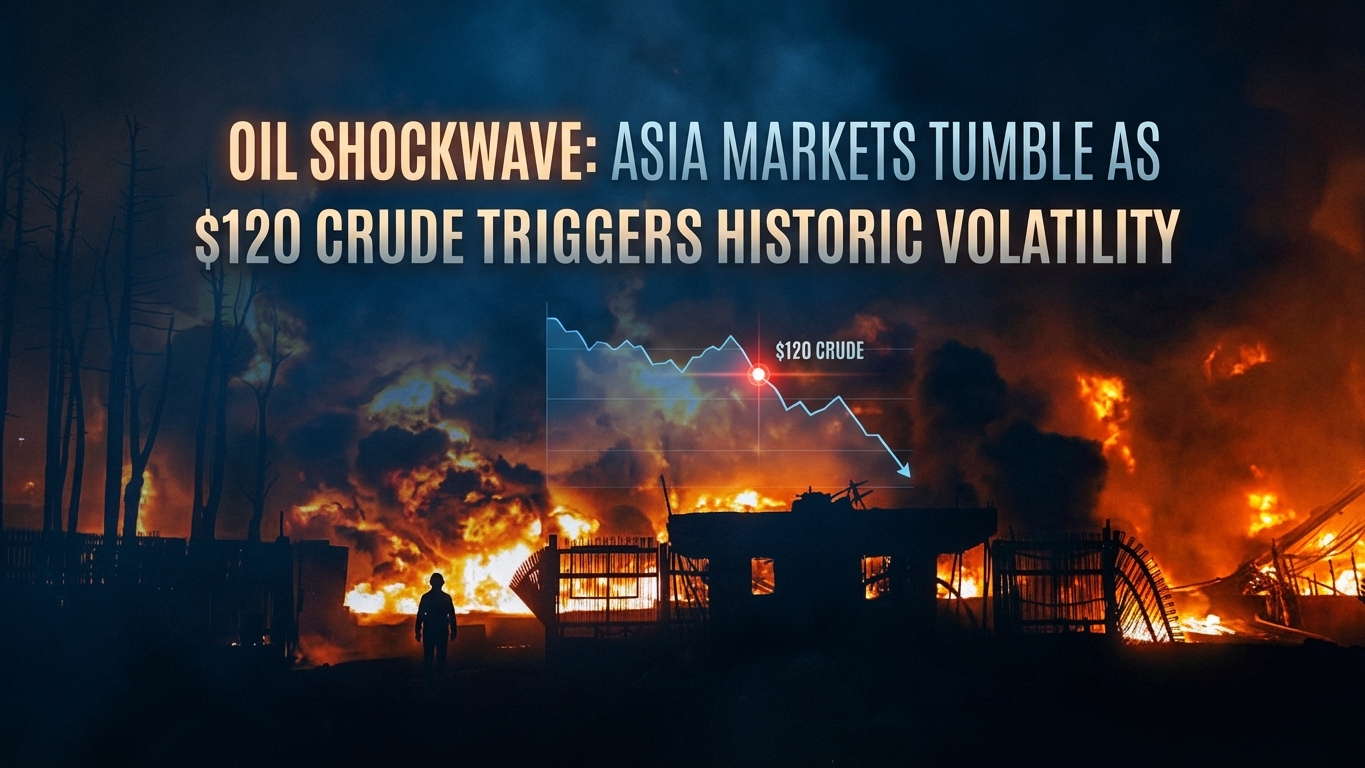
The Shockwave Hits Asia: Circuit Breakers and Massive Selloffs Rock Markets
The financial world is reeling from a synchronized, brutal selloff across Asian trading floors, fueled entirely by the terrifying trajectory of global energy prices. We are witnessing a textbook panic event driven by supply destruction and geopolitical instability. Markets across the region, including the vital indices on the \*\*ASX\*\*, are catching severe collateral damage as crude oil prices flirt with levels not seen in over a decade, threatening to choke global economic growth into a deep contraction. The immediate visible symptom of this fear was the activation of emergency trading halts in major hubs, signaling that the selling pressure was too immense for normal market mechanics to handle.
South Korea’s main equity gauge, the Kospi, became the bellwether for this regional crisis, triggering its second circuit breaker in just four trading sessions. For readers unfamiliar with this mechanism, a circuit breaker is an automatic suspension of trading designed to pause a freefall and allow sanity to potentially return to the floor. The magnitude of the decline—plunging over 8 percent before the intervention—shows the depth of investor despair. When these mechanisms are deployed multiple times in a short span, it tells us that the underlying fundamentals driving the fear are not transient; they represent a structural crisis in commodity flows that traders believe will persist.
The impact on heavyweight technology stocks, the supposed safe harbors of the modern economy, was particularly devastating. Samsung Electronics saw its shares plummet by more than 10 percent, while its semiconductor rival, SK Hynix, faced an even more staggering 12.3 percent loss. This demonstrates a critical market shift: when the cost of energy becomes this high, the operational costs for every company soar, regardless of the products they manufacture, thereby crushing profit margins universally. Investors are not just selling winners; they are fleeing everything in anticipation of an impending recessionary environment.
This swift, violent reaction across Asia underscores a profound dependency on imported energy, making these economies acutely vulnerable to spikes in Brent and WTI futures. When the cost of powering factories, transporting goods, and fueling logistics chains rises this sharply in one day, the immediate calculation for every analyst pivots from growth to pure survival, leading inevitably to mass liquidations across equity desks.
The Dangerous Ascent of Oil: A 40-Year Gain in Two Days
The narrative driving this entire market turmoil centers squarely on the unprecedented spike in crude oil. Reports indicate that Brent futures have surged by over 26 percent, while U.S. West Texas Intermediate crude has shot up by more than 27 percent in a single trading session. To put this into historical perspective, the data suggests this single-day jump represents the largest one-day percentage gain recorded since late 1988\. This is not a normal supply-demand fluctuation; this is a shock of historic proportions hitting the energy complex.
The immediate catalyst cited for this explosive move involves severe disruptions in the Middle East, specifically concerning major oil producing nations like Kuwait, Iran, and the United Arab Emirates. Reports circulating suggest coordinated production cuts following instability or closure around the Strait of Hormuz, a crucial chokepoint for global oil transit. When a significant portion of the world’s readily available supply is suddenly taken offline or restricted due to geopolitical maneuvering, the market reacts in true scarcity mode. Traders race to secure whatever barrels are available, bidding the price up vertically.
Crossing the $120 per barrel threshold acts as a psychological barrier for central banks and treasuries globally. At this price level, inflation—already a persistent headache—moves from being a manageable risk to an outright economic emergency. Every imported good, every manufactured item, and every logistical expense is suddenly priced at a massive premium, forcing consumer pocketbooks to shrink and corporate earnings forecasts to become obsolete overnight. This is the mechanism through which high oil prices translate directly into equity crashes.
What is most alarming about this specific surge is its speed and the perceived lack of an immediate diplomatic fix. Without the expectation of swift de-escalation or the injection of previously strategic reserves, the market price reflects the expectation that this energy crunch will persist, necessitating a drastic downward revision of global GDP forecasts. This fear is what propels indices downward far faster than current economic data might suggest, as markets are always pricing in the near future, not just the present.
Echoes of History: Comparing Today’s Commodity Shock to Past Crises
To grasp the severity of the current situation, one must look back at the few comparable moments in financial history where oil sent equity markets into a tailspin. The first obvious parallel is the 1970s oil shocks, particularly 1973 and 1979, where geopolitical events severed supply, leading to rampant stagflation—a toxic combination of high inflation and stagnant economic growth. Those crises fundamentally reshaped monetary policy and led to years of subdued equity market performance globally.
The reaction seen in markets like the \*\*ASX\*\* this week bears a striking resemblance to the aftermath of the 2008 commodity bubble peak, although the underlying cause differs slightly. In 2008, the spike was driven more by massive demand growth from emerging economies meeting constrained supply capacity. Today’s surge is primarily driven by conflict and supply curtailment. Supply shocks tend to have a more immediate and destructive effect on equity valuations because they imply physical hardware—oil tankers, pipelines, refineries—are physically unavailable, a problem that takes years, not months, to resolve through new investment.
Consider also the brief but intense panic surrounding Iraq’s invasion of Kuwait in 1990, which sent oil soaring briefly near $40 a barrel—a massive move in percentage terms then. While the absolute price is higher today, the percentage shock—the 27 percent one-day gain in WTI—is far more acute than what was seen during that period. The market mechanisms today, dominated by high-frequency trading and leveraged derivatives, amplify speed, meaning historical shocks that took weeks to unfold are now compressed into hours.
The crucial difference today, however, lies in the existing backdrop of elevated inflation and already strained supply chains left over from pandemic-era disruptions. In the 1970s, inflation was building; today, it is already entrenched. This means this energy shock is not initiating a problem; it is pouring gasoline onto a structural fire that central banks were already struggling to contain with modest interest rate hikes. The magnitude of the required policy response to quell this new energy-driven inflation is now exponentially greater, leading to greater market apprehension.
Deconstructing the Economic Fallout: Inflation, Margins, and Monetary Policy
The technical mechanism through which $120 oil destroys corporate value is straightforward yet devastating. Energy is a primary input cost across nearly every sector. For energy-intensive industries like manufacturing, chemicals, and transportation, margins are instantly vaporized. A 27 percent rise in a fundamental input cost cannot easily be passed onto consumers when general inflation is already sparking consumer fatigue. This leads companies to absorb the cost, sending stock prices tumbling as future earnings expectations are slashed.
Furthermore, the impact cascades into the consumer side through transportation costs. Record high pump prices directly reduce disposable income available for discretionary spending. When households allocate a significantly larger portion of their budget to simply commuting to work and heating their homes, sectors like retail, hospitality, and travel contract sharply. This creates a broad-based economic slowdown, which is precisely what the Asian markets are pricing in based on the Kospi’s dramatic plunge.
Central banks now face an impossible bind, often termed the stagflation dilemma. If they aggressively hike interest rates to combat the inflation fueled by high oil prices, they risk tipping the fragile economy, already burdened by high energy costs, into a harsh recession. If they remain cautious, inflation expectations become unanchored, leading to a more damaging and prolonged period of economic stagnation. The severity of the oil price move effectively forces policymakers’ hands toward the more aggressive rate-hiking path, creating short-term pain for long-term stability.
The currency markets are also registering this intense stress. Nations highly dependent on energy imports—which includes nearly all of developed Asia and the \*\*ASX\*\* markets in Australia—see their trade balances deteriorate instantly. Their domestic currencies weaken as vast amounts of capital must be spent overseas to purchase necessary dollar-denominated oil. This currency depreciation further increases the local cost of imported goods, creating a vicious cycle where high oil prices fuel local inflation via cheaper local currency.
Finally, the move highlights the fragility of energy infrastructure reliance. The Strait of Hormuz situation, whether a sustained policy or a temporary disruption, shines an unforgiving light on the world’s dependence on narrow maritime passages for essential commodities. The premium traders are adding to the price is a literal insurance premium against geopolitical instability closing that artery entirely, which would plunge the world into a depressionary scenario far worse than what we are currently modeling.
The Road Ahead: Three Potential Scenarios for Market Recovery
Given the severity of this energy shock, the market trajectory splits into distinct, high-impact paths from here. The first scenario is the De-escalation Hope. This unfolds if diplomatic efforts swiftly resolve the issues causing the Middle Eastern production cuts, or if major non-OPEC suppliers unexpectedly pump significantly more volume. In this case, oil prices moderate rapidly, perhaps falling back toward the $90 range. Markets would experience a sharp, vigorous relief rally, driven by short-covering and optimism that the margin squeeze is temporary. Equities in Asia and elsewhere would bounce strongly, but trust in energy security would remain low.
The second, and perhaps more probable, path is the Entrenched Stagflation Grip. In this scenario, oil prices stabilize at a persistently elevated level, say between $110 and $125, due to ongoing geopolitical friction or structural supply deficits. Central banks are then forced into substantial, aggressive rate hikes globally to tame inflation expectations. This scenario guarantees a painful period of economic contraction marked by low corporate earnings growth, high unemployment, and sustained volatility in the equity space. Assets that benefit from higher inflation, like certain commodities and hard assets, would outperform conventional growth stocks.
The final, most disruptive scenario is the Full Supply Catastrophe. This occurs if the Strait of Hormuz closure becomes protracted or if further instability locks in more global supply capacity. Oil breaches $150, entering territory that truly mirrors a severe historical recession trigger. In this environment, circuit breakers become commonplace globally, liquidity dries up, and equity markets enter a sustained bear market lasting multiple quarters. Investor focus shifts entirely to capital preservation, leading to massive selloffs across sovereign and corporate debt as well, predicated on the belief that corporate defaults become inevitable across high-debt sectors.
The current environment demands acute attention from investors globally, whether they hold shares listed in Sydney or Shanghai. The energy price action is the single most powerful driver of global financial behavior right now, dictating everything from central bank policy to consumer confidence. Monitoring crude oil futures is no longer just the job of an energy analyst; it is the mandatory focus for every serious investor navigating this volatile landscape.
FAQ
What immediate market mechanism was triggered in major Asian trading hubs due to the oil price shock?
The immediate visible symptom of fear across Asian markets was the activation of emergency trading halts or circuit breakers. These mechanisms are designed to automatically suspend trading to pause a market freefall when selling pressure becomes too intense for normal market mechanics to handle.
How severe was the selloff that triggered the circuit breaker on South Korea’s Kospi index?
The Kospi triggered its second circuit breaker in four trading sessions after plunging over 8 percent before the intervention. This frequency signals that traders perceive the underlying fundamental fear regarding commodity flows as a persistent, structural crisis.
Why did major technology stocks like Samsung Electronics suffer significant losses despite not being directly related to the energy sector?
High crude oil prices dramatically increase operational costs, such as energy for manufacturing and logistics, thereby universally crushing profit margins across all sectors. Investors are selling technology stocks because impending recession fears negate anticipated future earnings, regardless of the company’s end product.
What historical percentage gain in WTI crude oil was achieved in a single trading session according to the article?
U.S. West Texas Intermediate (WTI) crude shot up by more than 27 percent in a single trading session. This specific one-day jump is noted as potentially the largest one-day percentage gain recorded since late 1988.
What geopolitical area is cited as the immediate catalyst for the explosive surge in oil prices?
The primary catalyst involves severe disruptions and reported coordinated production cuts in major Middle Eastern oil-producing nations, specifically mentioning Kuwait, Iran, and the UAE. Instability around the Strait of Hormuz, a critical global oil chokepoint, is central to the market anxiety.
How does crossing the $120 per barrel threshold functionally turn inflation into an ‘economic emergency’?
At $120 per barrel, the cost for every imported good, manufactured item, and logistical expense rises sharply, reducing consumer disposable income and making corporate earnings forecasts immediately obsolete. This price level forces a direct translation of high energy costs into systemic economic strain.
How does today’s supply shock differ fundamentally from the 2008 commodity bubble peak?
The 2008 spike was primarily driven by massive demand growth meeting constrained capacity, whereas today’s surge is driven chiefly by conflict and physical supply curtailment. Supply shocks caused by physical availability issues tend to be more destructive to valuations as they take years to resolve.
What characteristic of modern trading amplifies the speed of historical commodity shocks?
Modern markets are dominated by high-frequency trading and leveraged derivatives, which compress historical shock timelines. Events that might have taken weeks to unfold during past crises are now often compressed into mere hours.
What existing economic backdrop makes this new energy shock particularly dangerous compared to the 1970s energy crises?
Unlike the 1970s where inflation was building, inflation is already entrenched globally due to pandemic-era supply chain issues. This means the energy shock is exacerbating a pre-existing structural fire, requiring vastly more aggressive policy responses.
How do high oil prices specifically erode corporate value via the mechanics of input costs?
For energy-intensive sectors, high input costs instantly vaporize profit margins, and companies cannot easily pass these expenses onto already fatigued consumers. This forces companies to absorb the costs, leading analysts to slash future earnings expectations and stock prices.
How does the immediate rise in gasoline prices functionally impact consumer spending patterns?
Record high pump prices directly reduce the disposable income households have available for non-essential purchases. When more budget is allocated to necessary commuting and heating, discretionary sectors like retail and hospitality contract sharply.
What is the ‘stagflation dilemma’ facing central banks in response to this high oil price environment?
Central banks face a choice: aggressively hike rates to fight inflation, risking a harsh recession, or remain cautious, risking unanchored inflation expectations and prolonged economic stagnation. A severe oil shock pushes policy toward the more aggressive rate-hiking path.
What happens to the trade balances and currencies of energy-importing nations like those in developed Asia?
Energy-importing nations instantly see their trade balances deteriorate because vast amounts of capital must be spent overseas to purchase dollar-denominated oil. This results in domestic currency weakening, which further increases the local cost of all imported goods.
What is the difference between the anticipated effect of the ‘De-escalation Hope’ scenario and the resulting market action?
In the ‘De-escalation Hope’ scenario, diplomatic efforts resolve the supply issues, causing oil prices to drop rapidly, perhaps toward $90. This would lead to a sharp, vigorous relief rally in equities driven by short-covering and renewed optimism.
What defines the ‘Entrenched Stagflation Grip’ scenario for oil prices and central bank response?
This probable scenario sees oil prices stabilizing persistently elevated, perhaps between $110 and $125, forcing central banks into substantial, aggressive global rate hikes to curb inflation expectations. This guarantees a painful period of economic contraction with low corporate earnings growth.
What must happen for the market to enter the most disruptive ‘Full Supply Catastrophe’ scenario?
This scenario requires the Strait of Hormuz closure to become protracted or for further instability to lock in more global supply capacity, pushing oil well above $150 per barrel. This level historically triggers sustained bear markets, potential liquidity evaporation, and inevitable corporate defaults.
Which specific stock exchange mentioned in the article is used as an example of heavily affected import-dependent economies?
The Australian Securities Exchange (**ASX**) and South Korea’s Kospi are repeatedly cited as examples of major equity markets suffering collateral damage due to high reliance on imported energy.
What unique aspect of the current crisis means that policy response required to quell inflation is magnified?
Because inflation is already entrenched rather than building, this energy shock is not the starting signal for the problem, but rather an accelerant. Therefore, the magnitude of interest rate hikes needed to control expectations is exponentially greater than in previous cycles.
In historical context, what event is the 1990 invasion of Kuwait compared to in terms of percentage price shock?
The 1990 event saw oil briefly surge near $40 a barrel, which was a massive percentage move at that time. However, the article notes that the current 27 percent one-day gain in WTI is a far more acute percentage shock than what was experienced then.
What is the literal financial concept embedded in the current price premium for oil related to the Strait of Hormuz?
Traders are adding a literal insurance premium to the price of oil due to geopolitical instability threatening to close this critical maritime artery entirely. This premium guards against the world entering a depressionary scenario if the flow is cut off.
According to the article, what must investors now monitor besides traditional indices to understand current financial behavior?
Monitoring crude oil futures is now the mandatory focus for every serious investor navigating this landscape. The energy price action is stated as the single most powerful driver of global financial behavior currently, dictating everything from monetary policy to consumer sentiment.
