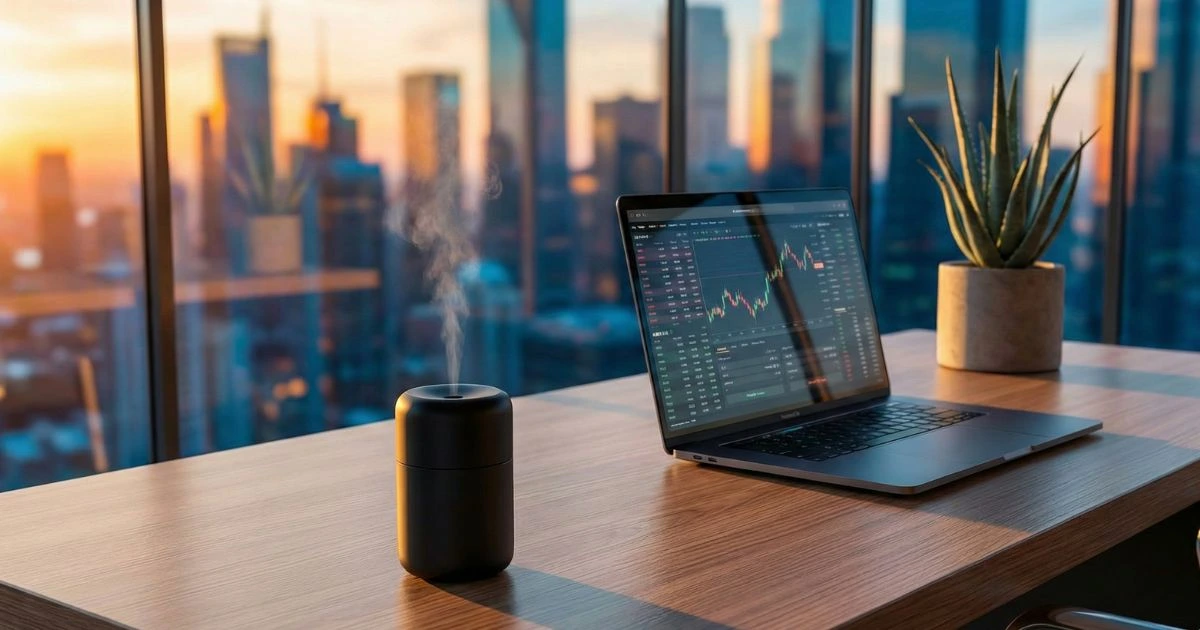
The first time I walked into a venture capital firm in Singapore this year, I did not notice the technology. I noticed the air. It was not the sterile, recycled oxygen of the 2010s, nor was it the heavy, perfumed mask of a hotel lobby. It was a crisp, almost imperceptible note of Hinoki wood and wet stone that felt less like a fragrance and more like a cognitive reset. As I sat through a grueling three hour due diligence session, the atmosphere shifted. By the second hour, the air grew slightly sharper, carries of peppermint and rosemary cutting through the mental fog that usually settles after ninety minutes of spreadsheets. This is the new reality of the Office Mood AI, a silent collaborator that has moved beyond the fringe of wellness into the core of institutional productivity strategy.
We have spent the last decade obsessed with what our eyes see on screens and what our ears hear in noise canceling headphones, yet we ignored the most direct path to the human limbic system. The nose is a highway to the parts of the brain that govern emotion and memory, and in 2026, the finance world is finally starting to trade on that data. It is no longer about making a room smell nice. It is about biological optimization through a subscription model, a literal Mood-as-a-Service that adjusts in real time to the heart rate variability and calendar density of the team. When the tension in a trading floor rises, the sensors pick up the physiological shift and the diffusers release a micro-dose of lavender or linalool to keep the collective cortisol levels from redlining. It is subtle, effective, and deeply transformative for those of us who live and die by our focus.
Designing deep focus with Office Mood AI and biometric feedback
The shift toward these systems was born out of a desperate need to fix the post-remote work office. When companies realized that just offering free coffee and ergonomic chairs was not enough to lure talent back from their home setups, they turned to sensory architecture. Modern systems now integrate directly with workplace wellness platforms to create a feedback loop that feels almost sentient. I spoke with a fund manager last week who treats his office scent profile with the same rigor he applies to his portfolio. His team uses a localized grid of AI-driven diffusers that can target individual desks. If an analyst is deep in a complex valuation, the AI recognizes the sustained keyboard activity and lack of movement, signaling the system to maintain a focus-oriented terpene profile.
This is not just about keeping people awake. It is about the quality of the wakefulness. Traditional stimulants like caffeine have a ceiling and a subsequent crash, but olfactory stimulation can be modulated. We are seeing the rise of Workplace wellness protocols that treat the air as a dynamic asset. For example, during collaborative brainstorming sessions, the system might lean into citrus and ginger to promote expansive thinking. Then, as the group moves into the execution phase, the scent profile pivots toward the grounded, earthy tones that assist in detail-oriented tasks. The result is an environment that actively participates in the work being done, rather than just being a passive container for it. It is a quiet revolution in how we perceive the overhead costs of a physical location, turning a lease into a high-performance tool.
The skepticism, of course, remains for some. Critics argue that this is just another layer of corporate surveillance, a way to squeeze every last drop of output from a tired workforce. But the feedback from the ground tells a different story. Employees in these scented environments often report a significant reduction in the afternoon slump and a general sense of being less drained at the end of the day. Because the AI is reactive, it prevents the olfactory fatigue that used to come with static plug-in air fresheners. By pulsing the scents and changing the chemical composition based on real-time needs, the brain stays engaged. It is a nuanced dance between chemistry and computation that makes the old way of working feel remarkably primitive.
The ROI of Productivity tech and the future of sensory assets
For those of us in the business of valuing assets and looking for the next edge in operational efficiency, the data coming out of these “sensorial offices” is hard to ignore. We are seeing a measurable uptick in accuracy for repetitive data tasks and a decrease in reported stress markers among executive teams. Productivity tech has moved past the dashboard. We are now in the era of the ambient environment. In 2026, the competitive advantage belongs to the firms that can manage the biological state of their human capital without intruding on their autonomy. It is about creating a space where the work feels easier to do, where the friction of the day-to-day is lubricated by a invisible, intelligent mist.
The investment into these systems is also changing the way we look at property value and agency services within the commercial sector. A building is no longer just its location and its square footage. It is its internal ecosystem. When we evaluate listings or look at the performance of a particular boutique firm, we are starting to ask about their sensory stack. Does the office support the cognitive demands of the industry? If you are running a high-frequency trading shop, your atmospheric needs are radically different from a creative agency or a legal firm. The ability to customize these environments via a centralized AI hub is becoming a standard expectation for premium tenants who understand that their biggest expense, and their biggest asset, is the mental clarity of their staff.
As we look toward the end of the decade, the integration will only deepen. We are already seeing prototypes of wearable devices that sync with the office AI, allowing the scent profile to follow you from the conference room to the private booth, ensuring a consistent cognitive state regardless of your physical movement. It sounds like science fiction, yet we are breathing it in every day. The transition from “managed offices” to “optimized experiences” is complete. We have reached a point where the air we breathe is as much a part of our professional toolkit as the proprietary algorithms we run on our servers. It is a strange, aromatic world, but for those of us who have felt the difference in our own focus, there is no going back to the odorless, stagnant days of the past.
The true brilliance of these systems lies in their invisibility. You don’t walk into a room and think about the software or the chemical cartridges hidden in the ceiling panels. You just find yourself working. You find that the usual 3:00 PM headache doesn’t arrive. You find that the team is slightly more patient during a tense negotiation. It is a gentle nudge from a machine that knows you better than you know yourself, guided by the silent logic of an algorithm that understands the exact scent of success. In a world of loud, demanding technologies, there is something profoundly elegant about a solution that works through the simple act of taking a breath. The office of 2026 isn’t just a place where you work, it is a place that helps you think, one molecule at a time.