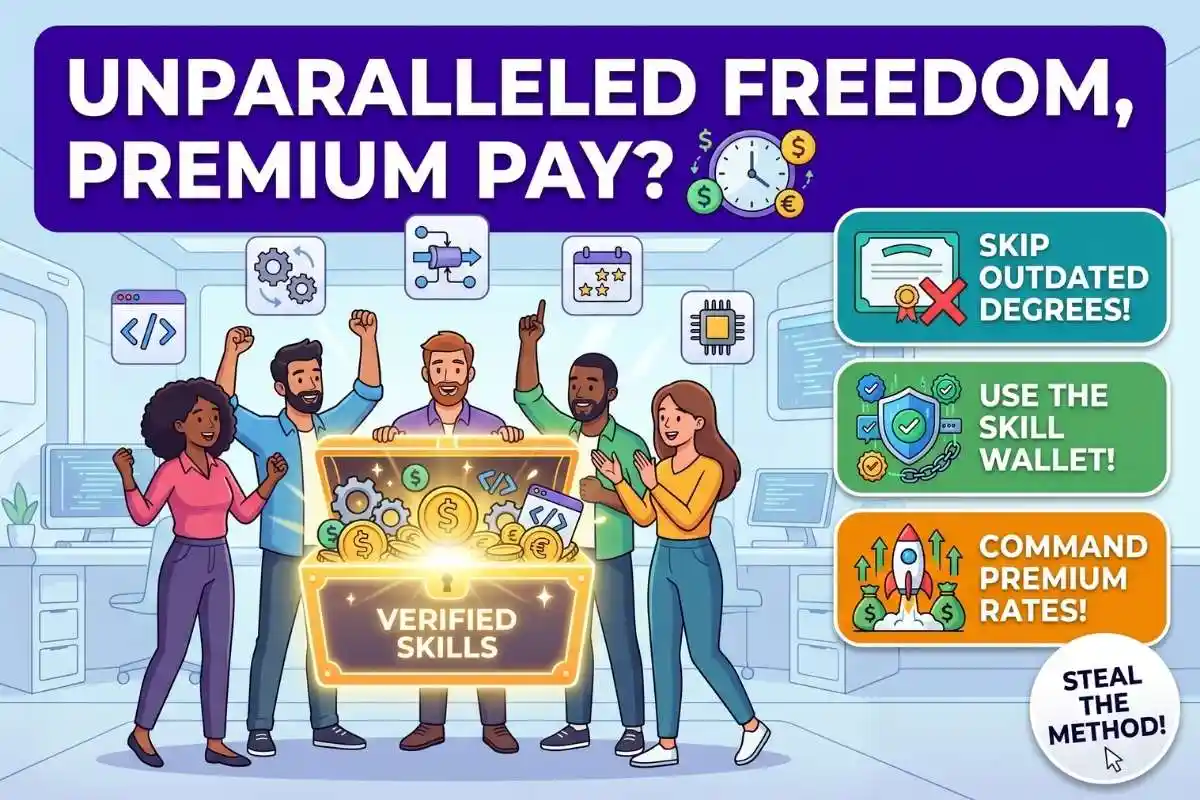
It is the year 2026, and the traditional corporate ladder is rapidly transforming into a sprawling, interconnected mosaic. For decades, a successful career in technology involved securing a full-time position, climbing the managerial ranks, and wearing multiple hats to prove your worth to a single employer. Today, however, that familiar model is being systematically dismantled. In its place, the industry is adopting a highly efficient approach known as modular skill-based hiring. Instead of searching for the perfect “Full-Stack Developer” or “Marketing Director,” forward-thinking companies are breaking down their massive, monolithic projects into deeply manageable components. They deliberately source the exact human ability required for each specific task. This radical shift fundamentally changes how we view employment, turning the modern workforce into a dynamic network of highly specialized experts who plug into projects exactly when needed, and unplug just as quickly when the job is done. This modular approach allows businesses to stay incredibly lean, fiercely competitive, and entirely adaptable to the fast-paced demands of the digital era, forever changing the human resources landscape.
The End of the Traditional Job Description
Imagine a rapidly growing artificial intelligence startup that urgently needs to build a highly complex data pipeline for a groundbreaking consumer application. In the past, human resources would have spent months drafting a generic job description, interviewing dozens of broadly skilled candidates, and eventually hiring a full-time engineer possessing some, but certainly not all, of the required niche skills. Fast forward to today, and that same tech company operates entirely differently. They break the massive pipeline project into distinct, bite-sized modules: one dedicated solely to initial data ingestion, another focused exclusively on cryptographic security, and a third tailored for predictive algorithmic modeling. Rather than hiring one person to stumble through three distinct phases, the firm contracts three separate, hyper-specialized professionals. Each expert drops into the project ecosystem, executes their refined skill with absolute precision, and seamlessly moves on to their next opportunity. This modular approach completely eliminates the notorious inefficiencies of traditional employment, ensuring companies pay only for the exact expertise they deeply need, without the immense overhead of long-term employee retention.
Why Tech Firms Are Leading the Charge
The technology industry has always been an eager pioneer of workplace innovation, making it uniquely positioned to lead this massive global transition toward modular hiring. The primary driver behind this seismic shift is the sheer, overwhelming pace of technological advancement. This pace has accelerated to a point where traditional university degrees often become thoroughly outdated before a student even graduates. Tech firms have realized agility is their most valuable asset, and being tied down by a rigid, full-time workforce simply slows them down in a hyper-competitive market. By adopting a modular approach, these companies instantly pivot business strategies, assembling temporary “flash teams” of independent specialists to tackle sudden market shifts or new innovations. Looking at historical employment data, such as the foundational labor frameworks from the United States Bureau of Labor Statistics, the trend of alternative work arrangements has grown steadily for years. However, the modern artificial intelligence landscape has completely supercharged this evolution, pushing companies to tap into a decentralized, global pool of contractors equipped with continuously updated skills.
The “Skill Wallet” and Verifiable Credentials
For this incredibly fast-paced, fluid ecosystem to function smoothly, the traditional paper resume had to die a swift death. In its place, the successful independent workforce of 2026 relies on something much more robust, transparent, and technologically advanced: the digital “skill wallet.” Because modern hiring managers no longer have the luxury of spending weeks vetting a candidate’s background for a three-day project, they desperately need instant, undeniable proof that a worker can deliver exactly what is promised. This critical necessity led to the mainstream adoption of cryptographic credentialing and decentralized micro-certifications. Workers enthusiastically accumulate verified digital badges for highly granular competencies—such as fine-tuning a specific large language model or auditing a complex smart contract. As detailed in the historical evolution of Microcredentials on Wikipedia, the aggressive shift away from generic degrees toward bite-sized, mathematically verifiable proof of competency allows advanced matching algorithms to pair the perfect worker to the exact task in mere milliseconds, establishing deep trust across borders.
The Impact on Workers and Workplace Culture
While this hyper-efficient system offers undeniable advantages for corporate project execution and overall profitability, it profoundly reshapes the psychological and financial realities of the modern worker. For deeply curious continuous learners, the modular hiring economy is an absolute, undeniable paradise. These driven individuals enjoy unparalleled personal freedom, setting bespoke hours, choosing only the projects that truly ignite their passion, and commanding massive premium rates for ultra-specialized knowledge. They are blissfully free from toxic office politics or highly subjective annual performance reviews. However, this appealing narrative of professional liberation is only one side of a complex coin. For those who strongly prefer long-term stability, highly predictable monthly income, and the meaningful social connections emerging from traditional team integration, the transition can feel intensely jarring and economically precarious. The comforting concept of “company loyalty” is rapidly fading into obscurity, replaced by a purely transactional relationship based entirely on current utility. Workers are now essentially required to function as their own marketing agencies, continuously upskilling and hustling to secure their next module of work.
Data Snapshot: The Shift in Tech Employment
| Feature | Traditional Hiring (pre-2024) | Modular Hiring (2026) |
| Primary Focus | Broad role fulfillment and culture fit | Highly specific task execution |
| Duration | Open-ended, long-term employment | Project-based, defined timeframes |
| Evaluation | Resumes, interviews, and broad degrees | Verified digital micro-credentials |
| Team Structure | Static, hierarchical departments | Fluid, dynamic “flash teams” |
| Compensation | Annual salary with standard benefits | Premium pay-per-module or milestone |
Frequently Asked Questions About Modular Hiring
Q1: How do workers get benefits like healthcare in a modular economy?
A1: The rapid rise of modular hiring has directly led to the creation of robust “guilds” and independent worker collectives. These large organizations pool member resources to offer highly competitive group health insurance, retirement planning, and continuing education stipends, entirely decoupling vital social safety nets from traditional corporate employers. These modern guilds ensure that independent specialists don’t have to sacrifice basic economic security in exchange for professional freedom and flexibility.
Q2: Can someone still have a traditional career path if they want one?
A2: While the tech industry is heavily skewing toward modular skills, traditional roles have not completely evaporated. Core leadership, overarching product vision, and deep cultural management still fundamentally require long-term, focused commitment. Workers who strongly prefer stability often aim for these vital “anchor” positions, managing the fluid, fast-paced network of modular specialists buzzing around them, though they are still increasingly evaluated on specific skill modules rather than just tenure.
Q3: Doesn’t this system heavily favor artificial intelligence over human workers?
A3: On the contrary, modular hiring actually protects human workers from total automation. By breaking jobs down into highly specific skills, humans can focus entirely on the creative, highly nuanced, and deeply empathetic tasks that artificial intelligence still struggles with. This leaves the repetitive, rote modules to the machines, creating a highly symbiotic and incredibly efficient working relationship between human intuition and AI processing power.
The Curiosity Section: The “Fractional Executive” Phenomenon
As we look toward the horizon of future employment trends, one of the most fascinating offshoots of modular skill-based hiring is the rapid, widespread rise of the “fractional executive.” It isn’t just ground-level coding, graphic design, or data analysis that is being heavily compartmentalized; high-level corporate leadership is also undergoing a complete modular revolution. Today, a seasoned Chief Technology Officer or Chief Marketing Officer might simultaneously lead distinct, highly focused strategic modules for five completely different startup companies around the globe. They expertly drop in for complex architectural planning, set the overarching trajectory, and then swiftly hand the day-to-day execution over to a swarm of specialized modular workers.
This fascinating trend serves as ultimate proof that absolutely no job is entirely immune to the unbundling of the traditional workday. Ultimately, the 2026 tech firm is no longer a static physical building filled with lifelong, nine-to-five employees. Instead, it functions much more like a dynamic, pulsing neural network—a living ecosystem explicitly designed to seamlessly connect the exact right human brain to the exact right problem, exactly when it matters most.