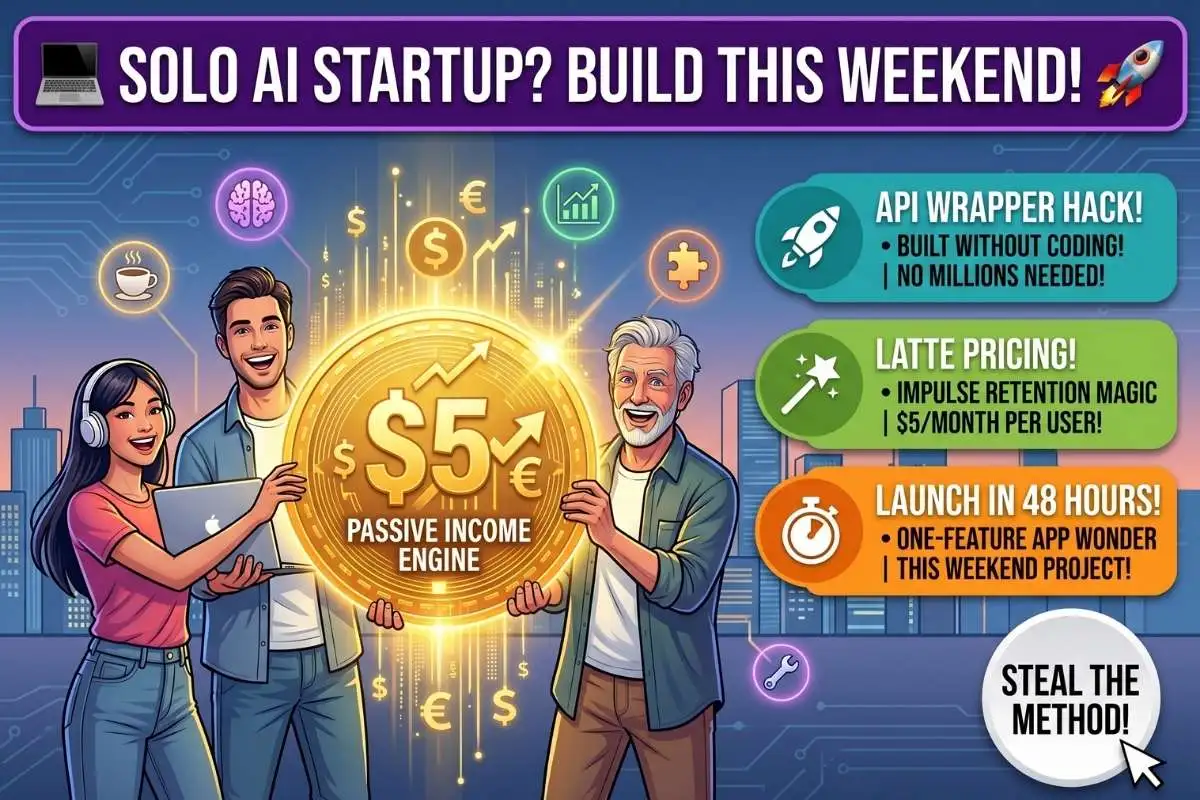
For decades, the standard playbook for launching a technology company felt like a grueling marathon reserved for elite insiders. You needed a deck of polished slides, months of pitch meetings with venture capitalists, a sprawling team of engineers, and millions of dollars in runway just to build a prototype. Over the last two years, generative artificial intelligence has completely inverted that model. Today, solo operators sit down on a Friday evening with a laptop and launch profitable, automated software businesses before Sunday night. They are not trying to build massive digital empires; instead, they hunt for a single, specific friction point in someone’s daily workflow and cure it with a simple application.
The Death of the Bloated Platform
The software industry spent the last twenty years trying to bundle every conceivable feature into massive platforms. While this created tech giants, it left everyday users exhausted by cluttered interfaces, steep learning curves, and high monthly bills. Consumers no longer want a complex Swiss Army knife when they only need a corkscrew. This shift has fueled the explosion of Software as a service sub-niches, specifically the Micro-SaaS. These ultra-lean businesses are operated by one person to solve one specific problem brilliantly well. By ignoring complex feature roadmaps and corporate overhead, solo founders can afford to charge radical, disruptive prices, turning a five-dollar monthly subscription into a compounding passive income engine.
Anatomy of a One-Feature Wonder
To succeed in this arena, your software must pass the classic toothbrush test: it needs to execute one specific task, but it must be a task your user performs frequently enough to justify keeping the tool around. Consider a simple tool designed strictly for real estate agents. Instead of navigating a complex marketing suite, the developer provides a single text box. The agent pastes in messy walkthrough notes, clicks a button, and instantly receives a compelling listing description ready for property platforms. It simply turns rough bullet points into polished sales copy in seconds. Because it directly saves the agent valuable typing time every week, paying five dollars a month feels like an absolute bargain.
The Weekend Blueprint and the API Wrapper Reality
A common misconception among aspiring creators is that you must hold an advanced computer science degree to build an intelligent application. In reality, the vast majority of profitable tools are what the developer community calls API wrappers. You do not need to spend millions training a language model from scratch. Instead, you act as the digital architect, utilizing an Application programming interface to securely connect your web interface directly to the processing power of industry giants. Your real value proposition is the intuitive interface and specialized prompt engineering you wrap around raw intelligence. A weekend builder can easily construct the visual front-end, plug in the intelligence behind the scenes, and launch.
The Unbeatable Psychology of the Five-Dollar Bill
Pricing a software product at five dollars a month unlocks a behavioral cheat code known in digital commerce as impulse retention. When a subscription costs thirty dollars, consumers scrutinize their bank statements constantly to evaluate whether they used the tool enough to justify the charge. However, five dollars sits comfortably beneath the psychological threshold of financial anxiety. It is the exact cost of an iced latte. Once a user experiences the initial burst of value, they rarely take the time to navigate to their account settings and cancel. For the solo operator, securing two thousand subscribers at this accessible price point translates to a reliable ten thousand dollars in monthly recurring revenue.
Customer Acquisition Without a Marketing Budget
Building a functional application over the weekend is only half of the equation; getting it in front of paying customers without spending a fortune on advertisements is where founders prove their resourcefulness. Successful operators rely heavily on transparent public building and organic distribution. By sharing their development journey, screen recordings, and authentic revenue metrics on social platforms, they generate natural curiosity and early sign-ups. Furthermore, creators harness targeted search engine optimization by generating highly specific landing pages addressing niche search queries. If an architect searches for a specialized note formatting tool, they land directly on your product, delivering a steady stream of targeted professionals discovering your simple solution organically.
Comparing the SaaS Landscapes
To understand why this lean startup model works so effectively in the modern economy, it helps to examine how a single-feature application directly contrasts with a traditional venture-backed platform. For years, the prevailing belief was that software had to be an all-encompassing destination. Founders believed that adding more features naturally justified charging higher prices. When enterprise software becomes too heavy, users look for lightweight alternatives. By comparing the operational metrics of both approaches side by side, we can clearly see why the micro-application model holds an asymmetric advantage for the independent creator.
| Feature Metric | Monolithic SaaS Platform | AI Micro-SaaS Application |
| Development Time | 6 to 18 months | 48 to 72 hours |
| Team Required | Specialized teams of engineers | Solo operator or amateur builder |
| Core Offering | Dozens of interconnected tools | One specific task executed well |
| Monthly Pricing | $30 to $150+ per user | $5 flat recurring fee |
| Primary Churn Reason | Feature bloat and high cost | Project completion or forgotten card |
Frequently Asked Questions
Won’t massive tech companies just copy my single feature?
This is the most common fear among solo developers, but it fundamentally misunderstands how large technology corporations operate. Giant companies have massive overhead and must pursue features that can generate tens of millions of dollars in new revenue. They cannot justify deploying valuable engineering resources to build, maintain, and support a tiny, five-dollar niche workflow tool. Furthermore, even if a major platform eventually adds a similar feature, your dedicated application will almost always remain faster, cleaner, and easier to use than a buried sub-menu inside a bloated corporate software suite.
How do I handle server costs if users generate lots of AI content?
The beauty of modern consumption-based billing is that you only pay for the exact computational power your users consume. When someone submits a request through your tool, the underlying artificial intelligence provider charges you a fraction of a penny for the processing tokens. By setting sensible monthly usage limits inside your five-dollar subscription tier, you can easily ensure that your profit margins remain exceptionally high—often hovering around eighty to ninety percent—making it practically impossible to lose money on an active subscriber.
Do I need to legally incorporate a business before launching?
When you are spending a single weekend validating a raw idea, speed is your ultimate priority. Most successful solo creators launch their initial prototypes as side projects under their own names or basic sole proprietorships to test the market first. Once the application successfully attracts its first ten or twenty paying subscribers and proves that real demand exists, you can then take the simple administrative steps to establish a formal limited liability entity and open dedicated business banking accounts.
The One-Percent Curiosity Wrap-Up
As you look at your computer screen this weekend, consider a fascinating statistic from the digital economy: nearly ninety-nine percent of internet users remain passive consumers their entire lives, endlessly paying monthly subscriptions to giant software conglomerates. By choosing to spend the next forty-eight hours building a single, highly focused solution to a tiny everyday problem, you cross over into the one percent of active digital creators. You do not need to invent a world-changing technology or raise millions in venture capital to achieve financial independence. You only need to find one small point of daily friction, build a reliable automated bridge over it, and offer it to the world for the price of a morning latte. The foundational tools have never been more accessible, the barrier to entry has never been lower, and your digital storefront is ready to be opened.