
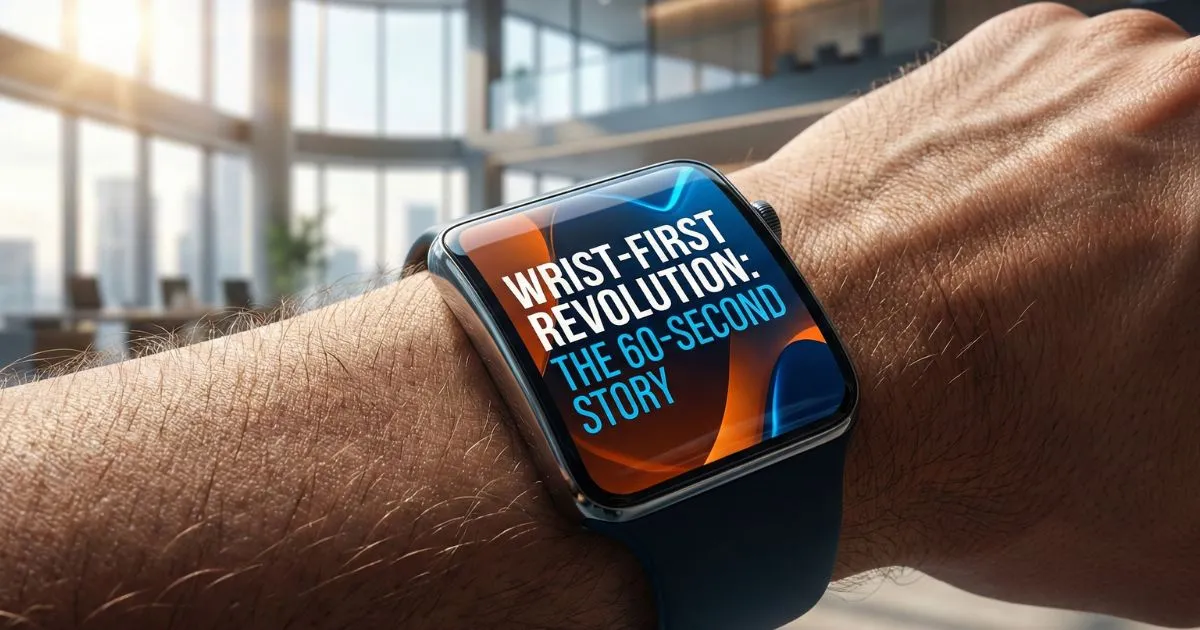
I remember sitting in a windowless boardroom back in 2019, listening to a consultant insist that long-form was the only way to build a real connection with a reader. We were all obsessed with the ten-minute read, the deep dive, the sprawling narrative that required a quiet afternoon and a large cup of coffee. But looking at the glow of my wrist today, that world feels like a distant memory. In 2026, the real estate that matters most isn’t measured in pages or pixels on a massive monitor, it is measured in the brief, flickering glances people give their smartwatches while waiting for an elevator or standing in line for a morning matcha.
The shift toward micro-publishing for wearables has been less like a sudden explosion and more like a slow, steady tide coming in. We used to think of the Apple Watch or the latest Samsung Gear as mere notification hubs, little buzzers on our skin that told us someone liked a photo or that a meeting was starting. But something changed. We realized that the intimacy of a device touching your body transforms the nature of the story itself. When a story vibrates against your wrist, it isn’t just data, it is a pulse.
Writing for this medium requires a level of discipline that most editorial teams aren’t prepared for. You have exactly one minute of their time, perhaps less. You have a screen the size of a postage stamp. If you waste the first three seconds on a generic introduction, you’ve lost them. They’ve already flicked their wrist away. This isn’t about shortening a long article, it is about creating a new architecture for human thought.
Watch-face stories and the art of the glanceable narrative
The concept of watch-face stories has forced us to abandon the traditional pyramid of journalism. There is no room for a lead, a body, and a conclusion in the way we once understood them. Instead, we are looking at a narrative that exists in a state of constant delivery. The prose has to be lean, almost skeletal, yet it must retain a sense of soul. I often find myself cutting adjectives like I’m trimming fat off a steak, leaving only the muscle of the idea behind.
One of the most fascinating aspects of this new era is how we use the physical limitations of the hardware to our advantage. The haptic engine is now as much a part of the storytelling as the words themselves. A subtle double-tap on the wrist can signal a shift in tone, or a long, slow vibration can build tension before a final reveal. We aren’t just writers anymore, we are choreographers of sensation. The goal is to make the reader feel the story before they even finish reading it.
In the finance world, this is particularly potent. Investors don’t want a 2,000-word analysis of a market shift when they are walking between terminals at O’Hare. They want the essence. They want the narrative arc of a stock’s movement delivered in a heartbeat. But they also want it to feel human. They are tired of the cold, robotic alerts that have dominated the last decade. They want to know the why behind the numbers, and they want it in a format that respects the frantic pace of their lives.
I’ve seen dozens of agencies try to port their mobile content directly to wearables, and they fail every single time. You cannot simply shrink a website. You have to understand that the psychology of a watch user is fundamentally different from a phone user. On a phone, the user is leaning in. On a watch, the user is being interrupted. To succeed in micro-publishing, you have to make that interruption a gift, not a nuisance.
The future of content is measured in heartbeats and haptics
As we look deeper into the year, the technical barriers that once held us back are dissolving. The integration of biometric data into the reading experience means the story can actually change based on the reader’s physiological state. If your watch senses your heart rate is elevated, the text might slow down, or the colors on the display might shift to a calming blue. This is the ultimate form of personalization, a story that literally breathes with the reader.
The future of content isn’t just about what we say, but where we say it. We are moving toward an ecosystem where the most valuable assets are those that can navigate the fragmented attention of the modern consumer. If you own a digital property that has mastered this, you aren’t just holding a website, you are holding a direct line to the most intimate parts of a person’s day. It’s why the market for these specialized content platforms has become so competitive.
I often wonder if we are losing something in this transition to the sixty-second story. There is a part of me that misses the slow burn of a long essay. But then I see someone catch a glimpse of their wrist, smile at a perfectly turned phrase in a micro-story, and realize that the medium doesn’t diminish the art, it only sharpens it. We are becoming more precise. We are learning how to say everything by saying almost nothing.
The challenge for those of us in the business of building and scaling these platforms is to maintain the integrity of the voice. It is easy to let AI take over the heavy lifting of summarization, but the moment you remove the human idiosyncrasy, the connection breaks. A watch is a personal object, often a piece of jewelry. It demands a personal touch. The stories we put on them must feel like they were written by a person, for a person, in that specific moment of their life.
The landscape is changing, and the “snackable” content we joked about a decade ago has become the main course. For those of us who have spent our careers navigating the shifts from print to web to mobile, this feels like the final frontier. We are no longer writing for a screen, we are writing for a person’s presence. It is a terrifying and exhilarating place to be. Whether you are building a boutique agency or looking to acquire a piece of this new digital real estate, the lesson remains the same: the smaller the screen, the bigger the impact.
We are just beginning to see what is possible when we stop trying to capture attention and start trying to earn it, one second at a time. The wrist is a small space, but the potential it holds is vast. As the technology continues to evolve, the stories will only get shorter, faster, and more essential. It is a race to the bottom in terms of word count, but a race to the top in terms of meaning.
