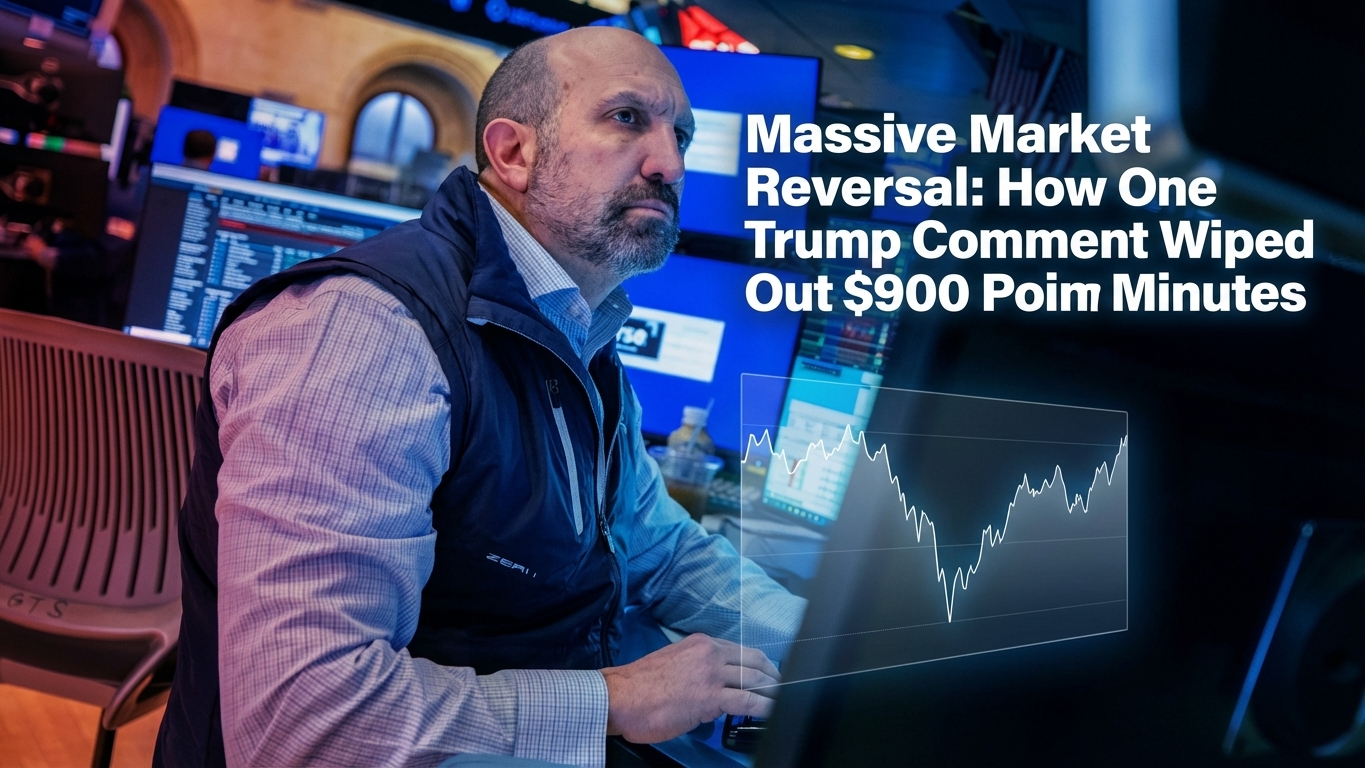
The stock market is less a reflection of rational analysis and more a massive, volatile mood ring subject to geopolitical whispers. What we witnessed yesterday was the purest form of this financial alchemy: a monumental session characterized by dizzying swings that left seasoned traders breathless. The Dow Jones Industrial Average staged a complete 180-degree turn, erasing a colossal intraday deficit of nearly 900 points to finish higher, powered by a single, highly impactful statement from the Commander-in-Chief regarding the Middle East conflict.
The session started looking like the prelude to a full-blown panic. Major indices were bloodied, indicative of deep fear embedded in the trading algorithms. The S&P 500, the benchmark for broad market health, had plummeted as much as 1.5 percent, mirroring similar sharp declines in the tech-heavy Nasdaq. This aggressive selling pressure stemmed directly from escalating tensions and confirmed fears that the conflict involving Iran could rapidly draw in global superpowers, triggering severe supply shocks in energy markets that everyone feared would derail global economic growth. Then came the pivot, swift and brutal for the bears.
President Trump’s casual declaration to a reporter suggesting the conflict was “very complete, pretty much” acted like a massive liquidity injection directly into the market’s collective veins. His assertion that Iran’s military capabilities were neutralized dramatically lowered the perceived risk premium attached to global oil prices. West Texas Intermediate crude, having briefly spiked well above $100 a barrel—a level seen by many analysts as the ignition point for recessionary pressures—retreated sharply, falling as low as $81\. This reversal in energy prices provided the immediate catalyst for every sector, allowing the indices to claw back their losses and then some. The Dow ultimately closed up 239.25 points, a nearly 0.5 percent gain, signifying the profound impact of geopolitical de-escalation news on capital markets.
The $100 Oil ‘Apple Cart’ That Almost Tipped Over
To fully appreciate the significance of the market’s rebound, one must understand the gravity of the preceding oil spike. West Texas Intermediate crude hitting $119 per barrel is not just a number on a ticker; it represents a direct tax increase on every consumer and manufacturer globally. Since the year began below $60, this ascent was stratospheric, exacerbated by supply disruptions, including reported production cuts from key Middle Eastern producers like Iraq whose output allegedly plunged by 70 percent following events surrounding the Strait of Hormuz. When oil prices breach critical psychological barriers like $100, investors rapidly price in inflation surges, reduced corporate margins, and a chilling effect on discretionary spending, which naturally forces massive portfolio de-risking.
The panic selling seen earlier in that Monday session was the street anticipating a drawn-out, costly engagement. Portfolio managers were busy shrinking exposure, fearing that sustained $110 or $120 oil would force central banks into aggressive tightening policies to combat imported inflation, creating the dreaded stagflationary environment. The consensus among many high-level fixed-income managers was that if oil stayed stubbornly high, recession probability spiked significantly. This explains the nine-hundred-point deficit the Dow had to overcome; it was the price of an afternoon filled with visions of economic stagnation.
Portfolio manager John Luke Tyner provided a crucial perspective, suggesting that this “little blip” above $100 might not have been damaging enough to cause permanent harm to the corporate earnings outlook, provided the situation normalized quickly. This sentiment validates the market’s quick reaction to positive news. Traders were essentially testing the sustainability of the oil price shock. Trump’s comments provided the external validation necessary for them to pivot from panic selling back toward risk-on buying, expecting normalization back into the $65 to $75 range, the “happy medium,” soon.
The fact that the market could absorb such extreme volatility and still close positive speaks volumes about underlying liquidity and the deep desire of institutional money to remain invested, provided the immediate tail risk of geopolitical expansion fades. The bounce was fundamentally a victory for the bulls betting on swift de-escalation over the bears betting on commodity super-cycles.
Semiconductors Provide the Technical Tailwinds
While oil provided the macro shift that unlocked buying capacity, the technical bounce in specific high-growth sectors provided the tangible momentum needed to sustain the rally into the closing bell. Semiconductor stocks, often viewed as the canary in the coal mine for technology and future capital expenditure cycles, roared back with impressive force. Nvidia, Broadcom, and Micron Technology all posted substantial gains, indicating that technical demand in crucial technology hardware remains robust irrespective of short-term geopolitical scares.
Broadcom gaining over four percent and both Micron and AMD seeing five percent climbs suggests that the sell-off earlier in the day was indiscriminate, sweeping up high-quality growth names along with the commodity-exposed or interest-rate-sensitive stocks. When the risk-off trade reverses so dramatically, the first money often flows back into the market leaders known for strong balance sheets and secular growth paths. This suggests that the foundational investment thesis around digital transformation and AI infrastructure remained intact.
This sector leadership during the rebound is a crucial technical signal. It confirms that the market’s focus is swiftly returning to earnings power and innovation rather than just immediate macro headlines. Had the market closed higher solely on the back of energy stocks swinging back, it would suggest a purely cyclical, short-term reaction. Instead, the involvement of major tech players indicates that money managers are aggressively repositioning for growth again, viewing the earlier decline as a temporary aberration, a “dip to buy” opportunity, rather than the beginning of a structural market downturn.
The performance of these chipmakers is particularly important when considering the health of the broader economy, including the \*\*S&P/TSX Composite Index\*\* in Canada, which remains deeply intertwined with US tech demand and commodity cycles. Strong US tech demand signals robust global capital flows, which is a net positive for exporter-heavy markets everywhere.
Historical Parallels: When Geopolitics Drives Volatility
We have seen market tantrums before where geopolitical events momentarily dominate trading, only for risk assets to rally sharply once uncertainty dissipates, or at least becomes less acute. Think back to the Cuban Missile Crisis, where markets experienced extreme fear but recovered quickly once the direct threat of nuclear exchange was off the table. More recently, similar sharp, V-shaped recoveries occurred following initial shocks after major terror attacks or sudden military escalations in the Middle East.
The key commonality in all successful recoveries is the speed of perceived resolution. Wall Street absolutely loathes ambiguity. A clear, though perhaps temporary, pathway out of conflict—like the suggestion that Iran’s organized military response capabilities were crippled—allows algorithms to instantly recalculate risk exposure. This mirrors scenarios where unexpected Federal Reserve commentary or surprisingly strong employment numbers cause sharp but temporary dislocations followed by a rapid snap-back toward established trends.
It is vital to remember that this market was coming off its biggest weekly slide in nearly a year coming into Monday. This built-in fragility meant that any catalyst, positive or negative, would be amplified. The massive weekly slide meant that many funds were likely underweight risk heading into the week, creating an environment where forced buying—or “short covering” fueled by positive news—could become self-perpetuating, driving prices even higher than fundamentals strictly dictated in the short term. The 900-point intraday swing wasn’t just value returning; it was fear being violently ejected from portfolios.
Moreover, the fact that G7 energy ministers were already planning virtual meetings to discuss releasing strategic oil reserves provided a crucial safety net. Even before Trump’s definitive comments, the market knew coordinated international action was imminent if oil prices spiked excessively. This layered response—a combination of political signaling and institutional preparedness—reduced the maximum downside scenario, encouraging the rapid return of capital.
Scenarios Ahead: What Happens After the Volatility Flush?
This massive intraday reversal presents three distinct pathways for investors navigating the coming weeks. The first, and perhaps most optimistic scenario, is the Normalization Scenario. Under this view, Trump’s statement solidifies diplomatic maneuvering, the market believes the primary threat of sustained $120+ oil is gone, and prices consolidate in the $70 to $85 range. This allows global growth to remain intact, corporate earnings projections stay healthy, and the indices like the Dow Jones Industrial Average continue a steady upward grind, using this market volatility as a base building exercise.
The second, more cautious pathway is the Lingering Tension Scenario. Here, the market suspects the de-escalation is fragile. While oil retreats from its peak, it stabilizes uncomfortably high, perhaps staying near $90 due to underlying strategic vulnerability in the Strait of Hormuz or uncertainty over domestic Iranian response capabilities. If this occurs, volatility remains elevated. Investors will treat any dips as short-term rallies rather than sustained recoveries, preferring a more defensive allocation, perhaps favoring value sectors over high-flying technology until genuine, sustained peace is verifiable. The recent gains could prove fleeting as inflation concerns simmer just beneath the surface.
The final, most bearish pathway is the Recalibration Event. This scenario hinges on skeptics being correct: that the underlying geopolitical pressure remains, and political statements proved temporary. If oil prices quickly reassert upward pressure—perhaps due to an unexpected incident in the Strait—the market will likely fall back to test the session low. Having witnessed a 900-point reversal, investors will be acutely aware of their exit points. Any sustained break below the indices’ recent weekly lows could trigger further systematic selling, as the market realizes the “cheap price to pay” mentioned by Trump is actually proving to be a significant drag on economic output, regardless of the conflict’s duration.
For now, the immediate market psyche suggests the first scenario is winning. The speed and breadth of the recovery, spearheaded by technology, indicate that capital is eager to deploy, provided the geopolitical clouds part, even slightly. The key variable moving forward remains the energy markets, and whether they settle into a comfortable equilibrium or remain poised for the next explosive spike. Watch crude oil inventory reports and any nuanced clarification from diplomatic channels for the next signal that will truly determine the market’s sustained direction post-this massive rebound.
FAQ
What was the primary catalyst for the massive intraday market reversal described in the article?
The primary catalyst was a statement from President Trump suggesting that the recent conflict involving Iran was ‘very complete, pretty much.’ This declaration dramatically lowered perceived geopolitical risk, especially concerning energy supply shocks.
How large was the Dow Jones Industrial Average’s intraday deficit before it reversed?
The Dow Jones Industrial Average had erased a colossal intraday deficit of nearly 900 points from its low point during the session. It ultimately recovered to close higher, finishing up 239.25 points.
How did the reversal in oil prices directly impact the stock market recover Y?
The easing of oil prices, specifically West Texas Intermediate (WTI) retreating sharply from over $100 a barrel, reduced recessionary fears baked into the market. This reduction in energy price risk immediately lowered the perceived premium on global assets, encouraging buyers to step back in.
What critical psychological barrier in oil prices was breached before the market panic set in?
The market panic intensified when West Texas Intermediate (WTI) crude briefly spiked well above the $100 per barrel psychological barrier. This level is widely seen by analysts as the ignition point for major inflation and recessionary pressures.
Which specific high-growth sector provided the technical momentum needed to sustain the market rally after the macro shift?
Semiconductor stocks provided the crucial technical tailwinds for the late-session rally. Key players like Nvidia, Broadcom, and Micron Technology posted substantial gains, signaling robust underlying demand in technology hardware.
What does the strong rebound in semiconductor stocks suggest about the market’s long-term focus?
The robust performance of chipmakers indicates that money managers are rapidly shifting focus back to earnings power and secular growth trends like digital transformation. It suggests the decline was viewed as a temporary aberration rather than the start of a structural market downturn.
Why did portfolio managers anticipate an aggressive tightening policy from central banks?
Managers feared that sustained high oil prices (above $110) would cause severe imported inflation, forcing central banks to aggressively raise interest rates. This combination of high inflation and slow growth is the dreaded stagflationary environment most investors seek to avoid.
What specific supply disruption exacerbating oil prices did the article mention?
The article noted concerns over supply disruptions, specifically referencing reports that oil output from key Middle Eastern producers like Iraq had allegedly plunged by 70 percent following events surrounding the Strait of Hormuz.
According to portfolio manager John Luke Tyner, why might the brief oil spike not cause permanent damage?
Tyner suggested that if the situation normalized quickly following the blip above $100, the short-term price shock might not significantly harm the broader corporate earnings outlook. This validates the market’s quick pivot back to risk-on once clarity emerged.
What is the ‘Normalization Scenario’ for the market moving forward after this volatility flush?
The Normalization Scenario posits that Trump’s comments solidify diplomatic efforts, keeping oil prices consolidated between $70 and $85 per barrel. This allows expectations for global growth and corporate earnings to remain intact, supporting a steady upward grind for indices.
What is the ‘Lingering Tension Scenario,’ and what is its implication for investor allocation?
In this cautious scenario, oil stabilizes uncomfortably high around $90 due to lingering strategic vulnerabilities, such as in the Strait of Hormuz. This would keep volatility elevated, leading investors to favor more defensive allocations over high-flying technology stocks.
What must happen for the ‘Recalibration Event’ (bearish pathway) to occur?
This bearish scenario occurs if geopolitical pressure remains strong and the positive political statements prove temporary, causing oil prices to quickly reassert their upward trajectory. A sustained break below recent weekly lows in the indices could then trigger systematic selling.
What role did anticipation of coordinated international action play in limiting the downside risk?
The market knew that G7 energy ministers were already preparing virtual meetings to discuss releasing strategic oil reserves. This imminent safety net reduced the maximum potential downside risk associated with extreme oil prices, encouraging the rapid return of capital.
How did the prior massive weekly slide impact the market’s reaction to the news?
The market entered Monday fragile after its biggest weekly slide in nearly a year, meaning many funds were underweight risk heading into the session. This built-in fragility amplified the intraday swing through rapid short covering fueled by positive news.
What fundamental trait of Wall Street did the V-shaped recovery exploit?
The recovery exploited Wall Street’s intense aversion to ambiguity. A clear, even if temporary, pathway out of conflict allows trading algorithms to instantly recalculate and aggressively unwind risk exposure.
What range are traders expecting oil to settle into as the ‘happy medium’ following the de-escalation?
Following the positive news, traders began expecting oil prices to normalize back into the $65 to $75 range. This range is considered the comfortable equilibrium that supports current economic projections.
What specific technical signal did the rally signal regarding the market’s underlying health?
The breadth of the recovery—spearheaded by major tech players rather than just energy—is a crucial signal. It confirms that money is aggressively repositioning for growth, suggesting the dip was a buying opportunity.
What index alongside the Dow was mentioned as being intertwined with US tech demand and commodity cycles?
The article mentioned the S&P/TSX Composite Index in Canada as being deeply intertwined with US tech demand and commodity cycles. Strong US tech performance signals robust global capital flows beneficial to exporter-heavy markets like Canada’s.
What type of selling pressure characterized the market at the start of the session before the comments were made?
The market experienced aggressive selling pressure characterized by deep fear embedded in the trading algorithms. The S&P 500 had plummeted as much as 1.5 percent, reflecting fears of a major global economic derailment.
What made the trading session described as a ‘financial alchemy’?
It was termed ‘financial alchemy’ because the market performed a complete 180-degree turn, wiping out nearly 900 points of losses to close higher, powered by a single verbal declaration rather than fundamental economic data.
What key reports should investors watch for the next directional signal in the market?
Moving forward, investors should closely monitor crude oil inventory reports and any nuanced clarifications emerging from diplomatic channels. These factors will determine if oil settles into equilibrium or remains poised for the next major spike after this rebound.