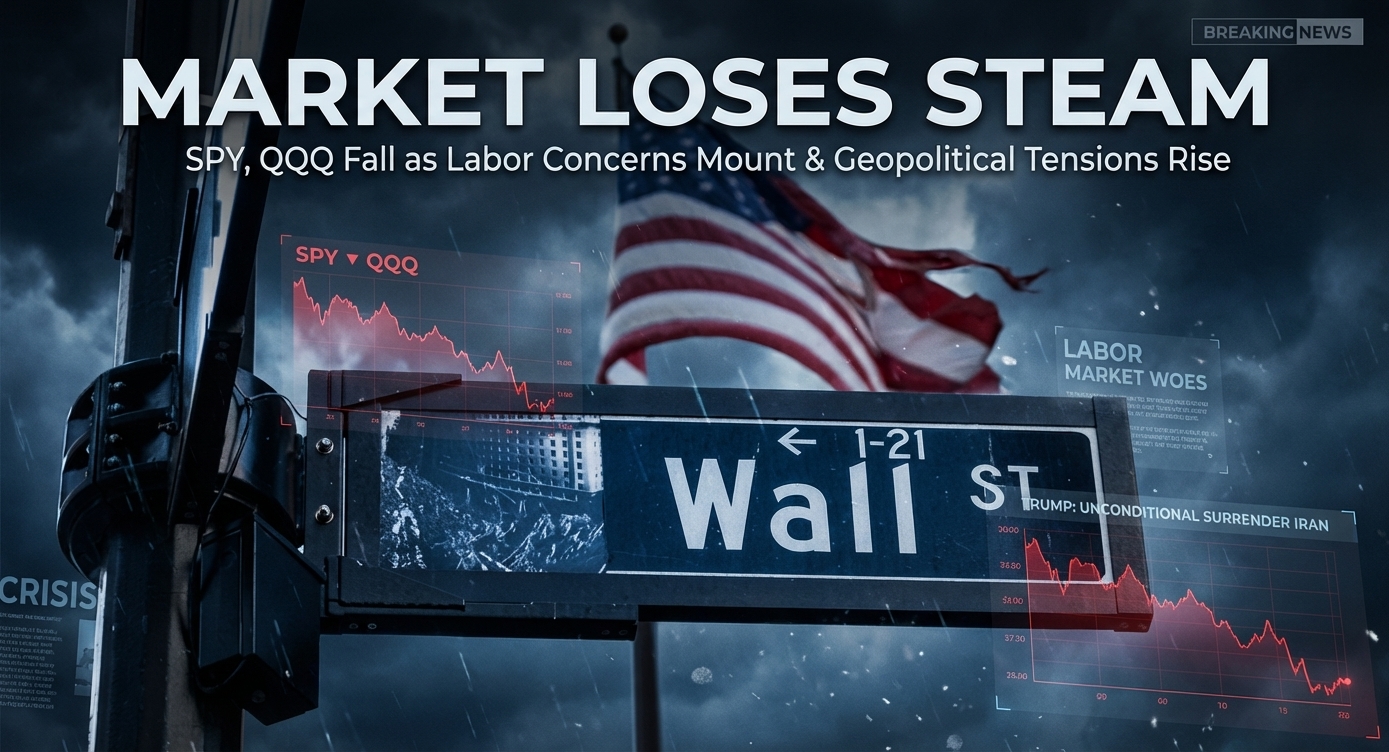
The global financial narrative flipped on a dime this Friday, sending shockwaves through the core indices that define modern market health. When both the behemoth \*\*SPY\*\*, tracking the S&P 500, and the tech-heavy QQQ falter in tandem, it signals a deep-seated unease, not merely sector rotation. This wasn’t a quiet correction; it was a sudden, collective gasp from investors digesting two simultaneous, high-stakes catalysts: disappointing labor market figures and a rapidly escalating geopolitical crisis involving Iran. For those paying attention, the signals were flashing red, demanding a fundamental shift from risk-on exuberance to defensive positioning, evidenced by capital flooding into the stoic safety of consumer staples. The immediate impact registered clearly across Wall Street’s benchmark averages. The failure of the \*\*SPY\*\* to maintain upward momentum signaled that the broadest measure of American corporate health was under pressure. Simultaneously, the QQQ’s descent highlighted a growing nervousness about future growth expectations, often the lifeblood of technology stocks. What drove this risk-off sentiment so definitively was the Bureau of Labor Statistics report, which painted a less rosy picture of employment than many optimistic trading desks had hoped for. A wobbling labor market acts as a direct drag on aggregate demand, making future corporate earnings projections immediately suspect. Overlay this foundational economic uncertainty with the unprecedented volatility introduced by escalating international tensions, specifically reports surrounding a U.S.-Iran conflict entering its seventh day, and you have the perfect recipe for market paralysis. Investors hate uncertainty, and on Friday, they received a double dose of the most toxic kind. When we look back at historical reversals, periods of simultaneous economic weakness and geopolitical flare-ups create specific market footprints. Think back to the initial phases of the COVID-19 panic in early 2020, where employment concerns merged with the unknown threat of a global shutdown. Or consider the oil shocks of the 1970s, where stagflation—stagnant growth coupled with high inflation—was the terrifying reality driven by Middle East disruptions. What we are witnessing now is a nascent convergence of these pressures. The 2021-2022 recovery thesis was built upon robust employment and low perceived geopolitical risk. When employment starts sputtering, that foundation cracks. When an active, significant conflict manifests in a critical energy-producing region, the narrative shifts from managing inflation to managing scarcity and sudden cost spikes, something the market has not priced in adequately. The memory of past stagflationary spirals is long, and even the hint of a recurrence prompts aggressive de-risking. The technical breakdown offers a clearer window into investor psychology. The defensive rotation away from cyclicals and into staples tells us that fund managers are preparing for a scenario where the consumer pulls back spending drastically. Consumer staples—food, soap, basic necessities—are recession-proof, but not recession-proof in the short term. They are the last line of defense. Conversely, the catastrophic underperformance of the consumer discretionary sector reveals where the pain point lies. Rising gas prices, an indirect but powerful consequence of Middle East instability, act like an invisible tax on every consumer. When households must allocate more budget to filling tanks and buying necessities, they naturally slash spending on travel, new electronics, and dining out. This direct negative correlation between energy costs and discretionary spending is a primary mechanism suppressing projections for retailers and leisure companies, hammering the stocks within the \*\*SPY\*\* that track these areas. Drilling deeper into the mechanics, the job report’s specific metrics—perhaps a rise in the unemployment rate or softening wage growth—are crucial context for the Federal Reserve’s next moves. Any sign that the labor market is cooling below inflationary levels can be interpreted in two ways: either the economy is achieving a soft landing, or it is crashing headlong into a recession. Given the external shock of an active military engagement affecting global shipping and energy flow, traders are defaulting to the recessionary interpretation, which necessitates immediate pessimism regarding future corporate earnings. Nobody wants to hold growth stocks when future cash flows are suddenly discounted at a higher risk premium due to war premium, and this directly impacts the QQQ. The market’s current posture suggests that leverage built up during the easy money era is being aggressively unwound. High-beta stocks, those most sensitive to economic swings, are the first to be jettisoned during perceived crises. The initial reaction is often panic selling, leading to volatility products soaring. While this article does not detail the performance of every esoteric instrument, it is worth noting that instruments designed to track fear, such as the \*\*BATS:UVXY\*\*, would likely see substantial upward pressure as options traders rush to hedge against further sharp declines in the core index ETFs. The willingness of capital to flee even relatively stable equities highlights a severe liquidity crunch fear, a key characteristic of a genuine market panic, not just a routine pullback. Looking ahead, three distinct scenarios emerge for the near-to-medium term trajectory of the market, driven primarily by how these twin shocks resolve themselves. The first, and perhaps most benign scenario, involves a rapid diplomatic de-escalation in the Middle East. If tensions subside within the next two weeks, allowing oil prices to retreat substantially, the market could stage a sharp “short squeeze” rally. Investors who sold risk assets would rush back in, hoping to capture the rebound, viewing the current downturn as an overreaction to geopolitical noise rather than a fundamental shift. This scenario relies heavily on swift political maneuvering trumping military momentum. The second scenario posits a prolonged, low-intensity conflict—the slow burn. In this middle ground, Middle East tensions remain elevated, keeping the energy risk premium locked in at current high levels, exacerbating inflation fears. Concurrently, the labor market continues to show signs of deterioration, forcing the Federal Reserve into an impossible bind: fight inflation with high rates or pivot to support a crumbling employment picture. If the Fed stalls, the market grinds sideways or slowly lower, punishing companies that rely on cheap capital or robust consumer spending, keeping the \*\*SPY\*\* under constant downward pressure as earnings estimates are repeatedly revised downward across the board. The final, most damaging scenario involves a full-scale escalation in the conflict, leading to sustained supply chain disruptions far beyond just oil markets, possibly involving key chokepoints like the Strait of Hormuz. This path almost guarantees a deep recession. Energy prices would spike uncontrollably, pushing inflation far beyond the Fed’s target and forcing a brutal tightening cycle or, perhaps more likely, a collapse in consumer confidence that renders monetary policy irrelevant. In this environment, the defensive positioning seen Friday would become permanent, and equities across the board, including staples, would see valuations contract significantly as investors prioritize capital preservation above all else until a clear bottom is established, a process that could take many agonizing months. The interplay between the invisible hand of job creation and the very visible hand of geopolitical power projection has created a tight squeeze for markets currently riding a threadbare margin for error. The consensus trade of the past year—buying the dip on any sign of resilience—is being severely tested by fundamental data points suggesting demand destruction is already underway, exacerbated by an external threat that nobody can model accurately. The resilience of consumer staples demonstrated a necessary, if grim, understanding of immediate risk, but the decline in the major indices shows that structural confidence in robust growth has evaporated. As we monitor diplomatic cables alongside the next Non-Farm Payrolls release, the market is holding its breath, waiting to see which force—labor dynamics or kinetic conflict—will ultimately dictate the direction of capital flows for the rest of the quarter.
FAQ
What two simultaneous catalysts caused the market shockwave affecting SPY and QQQ?
The market shockwave was driven by high-stakes catalysts: disappointing labor market figures and a rapidly escalating geopolitical crisis involving Iran. This combination signaled deep-seated investor unease, leading to a collective gasp on Friday.
Why is the tandem decline of both SPY and QQQ significant for market health?
When both the broad S&P 500 tracker (SPY) and the tech-heavy QQQ fall together, it signals systemic pressure rather than simple sector rotation. This tandem decline indicates a fundamental worry affecting the entire health of American corporate performance and future growth expectations.
How does disappointing jobs data negatively impact projected corporate earnings?
A wobbling labor market directly drags on aggregate demand, making future corporate earnings projections immediately suspect as consumers potentially pull back spending. This economic uncertainty forces investors to re-evaluate the fundamental strength underpinning market valuations.
What historical market condition, analogous to the current situation, concerns investors regarding the interplay between economic weakness and geopolitical flare-ups?
Investors are concerned about a nascent convergence similar to the stagflationary spirals of the 1970s, where stagnant growth coupled with high inflation was driven by Middle East disruptions. The combination of sputtering employment and energy cost shocks raises the specter of similar macroeconomic instability.
Which sectors demonstrated defensive positioning amid the recent market decline?
Capital was seen flooding into consumer staples, which are viewed as recession-proof because they sell necessities like food and basic necessities. This move indicates fund managers are preparing for a scenario where discretionary consumer spending is drastically pulled back.
What technical indicator signals the pain point in consumer spending mentioned in the article?
The catastrophic underperformance of the consumer discretionary sector reveals where the pain point lies among households. Rising gas prices, driven by geopolitical instability, act as an ‘invisible tax,’ forcing consumers to slash spending on non-essentials like travel and new electronics.
How does escalating geopolitical tension translate into a negative feedback loop for companies tracked by the QQQ?
Geopolitical turmoil, especially concerning energy markets, introduces volatility and a ‘war premium’ that raises the risk associated with future cash flows. Growth stocks, heavily represented in the QQQ, are heavily penalized when future earnings visibility is degraded by external conflict.
What happens to high-beta stocks during periods of perceived market crisis?
High-beta stocks, being the most sensitive to economic swings, are typically the first assets to be jettisoned during perceived crises. This rush to sell often leads to panic selling and a soaring in volatility products.
What instrument, designed to track fear, would likely see upward pressure during this type of market decline?
Instruments designed to track fear, such as BATS:UVXY, would likely see substantial upward pressure as options traders rush to hedge against sharp declines in core index ETFs. This indicates a severe liquidity crunch fear among panicked market participants.
What federal economic data is crucial context for anticipating the Federal Reserve’s next moves after the recent job report?
The specific metrics within the job report, such as changes in the key unemployment rate and softening wage growth, are crucial. These figures help determine if the labor market is cooling enough to halt inflation without triggering an outright recession.
In the context of the job report, why are traders defaulting to a recessionary interpretation over a soft landing?
Traders are defaulting to the recessionary interpretation because the external shock of active military engagement affecting global shipping and energy overrides positive domestic data. This immediate fear necessitates pessimism regarding future corporate earnings projections.
What characterizes the most benign, best-case scenario for the market in the near-to-medium term?
The most benign scenario involves a rapid diplomatic de-escalation in the Middle East within the next two weeks, causing oil prices to retreat substantially. This could trigger a sharp ‘short squeeze’ rally as investors rush back into risk assets.
What defines the ‘slow burn’ or middle-ground scenario for the market trajectory?
The slow burn scenario involves prolonged, low-intensity conflict keeping the energy risk premium locked in at high levels while the labor market continues to deteriorate. This forces the Fed into an impossible bind between fighting long-term inflation and supporting job growth.
How would the Federal Reserve typically react under the pressures described in the ‘slow burn’ scenario?
Under the slow burn scenario, the Fed would struggle to set a clear policy path, potentially stalling monetary action or continuing policy that exacerbates the underlying economic struggles. This inability to effectively respond keeps the SPY under constant downward pressure.
What conditions constitute the most damaging scenario for equity markets moving forward?
The most damaging scenario involves a full-scale escalation of the conflict leading to sustained supply chain disruptions beyond just oil markets. This would almost guarantee a deep recession driven by uncontrolled energy price spikes and inflation.
In a deep recession scenario triggered by conflict escalation, what happens to the positioning seen last Friday?
The defensive positioning seen Friday would become permanent as investors prioritize capital preservation above all else, causing valuations to contract significantly across nearly all equities, including previously stable consumer staples.
What foundational thesis of the 2021-2022 recovery period is being undone by current events?
The 2021-2022 recovery thesis was heavily built upon assumptions of robust underlying employment figures and a low perceived geopolitical risk environment. Both these pillars are now showing significant cracks.
Why are investors who were conditioned to ‘buy the dip’ suddenly finding their strategy severely tested?
The strategy of buying perceived dips is being tested because fundamental data now suggests demand destruction is already underway, exacerbated by an external threat that cannot be accurately modeled. This suggests price drops are based on collapsing fundamentals, not transient noise.
What negative consequence does the article attribute to rising gas prices acting as an ‘invisible tax’ on consumers?
Rising gas prices force households to allocate more budget to necessities, which consequently forces them to slash spending on discretionary items like travel and leisure. This directly suppresses revenue projections for companies in the discretionary sector.
What does the flight of capital from cyclicals to staples reveal about investor expectations for consumer spending?
The rotation into staples reveals that fund managers expect the consumer to pull back spending drastically in the immediate future, as staples represent the bare necessities needed even during economic contraction. This indicates short-term pessimism about robust consumer behavior.
What two key data points must investors monitor together to dictate the market’s direction for the rest of the quarter?
Investors must closely monitor diplomatic cables/geopolitical developments alongside the next formal Non-Farm Payrolls release. The resolution of kinetic conflict versus underlying labor market dynamics will ultimately dictate short-term capital flows.