If you logged into your Amazon Kindle Direct Publishing (KDP) dashboard this past month only to find your top-selling lined journals, habit trackers, and puzzle books suddenly marked as “Blocked” or completely removed from the marketplace, you are definitely not alone. June 2026 will be forever etched into the memories of independent publishers as the month Amazon officially closed the floodgates on mass-produced, low-effort book content. For years, the dream of passive income lured thousands of creators into the low-content publishing space. The strategy was deceptively simple: upload hundreds of identical interiors with slightly modified, colorful covers, sit back, and watch the royalties roll in. However, that era has officially ended. The retail giant has deployed a massive algorithm update aimed at cleansing the platform of repetitive, automated, and unoriginal publications. This sweeping ban wave has left countless self-published authors scrambling to save their digital empires, wondering what exactly triggered the suspension of their accounts and how they can adapt to these strict new rules before they lose their primary source of income forever.
The Evolution of Low-Content Publishing and the Breaking Point
The rise of low-content books began as a brilliant entrepreneurial loophole that democratized book creation. A low-content book is traditionally defined as a publication with minimal or no text on the interior pages, designed explicitly to be filled in by the user. Think of blank notebooks, fitness logs, gratitude journals, and basic daily planners. In the early days, KDP welcomed this influx of products because it filled a massive consumer demand for affordable, niche-specific stationery. Anyone with an internet connection and basic graphic design skills could build a thriving business. However, as automated tools and artificial intelligence became more sophisticated, the marketplace became severely oversaturated. Unscrupulous publishers began utilizing bots and template generators to mass-produce tens of thousands of books per day, entirely clogging the search results and frustrating genuine customers looking for quality products. By early 2026, the sheer volume of identical, auto-generated content forced Amazon’s hand. Recognizing that customer trust was rapidly eroding, Amazon fundamentally changed how its algorithm evaluates and ranks content. The introduction of the updated A10 algorithm wasn’t just about matching keywords anymore; it was designed to analyze semantic relevance, user engagement, and most importantly, the actual uniqueness of the interior file. As detailed in the broader history of Self-publishing, platforms must constantly balance open access with strict quality control, and Amazon finally tipped the scales heavily toward the latter to protect its readers.
Anatomy of the June 2026 Purge: What Triggered the Bans
To understand how to protect your portfolio, you must first understand exactly what the newly deployed detection systems are targeting. The June 2026 purge did not ban low-content books outright; rather, it aggressively penalized a specific set of lazy publishing behaviors that were previously tolerated. The primary trigger for removal was duplicate interiors. For years, a common strategy involved taking one single 120-page lined interior and attaching it to five hundred different floral covers. Under the new KDP content guidelines, this is now classified as marketplace spam. Amazon’s internal systems cross-reference the digital fingerprint of your interior manuscript against millions of other files in their massive database. If your book offers zero differentiation from a hundred others in your catalog, it is flagged for immediate suppression. Another major target was keyword stuffing in titles and subtitles. Titles like “Lined Journal Notebook Cute Pink Flowers For Girls Women School Office” are now an instant red flag. The modern algorithm uses Natural Language Processing to detect robotic, unnatural phrasing that no human would ever speak. Furthermore, strict new artificial intelligence disclosure rules were activated. While authors are still permitted to use AI to assist in creating content, failing to disclose fully AI-generated interiors or covers during the upload process has resulted in immediate, permanent account terminations. The new transparency mandate means you can no longer hide behind anonymous generation tools if you want to participate in Amazon Kindle Direct Publishing.
Defending Your KDP Account: Strategies for the New Era
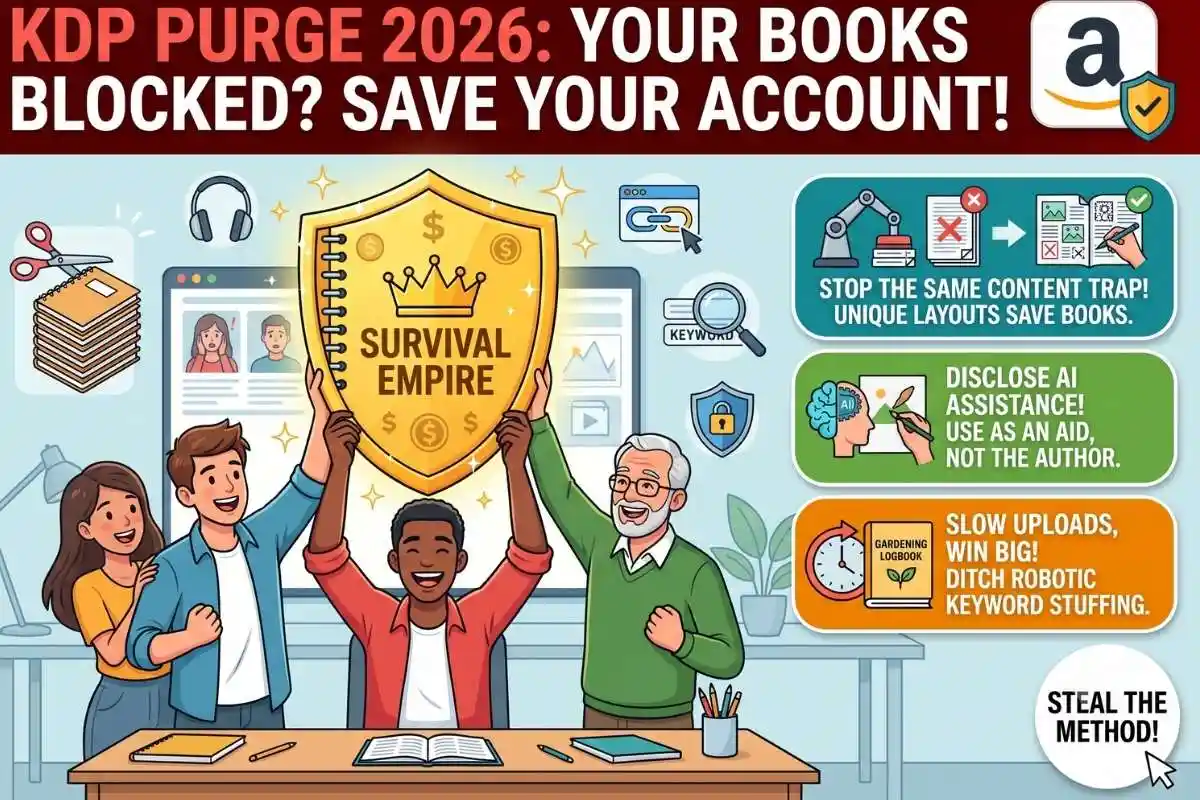
If your account survived the purge, or if you are currently trying to rebuild after a devastating suspension, your entire business model must pivot immediately from sheer quantity to exceptional quality. The old “upload and pray” method is officially dead. Moving forward, survival in the low-content space requires treating your books like genuine, branded products rather than disposable digital commodities. First, you must create substantial interior variation. If you are publishing a series of fitness trackers, do not just lazily change the cover graphic; adjust the interior layouts, add helpful instructional pages, incorporate unique graphics, and provide real structured value that a customer cannot get from a generic dollar-store notebook. Secondly, you need to slow down your upload velocity. Amazon now actively monitors how fast accounts are publishing new titles. Dumping fifty books into the review queue in a single afternoon will automatically trigger a manual audit of your account. You must also clean up your metadata. Write titles that sound like they were crafted by a human being, designed specifically for a human reader. Limit your backend keywords to hyper-relevant, targeted phrases rather than desperately stuffing every possible synonym into the backend fields. Finally, embrace off-platform marketing. The new algorithm heavily rewards books that bring external traffic to Amazon. By building a dedicated brand presence on platforms like TikTok, Pinterest, or Instagram, you signal to Amazon that you are a legitimate publisher driving genuine interest, which drastically insulates your account from automated purges.
Navigating AI and the Future of Self-Publishing Tools
The rapid integration of Artificial Intelligence into the self-publishing ecosystem has been a double-edged sword, and the June 2026 KDP update tackled this issue head-on. Many publishers fell into the trap of using AI image generators to create hundreds of intricate coloring book pages or puzzle layouts with a single click, only to find those books permanently blocked during the ban wave. Amazon has not outlawed AI, but they have drawn a very distinct, non-negotiable line between “AI-assisted” and “AI-generated” content. If an AI tool handled the heavy lifting—meaning it generated the actual core text, the cover artwork, or the interior graphics—you must explicitly check the AI disclosure box when setting up your title in the dashboard. Attempting to bypass this requirement is a critical violation of their updated terms of service. Authors must now maintain meticulous records of their creative process. If KDP flags your account for suspected AI policy violations, you will need to provide original design files, layered project documents, or version histories to prove your case and successfully appeal the ban. Consequently, the most successful independent publishers are now using AI strictly as a collaborative assistant. They use it to brainstorm niche ideas, optimize their product descriptions, or refine their marketing copy, but they rely heavily on human creativity and professional design software to execute the final, unique product. This hybrid approach not only keeps your account safe from algorithmic purges, but it also results in a significantly higher-quality book that naturally attracts better, more authentic customer reviews.
The Strategic Shift: At a Glance
| Publishing Element | Pre-2026 Low-Content Strategy | Post-June 2026 Survival Strategy |
| Interior Files | Duplicated exactly across hundreds of covers | Unique, structured, and highly customized layouts |
| Upload Velocity | Mass bulk uploads (dozens of books per day) | Deliberate, paced releases (no more than 3 a day) |
| Metadata & Titles | Keyword-stuffed, robotic, unreadable sentences | Clean, human-readable semantic titles and subtitles |
| AI Generation | Fully automated generation without any disclosure | Strictly disclosed, heavily edited and modified content |
| Marketing Focus | Relying purely on Amazon organic search results | Driving external traffic via social media and email |
Frequently Asked Questions About the KDP Ban Wave
What exactly qualifies as a low-content book under the new 2026 KDP rules?
A low-content book is defined as any publication that features minimal or entirely absent interior text, requiring the customer to fill in the pages. Standard examples include blank diaries, lined notebooks, basic planners, and simple logbooks. Notably, Amazon explicitly states that low-content books are not eligible for free KDP ISBNs or the “Look Inside” feature unless you provide your own professional barcode and formatted files.
Will Amazon reinstate my account if I was banned during the June purge?
Reinstatement is absolutely possible, but it requires a very carefully constructed appeal. If your account was suspended due to genuine misunderstandings regarding the new AI disclosure rules or metadata guidelines, you must write a concise, professional email to KDP support acknowledging the specific error, detailing the exact steps you have taken to rectify the issue, and promising strict compliance moving forward. If you were banned for deliberate plagiarism, the ban is typically permanent.
Are puzzle books and coloring books considered low-content?
No, Amazon currently classifies puzzle books, coloring books, and prompt journals as medium-content or standard books because they require substantial upfront design and provide structured entertainment value. However, these categories were heavily impacted by the June 2026 purge because many publishers were using automated tools to generate identical puzzles en masse, which strictly violates the core policy against duplicative and low-effort content.
Do I need to unpublish all my old duplicate journals immediately?
If you have a massive backlist of hundreds of identical lined journals that are not generating consistent sales, it is highly recommended to unpublish them proactively. Leaving vast amounts of duplicate, dormant content on your account significantly lowers your overall account health score and makes you a prime target for the next algorithmic sweep. Focus on keeping only your best-selling, highest-quality assets active.
Final Thoughts: The New Notebook Empire
The fascinating truth about the June 2026 KDP purge is that it was not designed to destroy the self-publishing community, but rather to save it from its own worst habits. By forcibly removing millions of pieces of digital clutter, Amazon has effectively cleared the runway for genuine creators who take true pride in their work. The barrier to entry has undeniably been raised, transforming what was once a get-rich-quick scheme into a legitimate, professional business model requiring real design skills and marketing acumen. While the immediate aftermath of the ban wave feels chaotic and punitive, it ultimately benefits the publishers who are willing to adapt and evolve. When readers know they can trust the quality of a KDP product, they buy more often and leave better reviews. Moving forward, the secret to building an unstoppable notebook empire isn’t found in a software exploit or a mass-upload tool; it’s found in creativity, patience, and a deep respect for the reader’s experience.
For a deeper dive into how these specific changes impact self-publishers and what steps you can take today, check out Amazon KDP is Changing in 2026, which offers a great breakdown of the updated guidelines.