


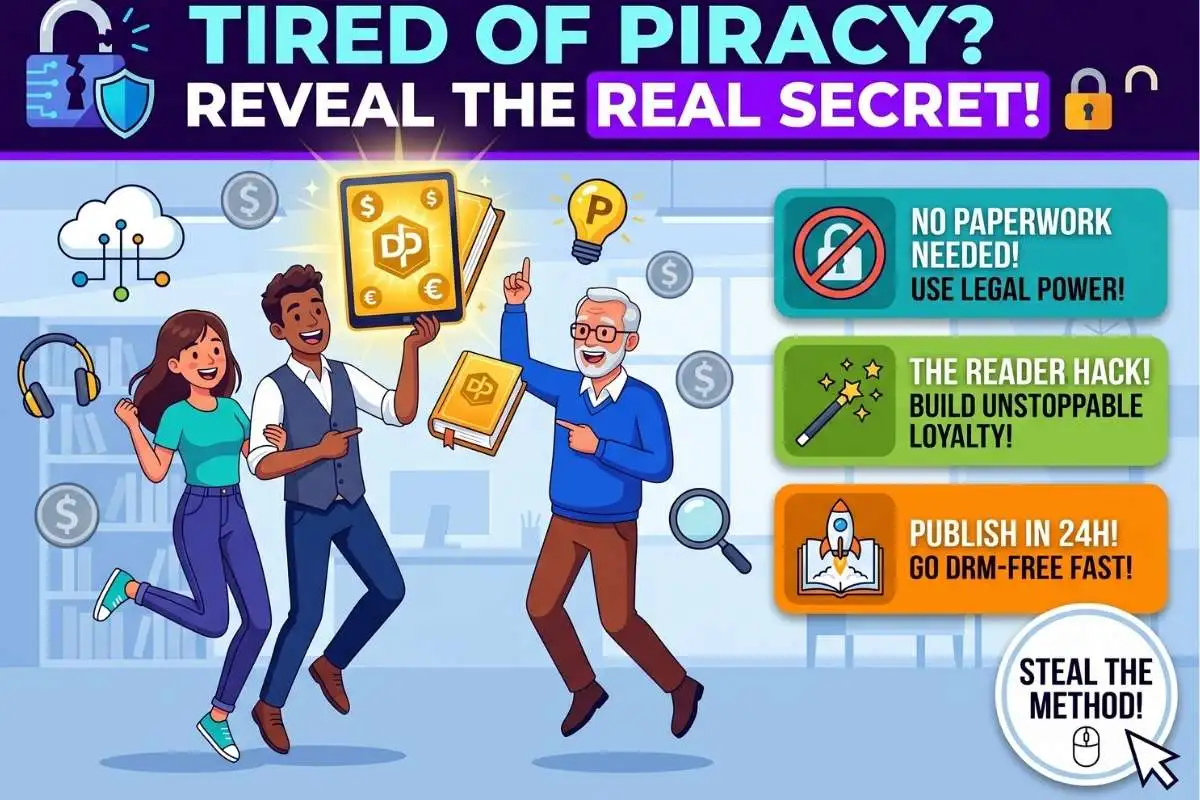
The world of self-publishing experienced a seismic shift in early 2026. Amazon’s Kindle Direct Publishing (KDP) quietly rolled out a massive update regarding how readers interact with digital books. Starting in January 2026, Amazon allowed verified purchasers of DRM-free ebooks to download their files directly in standard EPUB and PDF formats. Initially, the panic was palpable as writers feared rampant piracy. However, a surprising trend has emerged in the aftermath. Instead of locking their digital files down tighter, a growing cohort of savvy, forward-thinking indie authors is deliberately turning off their copy protection. They aren’t doing it by accident; they are doing it as a calculated, highly effective business strategy to build larger audiences and foster deeper reader loyalty.
The Illusion of the Unbreakable Digital Lock
For years, the standard advice for new authors publishing on Amazon was simple: always tick the box to enable Digital Rights Management. The assumption was that this digital padlock would protect a writer’s hard-earned intellectual property from the shadowy depths of internet piracy. But here is the uncomfortable truth industry veterans have finally accepted: DRM only restricts the honest reader. Determined pirates have access to software that strips copy protection from a Kindle file in seconds. By locking a book down, authors were not stopping digital thieves; they were simply frustrating paying customers. A legitimate buyer who wanted to read their legally purchased ebook on an alternative device found themselves trapped inside a walled garden. Smart authors realized that penalizing their audience to mildly inconvenience a pirate is a terrible business model. For a deep dive into how these restrictions function, you can explore the comprehensive overview of Digital Rights Management on Wikipedia, which explains both the technological intentions and the consumer backlash.
The Battle Between Piracy and Obscurity
When you pour months into a manuscript, the idea of someone stealing your work is genuinely terrifying. However, modern independent authors are waking up to a harsh economic reality: for the vast majority of writers, piracy is not the true enemy. Obscurity is the enemy. If no one knows who you are, no one is going to buy your books—and ironically, no one is going to pirate them either. By removing the digital locks from their KDP titles, authors significantly lower the barrier to entry for new readers. When a book is free to be downloaded as a standard EPUB or PDF, it becomes infinitely more shareable. It can be easily transferred and integrated into a reader’s digital life. This increased accessibility acts as a powerful marketing engine. Every time a reader smoothly transfers an author’s book to their preferred device, that author builds invaluable goodwill. In a crowded marketplace, removing friction is the ultimate competitive advantage.
Leveraging the True Power of Copyright Law
Turning off Amazon’s copy protection does not mean an author is surrendering legal rights to their work. In fact, relying on a flimsy technological barrier often lulls creators into a false sense of security, causing them to neglect actual legal protections. The savviest self-published authors understand their true shield against intellectual property theft isn’t a retail website’s algorithm; it is the established legal framework of copyright law. Instead of depending on Amazon to police their content, these writers take legally binding steps. They officially register their manuscripts, providing leverage to claim statutory damages if a bad actor commercially exploits their work. If you want to genuinely protect your intellectual property, skipping the digital lock and formally securing your rights through the U.S. Copyright Office is a far more robust strategy. This proactive approach frees authors to distribute their work widely, backed by the weight of the law.
Embracing the Artificial Intelligence Era
The 2026 KDP update arrived as artificial intelligence began to fundamentally reshape how readers consume text. While some traditionalists view AI as a threat, forward-thinking indie authors see it as a revolutionary tool for engagement. When an ebook is available as a DRM-free PDF or EPUB, a reader can easily upload that text into advanced AI chatbots. They can ask the AI to summarize key concepts, extract character arcs, or generate study guides. Instead of viewing this as a violation, smart authors recognize it as a profound level of reader investment. A reader who uses AI to deeply analyze a magic system or a non-fiction framework is a super-fan in the making. By removing DRM, authors silently give their audience permission to interact with their work in cutting-edge ways. They understand that locked, rigid content is quickly forgotten, while flexible content thrives.
The Top-of-Funnel Marketing Masterclass
Ultimately, the secret migration away from Kindle DRM is rooted in a shift in how authors monetize their careers. The book is no longer the final destination; it is the top of the funnel. For fiction writers, a highly accessible first-in-series book acts as a magnet that draws readers into a massive backlist. For non-fiction authors, the book is essentially a business card that leads to high-ticket courses, coaching programs, and paid newsletters. In this model, restricting the flow of the book is financial sabotage. If an author wants to cast the widest net possible, they need their ideas to travel without friction. By utilizing Amazon’s new policy to allow PDF and EPUB downloads, these authors are transforming their ebooks from static products into dynamic marketing assets. They aren’t losing sales to piracy; they are gaining lifelong customers by prioritizing supreme user experience and acknowledging that an unhindered reader is their most lucrative asset.
The Reader Experience: DRM vs. DRM-Free
| Feature / Capability | With DRM Enabled | With DRM Disabled |
| Read on Kindle Apps/Devices | Yes, fully supported | Yes, fully supported |
| Download as standard EPUB/PDF | No, format is locked | Yes, direct from Amazon |
| Transfer to non-Amazon e-readers | No, prohibited | Yes, completely unrestricted |
| Text extraction for personal AI tools | No, text is encrypted | Yes, easily accessible |
| Long-term file ownership assurance | No, tied to account status | Yes, files can be backed up |
| Author Royalty Rates | Standard KDP rates apply | Standard KDP rates apply |
Frequently Asked Questions
1. What exactly changed with Amazon KDP in January 2026?
Amazon updated its policies to allow verified purchasers of DRM-free ebooks to download their purchased titles directly as EPUB or PDF files. Previously, even without DRM, extracting standard files from the Amazon ecosystem was a complicated process.
2. Does turning off DRM mean I lose my copyright?
Absolutely not. DRM is purely a technological restriction, not a legal one. Your copyright is inherent the moment you create the work. Turning off DRM simply changes how the file functions, not who owns the intellectual property.
3. Will my KDP royalties decrease if I choose the DRM-free option?
No, your royalties will not change. Amazon pays the exact same royalty percentage whether your book has DRM enabled or disabled. The only thing that changes is the level of convenience you offer your customers.
4. Can I change my mind after my book is published?
Yes. Under the KDP dashboard settings, you can toggle your DRM preferences. However, if you initially launch your book as DRM-free and a reader downloads the EPUB, they will retain that file permanently, even if you switch DRM back on.
5. Does this update apply to Kindle Unlimited subscribers?
No. Books borrowed through the Kindle Unlimited (KU) subscription program cannot be downloaded as standalone EPUB or PDF files, regardless of the author’s DRM settings.
The Psychology of True Ownership
Have you ever wondered why consumers feel so strongly about downloading files? It all comes down to a concept in behavioral economics known as the “Endowment Effect.” Psychological studies show that people place a significantly higher value on things they feel they truly own. When an ebook is trapped behind a corporate wall—where a retailer can theoretically revoke access at any time—the reader psychologically views it as a rental, regardless of the “Buy Now” button. By offering a DRM-free, downloadable file, authors tap into the Endowment Effect. They transform a temporary digital lease into a permanent, cherished possession. In a world increasingly dominated by fleeting subscriptions and vanishing media, the authors who give their readers the gift of true ownership are the ones building legacies that will outlast any digital storefront.

