


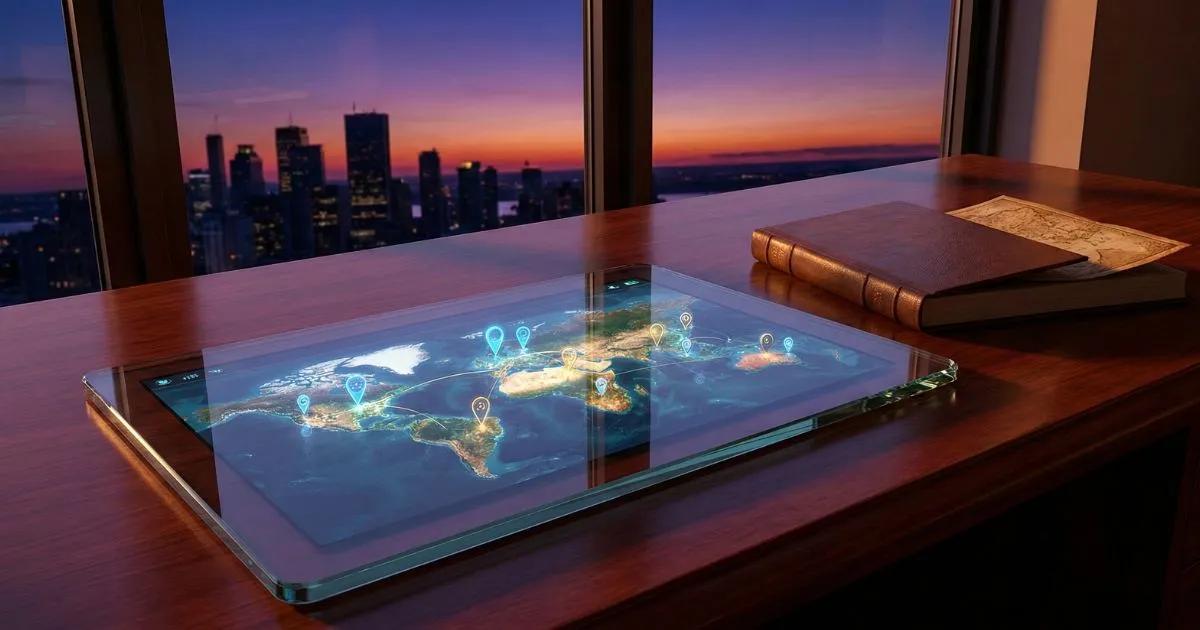
I remember sitting in a dimly lit library back in 2021, tracing my finger over a tattered map in the front of a fantasy epic. It was static, ink-stained, and beautiful, but it felt like a locked door. I knew the characters were moving through those valleys, yet I was just a spectator looking at a drawing. Fast forward to 2026, and that barrier has evaporated. We are no longer just writing books; we are building environments that readers inhabit. If you are still relying solely on adjectives to describe the trek from the capital to the border, you are missing the pulse of modern storytelling. The shift toward Interactive Maps for Authors isn’t just a gimmick, it is the evolution of how we consume narrative geography.
The finance of fiction has changed. Readers are no longer satisfied with a passive experience, they want to be “there.” For those of us who look at publishing as more than just a creative outlet—as a tangible asset, a business, or a service—the integration of location-based technology is the ultimate value-add. It transforms a $9.99 ebook into a multi-layered intellectual property. I’ve seen authors struggle to keep their readers engaged between releases, and the solution is rarely “more marketing.” It is almost always “more depth.” By using GPS-enabled layers, you allow a reader to pull up their phone and see exactly where a scene took place, perhaps even receiving a notification when they physically walk past a real-world landmark mentioned in your urban thriller.
The Architecture of Immersion through World-building Tools
When we talk about the internal mechanics of a story, we often get bogged down in character arcs and dialogue. But the setting is the silent protagonist that holds everything together. Using modern world-building tools, I’ve found that the process of writing becomes less about guessing distances and more about architectural precision. No more “it took them a few days to reach the coast.” Now, you can plot the actual topography, calculate the realistic travel time based on 2026 GPS algorithms, and embed that data directly into an interactive interface for your audience.
There is a specific kind of magic that happens when a reader clicks a pin on a digital map and sees a 360-degree render of the tavern where the protagonist was betrayed. It bridges the gap between the internal imagination and the external digital world. This isn’t just for fantasy, either. If you’re writing a historical finance thriller set in the 1920s, providing a GPS-overlaid map that compares modern Wall Street to its ancestral self creates a layer of “lived-in” authority that words alone cannot replicate. It shows you’ve done the work. It shows the asset—the book—has a structural integrity that goes beyond the last page.
I often find myself wondering if we are moving toward a world where the “book” is just the central hub of a much larger ecosystem. Think about the way we value digital real estate. A story with a dedicated, interactive map is essentially a developed plot of land in the cultural landscape. It has higher retention, better word-of-mouth, and a much higher perceived value if you ever decide to exit your project or hand it over to an agency for scaling. You aren’t just selling a story; you are selling a world.
Elevating the Reader Experience with Precision Geodata
The technical side of this can seem daunting, but it’s actually quite intuitive once you stop thinking like a coder and start thinking like a cartographer. The goal is to enhance the reader experience without overwhelming the senses. I’ve experimented with several platforms that allow you to import real-world GPS coordinates and “skin” them with fictional textures. This means your “Empire of Ash” can have the exact layout of the Roman Empire, but with interactive elements that update as the reader progresses through the chapters.
Imagine a reader opening your app or website and seeing a heat map of where other readers are currently “located” in the story. Or, better yet, a GPS-triggered audio file that plays a specific character’s monologue when the reader visits the actual park where the scene was set. This level of intimacy is what separates the hobbyists from the professionals in 2026. We are in an era where the “human connection” is facilitated by the very tech we once feared would replace us. The map is the bridge. It’s the visual handshake between the author’s brain and the reader’s reality.
I have some doubts, of course. There’s a risk that too much “seeing” stifles the “imagining.” But I’ve found that the best interactive maps don’t fill in every detail. They provide the skeleton—the mountains, the roads, the borders—and let the reader’s mind flesh out the rest. It’s about providing a sense of scale. When a reader realizes the “Long March” in your novel actually covers 1,500 real-world miles, the stakes are no longer abstract. They are visceral. They are measured in footsteps and GPS pings.
As we look at the trajectory of the publishing industry, it’s clear that the “flat” book is becoming a relic. We are moving toward “thick” media—content that has depth, data, and interactivity. For anyone involved in the business of stories, whether you’re building a brand or managing a portfolio of literary assets, these tools are no longer optional. They are the new standard for quality.
The question I often ask my peers is this: Does your world exist when the book is closed? If the answer is no, you might need to look at your geography. A map isn’t just a guide for the lost; it’s a proof of existence for the found. It’s the difference between a story someone reads and a world someone remembers.

