
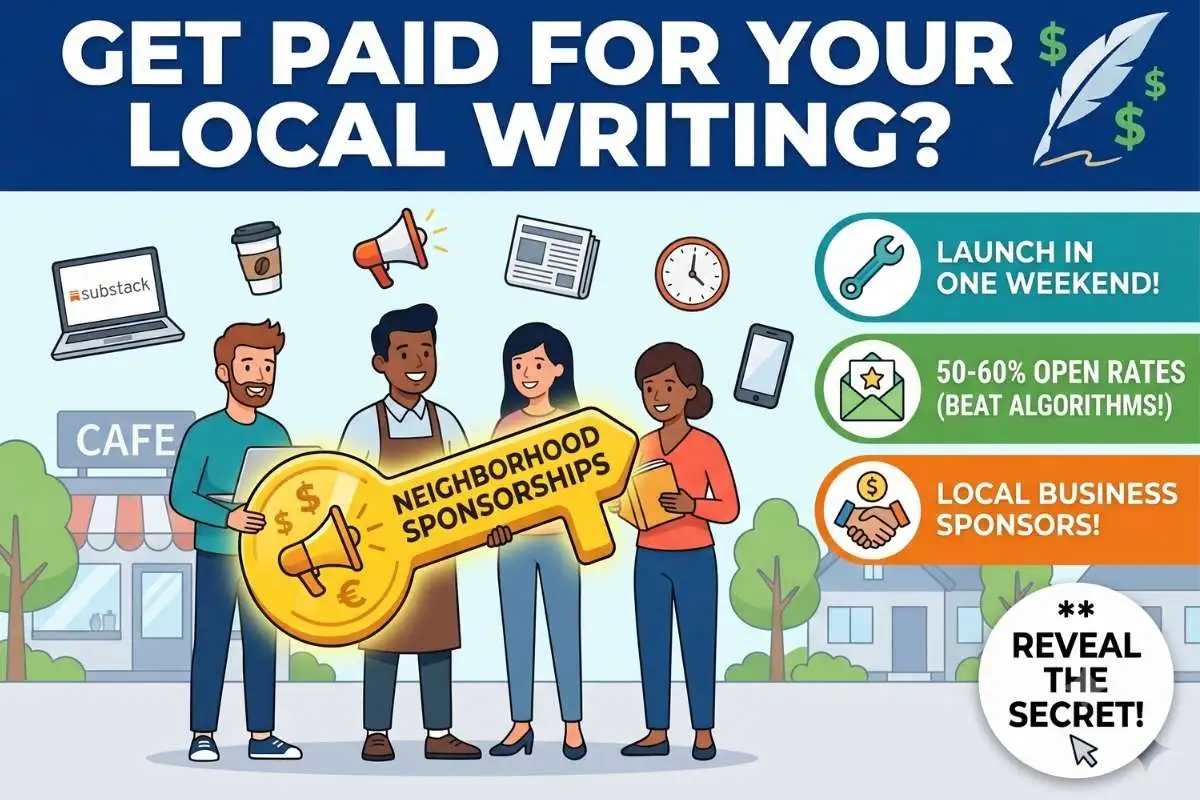
Have you ever walked down your neighborhood street, noticed a new café opening up, and wondered how anyone else in the community finds out about it? In an era dominated by globalized social media feeds and algorithmic echo chambers, a surprising counter-trend has quietly emerged and is proving to be incredibly lucrative. People are craving connection to their immediate physical surroundings. They want to know about the weekend farmers market, the high school football game, and the best place to get a flat white within walking distance. Enter the hyper-local Substack newsletter: a modern, digital reimagining of the neighborhood gazette. Not only is it a brilliant way to build community, but it is also a highly monetizable asset. If you love writing and know your neighborhood, you can launch a publication this weekend and have that new café sponsoring your work by Monday morning.
The Resurgence of Community in a Digital Age
For the past two decades, the media landscape has systematically shifted away from local coverage in favor of national and global syndication. Countless communities have transformed into what media researchers call “news deserts,” where traditional local journalism has completely dried up or been acquired by massive conglomerates that strip away the neighborhood-level focus. However, human nature still dictates a strong desire to understand our immediate environment. We inherently care more about a zoning change on our block or a new bakery opening downtown than we do about abstract global events. This massive void in local information represents an unprecedented opportunity for entrepreneurial writers. By focusing your lens strictly on your specific town, zip code, or even your specific neighborhood, you instantly become a highly relevant and trusted voice. You do not need thousands of readers to be successful; you only need a few hundred highly engaged locals. For more context on the historical importance and current challenges of community reporting, you can explore the comprehensive overview of Local News on Wikipedia. When you become the definitive source for neighborhood happenings, your writing transforms from a mere hobby into an essential community utility.
Why Substack and Email Outperform Social Media
If you are wondering why you should use a newsletter platform instead of simply starting a neighborhood Facebook group or an Instagram page, the answer lies in ownership and attention. Social media platforms are fundamentally designed to keep users scrolling through an endless feed of highly stimulating, algorithmically selected content. When a local business posts an update or when you share a community story, it is immediately buried under viral videos and sponsored national advertisements. Organic reach for small creators and local businesses is practically nonexistent today. Substack, on the other hand, delivers your writing directly into the sanctuary of the reader’s email inbox. There is no algorithm standing between you and your audience deciding if your content is “engaging” enough to be seen. When someone subscribes to your hyper-local newsletter, they are making a conscious, deliberate choice to invite your voice into their daily routine. This direct, unfiltered line of communication results in astronomical open rates compared to social media engagement. While an Instagram post might reach two percent of your followers, a well-crafted local newsletter routinely sees open rates of fifty to sixty percent. This captive, highly attentive audience is exactly what makes your publication so incredibly valuable to local businesses trying to reach those exact same people.
Crafting the Perfect Pitch for the Corner Café
The genius of the hyper-local sponsorship model lies in its simplicity and its direct alignment with the needs of small business owners. Picture the owner of your favorite independent coffee shop. They operate on tight margins and desperately need foot traffic from people living within a three-mile radius. Traditional advertising methods are often wildly inefficient for them. Taking out an ad in a regional paper is too expensive and reaches too many people who will never drive across town for a latte. Running digital ads requires technical expertise they often do not possess, and the targeting can still be incredibly wasteful. You offer them the holy grail of marketing: direct access to the exact local demographic they need to reach, packaged within a trusted community voice. According to resources provided by the U.S. Small Business Administration (SBA), effective local marketing is about building authentic relationships and community presence. When you approach the café owner, you are not selling an abstract “impression” or a generic “click.” You are offering to personally recommend their new seasonal roast to five hundred people who live right down the street. A fifty-dollar or one-hundred-dollar weekly sponsorship is a microscopic marketing expense for them, but it is pure, recurring profit for your weekend writing project.
The Weekend Sprint: From Concept to Sponsored Reality
Executing this strategy does not require months of planning or a massive initial investment; it literally requires a single focused weekend. Friday evening is dedicated to setup and branding. You choose a catchy, geographic-specific name for your Substack, design a simple logo using free online tools, and draft your inaugural post highlighting three upcoming weekend events in your town. Saturday is for aggressive, grassroots growth. You leverage your existing personal network, share the link in local community groups, and text your friends and neighbors to subscribe to this new local resource. Because the content is hyper-relevant to their daily lives, the conversion rate from visitor to subscriber is remarkably high. By Sunday afternoon, you have gathered your foundational audience—perhaps just fifty or one hundred people, but they are absolutely the right people. Armed with this highly targeted list, you craft a short, polite email or physically walk into the local coffee shop. You explain that you run the new neighborhood newsletter, you love their business, and you are offering an exclusive, low-cost sponsorship slot for Monday morning’s dispatch. Because the investment is low and the audience is perfectly aligned, the friction to say “yes” is almost nonexistent. By Monday, you hit publish on a fully sponsored piece of writing.
Traditional Local Ads vs. Hyper-Local Newsletters
| Feature | Traditional Regional Print Ads | Social Media Local Targeting | Hyper-Local Newsletter Sponsorship |
| Audience Relevance | Broad, often reaches far outside the target zone | Hit or miss, frequently blocked by algorithms | 100% targeted to the specific community |
| Reader Trust | Low to Medium | Low (often viewed as intrusive spam) | High (endorsed by a trusted community writer) |
| Cost Barrier | High (Hundreds to thousands of dollars) | Medium (Requires daily budget testing) | Low (Affordable, predictable flat rate for local shops) |
| Engagement Rate | Difficult to measure accurately | 1% – 3% average interaction | 50% – 60% average email open rate |
Frequently Asked Questions
How many subscribers do I realistically need before I can ask for a sponsorship?
You absolutely do not need thousands of readers to make this business model work. For a hyper-local newsletter, having just 50 to 100 highly engaged, verified local residents is often more than enough to secure a $20 to $50 weekly sponsorship from a small neighborhood business. Quality and geographical proximity matter far more than pure volume.
What should I write about if my town is very small or quiet?
Focus intensely on the micro-happenings that larger news outlets ignore. Write about high school sports scores, upcoming library events, city council meeting summaries, new real estate listings, or publish short, text-based interviews with long-standing local business owners. The more specific and granular the information, the better it serves your audience.
How do I price my newsletter sponsorships when I am just starting out?
Start incredibly low to completely remove the financial risk for the business owner. Offer a simple flat rate of $25 to $50 per issue initially. As your audience organically grows past 500 or 1,000 local subscribers, you can transition to a premium flat rate of $100 to $200 per send, turning your side project into a substantial income stream.
The Curiosity Corner: A Return to the Town Crier
Long before the internet, and even centuries before the widespread adoption of the printing press, local communities relied entirely on the “town crier” to deliver the most pressing and relevant local news. These designated individuals would stand out in the central town square, ring a heavy brass bell to command attention, and shout out the daily announcements, local legislative mandates, and current market prices for crops. In a truly fascinating twist of historical repetition, the modern hyper-local Substack newsletter is quite simply the digital evolution of the town crier. We have rapidly cycled through the exhausting era of massive global broadcasting and are now returning to a fundamental human desire for community-centric, highly localized information. By launching your own local publication, you are essentially picking up that digital bell. You are providing a deeply valuable civic service, connecting disconnected neighbors, supporting vital local commerce, and ultimately getting paid to write about the specific place you call home.
