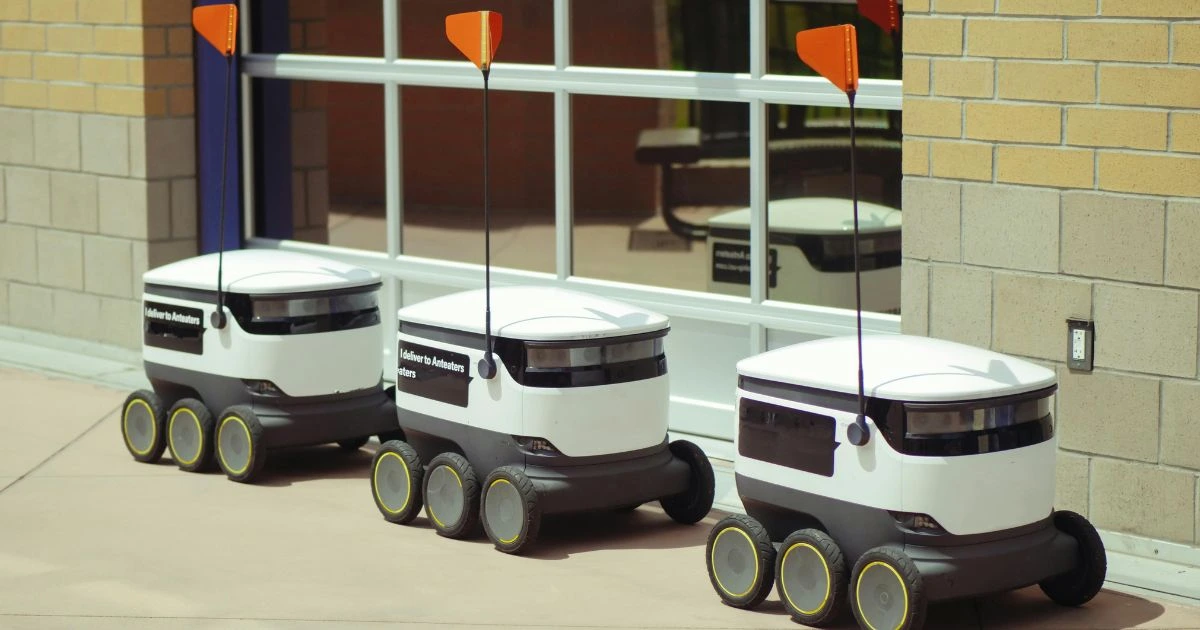
The morning light in mid-town Manhattan hits the glass storefronts in a way that makes you realize just how much empty space we are actually sitting on. It is February 2026, and the frantic energy of the city feels different than it did three years ago. Back then, we were obsessed with the “last mile,” that grueling stretch of asphalt between a massive regional warehouse and your front door. We thought the winner would be the one with the biggest planes or the most exploited gig workers. We were wrong. The giant from Seattle is still there, of course, but their armor is showing cracks, specifically in the places where they tried to replace community intuition with raw scale.
What we are seeing now is the rise of something much more granular. I call it hyper-local logistics, though the industry types keep trying to brand it as Local AI Logistics to make it sound more expensive than it is. In reality, it is just about being smart enough to know that a snowstorm in Chicago or a parade in New Orleans matters more than a global supply chain algorithm. This year, beating the giants isn’t about outspending them. It is about out-thinking them within a three-block radius.
The quiet pivot of retail survival in our neighborhoods
I spent an afternoon last week watching a small hardware store in Brooklyn. They shouldn’t be surviving. By all the logic of 2019, they should have been a showroom for an online giant. Instead, they were busier than ever. The owner wasn’t just selling hammers. He was part of a decentralized web of nodes that use predictive software to anticipate exactly what the neighborhood needs before the neighborhood even knows it. This is the core of retail survival in this decade. It is no longer about having everything in stock. It is about having the right things in stock for this specific zip code, right now.
The shift happened when we stopped looking at “the cloud” as a place where data goes to die and started seeing it as a nervous system for the physical world. When a local shop connects its inventory to a shared neighborhood intelligence, they aren’t just a store anymore. They are a micro-hub. If I need a specific filter for a vintage espresso machine, I don’t wait for a van to drive from a massive fulfillment center in the middle of a desert. I get it from a shop two miles away that knew, based on the demographic shift and recent local purchases, that there were likely forty of those machines within walking distance.
There is an inherent messiness to this that the big players hate. They like straight lines and predictable routes. But cities aren’t built on straight lines. They are built on relationships and weird shortcuts through alleys. By leaning into that chaos, local businesses are finding they can move goods faster than a drone ever could. It is a strange sort of irony that the most advanced technology we have created is finally allowing us to return to a village-style economy, just at a much higher velocity.
How e-commerce 2026 became a game of proximity and grit
If you look at the spreadsheets for e-commerce 2026, the numbers tell a story of fragmentation. The era of the “everything store” is peaking because people are tired of the friction of the massive. There is a psychological cost to waiting for a cardboard box to arrive from another state, even if it only takes twenty-four hours. We have become accustomed to a different kind of immediacy. We want the things from our own streets.
I remember talking to a courier in Austin who told me he doesn’t work for one company anymore. He works for a collective of twelve different local boutiques. They use a shared intelligence layer that routes him based on real-time pedestrian flow and traffic patterns that the big GPS apps haven’t figured out yet. He knows when the school buses will clog up the main artery and when the back way through the park is clear. That level of local nuance is something a centralized AI struggles to replicate. It lacks the “lived-in” data.
This isn’t just about speed, though. It is about the feeling of the transaction. There is a certain hollowness to the automated delivery experience. When the local network takes over, you see the same faces. There is a layer of accountability that doesn’t exist when your package is handled by six different states and a dozen different conveyor belts. We are rediscovering that logistics is, at its heart, a human service. The tech is just there to clear the path so the humans can actually do the work without getting stuck in a digital bottleneck.
The most fascinating part of this evolution is how the physical space of our cities is changing to accommodate it. I see parking garages being converted into sorting centers for five-block radiuses. I see bike couriers with modular trailers that look like something out of a sci-fi film, but they are carrying locally baked bread and artisanal electronics. It is a patchwork quilt of commerce that feels much more resilient than the monolithic systems we relied on during the early part of the decade.
We used to think the future was a sky full of drones. Instead, the future is a sidewalk full of people who know exactly where they are going because the data told them there is a person three doors down who needs exactly what they are carrying. It is less cinematic, maybe, but it is infinitely more efficient.
The struggle for the small business owner used to be access to the market. Now, the market is everywhere, but the struggle is the physical movement of the goods. Those who have embraced the local intelligence models aren’t just competing; they are setting the pace. They are finding that their smaller footprint is actually an advantage. They can pivot in an afternoon while the giants take months to reroute a single shipping lane.
I wonder sometimes if we will look back at the 2010s as a weird anomaly where we tried to make the whole world one big warehouse. It was an ambitious dream, but it ignored the reality of how we actually live. We live in neighborhoods. We live in specific pockets of geography with their own rhythms and moods. Any system that tries to ignore that is bound to feel slow eventually, no matter how many planes they own.
The air in the city feels a little clearer lately, and I like to think it is because there are fewer massive trucks idling on the corners. Instead, there is this quiet, buzzing network of local movement. It is a bit disorganized, a bit unpredictable, and entirely human. It isn’t perfect, and that is exactly why it works. The next time you order something and it arrives at your door before you’ve even finished your coffee, don’t look toward the horizon for a massive corporate logo. Look down the street toward the shop on the corner. That’s where the real revolution is happening, hidden in plain sight among the bricks and the people who know how to navigate them.
The logic of the future isn’t global. It is right here, under our feet, waiting for us to stop looking so far away for the answers to how we move things from point A to point B.
FAQ
It explores how local businesses are using hyper-local intelligence to outpace massive global distributors in delivery speed.
The article suggests that we are moving away from a global warehouse model toward a more human, localized one, but leaves the final outcome of this shift to be seen.
No, it uses AI as a tool to assist human decision-making and navigation rather than replacing it.
The competition shifts from just being about price to being about speed, convenience, and the experience of supporting the community.
It is the informal, localized knowledge of a neighborhood’s rhythms, traffic, and habits that isn’t always captured by global maps.
It suggests that existing spaces, like parking garages, are being repurposed to support these new logistics needs.
Because local nuance and relationship-based accountability are things that large, automated systems struggle to replicate.
Yes, the article hints at fewer large trucks on the road and more efficient, shorter delivery routes.
It focuses more on collaborative networks and local expertise rather than just a single large platform controlling many individuals.
While more visible in cities like New York or Austin, the principles of localized logistics can apply to any community with a dense enough population.
It fragments into more specialized, local options that provide better immediacy and a more human experience.
It is the ability of physical stores to remain relevant by integrating into the digital and physical delivery infrastructure of their community.
The article suggests that human-led, ground-based local delivery is often more practical and efficient than drones in dense cities.
They act as micro-fulfillment centers or “nodes” in a larger, decentralized delivery web.
Local networks can adapt more quickly to specific local conditions, like a neighborhood-specific snowstorm, than a national system.
It represents a near-future turning point where the limitations of centralized, massive-scale logistics become more apparent compared to localized systems.
It is the most expensive and difficult part of the shipping process, moving goods from a final hub to the customer’s door.
The article implies that while the tech exists, the real value comes from the “neighborhood intelligence” and shared networks rather than just raw capital.
It leads to faster delivery times, often measured in minutes or hours rather than days, and supports the local economy.
It is the use of localized data and predictive algorithms to manage inventory and delivery within a very small geographic area.
No, it suggests that their dominance is being challenged in specific urban environments by more agile, local networks.