
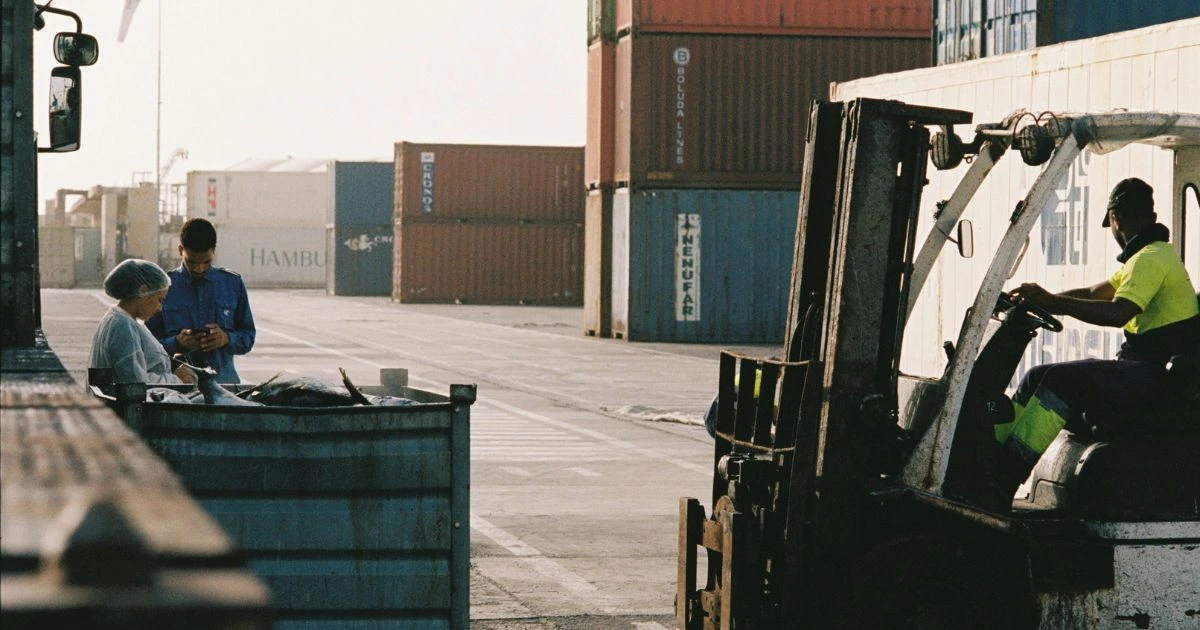
The freight ships are still out there, ghosts on the horizon, but for a growing number of people running businesses in the United States, those ships have stopped being the heartbeat of the operation. It is February 2026, and the old anxiety of wondering if a container from across the Pacific will clear the Port of Long Beach before a holiday rush has been replaced by something quieter. We are watching the rise of a fragmented, almost invisible web of production that relies less on the heavy lifting of global transit and more on the invisible hand of local AI logistics.
I remember talking to a furniture maker in North Carolina last year who told me he’d spent a decade chasing cheaper labor across three continents only to realize that the cost of waiting was killing his brand faster than the cost of a domestic paycheck. He wasn’t some tech evangelist. He was just tired of his inventory being held hostage by a canal blockage or a geopolitical spat he couldn’t control. Now, he uses a localized predictive model that doesn’t just tell him what people might buy, but orchestrates a dozen tiny workshops within a fifty mile radius to produce components just in time. This is the shift. It isn’t about bringing back the massive, smoke belching factories of the nineteen fifties. It is about a granular, hyper responsive network that feels more like an ecosystem than a corporate strategy.
The quiet shift toward retail efficiency in a fractured world
The term efficiency used to mean squeezing every cent out of a unit price, even if it meant the product spent six weeks on a boat. That math has broken. We’ve entered an era where retail efficiency is measured by the proximity of the thought to the object. If a trend pops up in Brooklyn on a Tuesday, waiting for a prototype to fly in from overseas means you’ve already lost. Brands that are surviving 2026 are those that have decentralised their thinking. They aren’t looking for one massive partner. They are looking for fifty small ones, coordinated by an intelligence that understands local traffic patterns, micro-climates, and regional tastes better than any human manager ever could.
I walked through a distribution hub in Ohio recently that looked nothing like the sprawling warehouses of five years ago. It was small, almost tucked away, and it felt remarkably still. There were no frantic workers checking clipboards. The local AI logistics systems were humming in the background, rerouting a delivery of biodegradable packaging because a storm was predicted for the next county over, while simultaneously triggering a 3D printing run for a specific sneaker sole that had suddenly spiked in local demand. It felt less like a business and more like a living thing that was breathing in sync with the neighborhood. There is an intimacy there that global shipping simply cannot replicate. You can’t be intimate with a customer when you are three months behind their current desires.
The tension, of course, is that this requires a level of trust in black box algorithms that makes many traditionalists uncomfortable. We are handing over the steering wheel of the supply chain to systems that see correlations we can’t possibly grasp. Why did the system order three times the usual amount of wool yarn for a small boutique in Portland during a heatwave? We might not know until three weeks later when a specific cultural moment shifts the vibe of the city. The AI doesn’t explain its reasoning, it just positions the assets. It is a strange, slightly unsettling way to work, but the alternative is watching your stock rot on a pier while your competitors are fulfilling orders within hours.
Navigating the complexities of the supply chain 2026
When we look back at the chaotic transitions of the early twenties, the biggest mistake was thinking that technology would just make the old ways faster. But the supply chain 2026 isn’t just a faster version of the 2019 one. It is structurally different. We are seeing a move away from the “just in case” hoarding of inventory and even away from the “just in time” fragility that preceded it. What we have now is “just here.” It is a geography of the immediate.
There is something inherently human about this, despite the heavy reliance on silicon. It brings the economy back to a human scale. If my shoes are made in the same state where I wear them, using materials that were sourced through a local AI logistics network that prioritizes regional sustainability, the distance between the maker and the user shrinks. The carbon footprint drops, sure, but the psychological footprint changes too. There is less noise. Less frantic tracking of tracking numbers. The product just arrives because the system knew it needed to be there before I even finished the checkout process.
But this isn’t a utopia. There are holes in this fabric. Small manufacturers who can’t or won’t integrate into these neural networks are being left behind. There is a new kind of digital divide, one that isn’t about who has an internet connection, but about whose workshop can “speak” the language of the coordinating AI. I’ve seen brilliant artisans in rural Vermont struggling because their legacy equipment doesn’t play well with the real-time data streams required by modern retail partners. We are trading one set of problems for another. The global shipping delays are gone, but in their place, we have a frantic, localized competition for raw materials and a desperate need for a new kind of technical literacy that has nothing to do with coding and everything to do with connectivity.
The sheer volume of data being processed to keep a single city fed and clothed in 2026 is staggering. Every sensor in a delivery van, every smart shelf in a grocery store, every weather station is feeding into this collective brain. It’s a messy, noisy, constant conversation. And yet, when you’re standing on a quiet street in a city like Savannah, you don’t see the complexity. You just see a small electric van pulling up to a curb, dropping off a package that was manufactured two towns over, and moving on. The magic is in the invisibility.
I wonder sometimes if we are losing the sense of wonder that used to come with things from “away.” There was a certain romance to the exotic, to the item that traveled ten thousand miles to reach your doorstep. Now, the luxury is the local. The prestige comes from knowing that the item in your hand didn’t spend a month in a salty steel box. It was born nearby, guided by a machine that knows your community’s needs better than the community knows itself. It’s a different kind of connection, one based on relevance rather than rarity.
As we move deeper into this decade, the brands that thrive won’t be the ones with the biggest marketing budgets or the most famous logos. They will be the ones that are the most deeply embedded in the local infrastructure. They will be the ones that have mastered the art of being present without being intrusive. The logistics are the foundation, but the feeling of the brand is what will remain. Whether this leads to a more stable world or just a more localized kind of chaos is something we are all still figuring out, day by day, shipment by shipment.
There is no going back to the way things were. The routes have changed, the players have changed, and the very definition of what it means to “deliver” has been rewritten. We are all just trying to keep up with the rhythm of a world that moves faster than we can think, but perhaps, just perhaps, at a scale we can finally understand again.
FAQ
It is a system using artificial intelligence to manage production and delivery within a tight geographic radius rather than relying on global networks.
Focus on finding local production partners and exploring AI tools that offer predictive inventory management.
It creates new types of jobs that blend traditional craft with digital coordination.
It refers to inventory that is produced and stored within the same region where it is sold.
Absolutely, it’s one of the most effective ways to reduce food waste and ensure freshness.
Tech-forward hubs and traditional manufacturing centers are seeing the fastest adoption.
It’s a concern; most systems use anonymized aggregate data to protect individual privacy.
Yes, because a failure in one local node doesn’t crash the entire global system.
It can instantly reroute production orders to multiple small workshops in the area simultaneously.
It changes their routes to be shorter and more frequent, often using smaller, electric vehicles.
Global instability and the high cost of shipping delays have pushed brands to seek more reliable, domestic alternatives.
That remains the bottleneck; local AI tries to optimize the use of what is already available nearby.
Most brands use integrated platforms that connect their sales data to local manufacturing networks.
Generally, yes, because it drastically cuts down on the carbon emissions associated with long-distance freight.
Yes, by analyzing local social data and buying habits in real-time.
They still handle bulk raw materials, but their role in finished consumer goods is shrinking.
It reduces the “dead time” when products are sitting in warehouses or on ships, getting them to customers faster.
Not everything, but high-demand, time-sensitive goods are increasingly being produced closer to the end user.
It’s a core component, allowing for instant manufacturing of parts and products within local hubs.
Initially, yes, but the reduction in shipping costs and waste often balances out the price over time.
It allows small shops to coordinate like a large corporation by predicting demand and managing shared resources.
