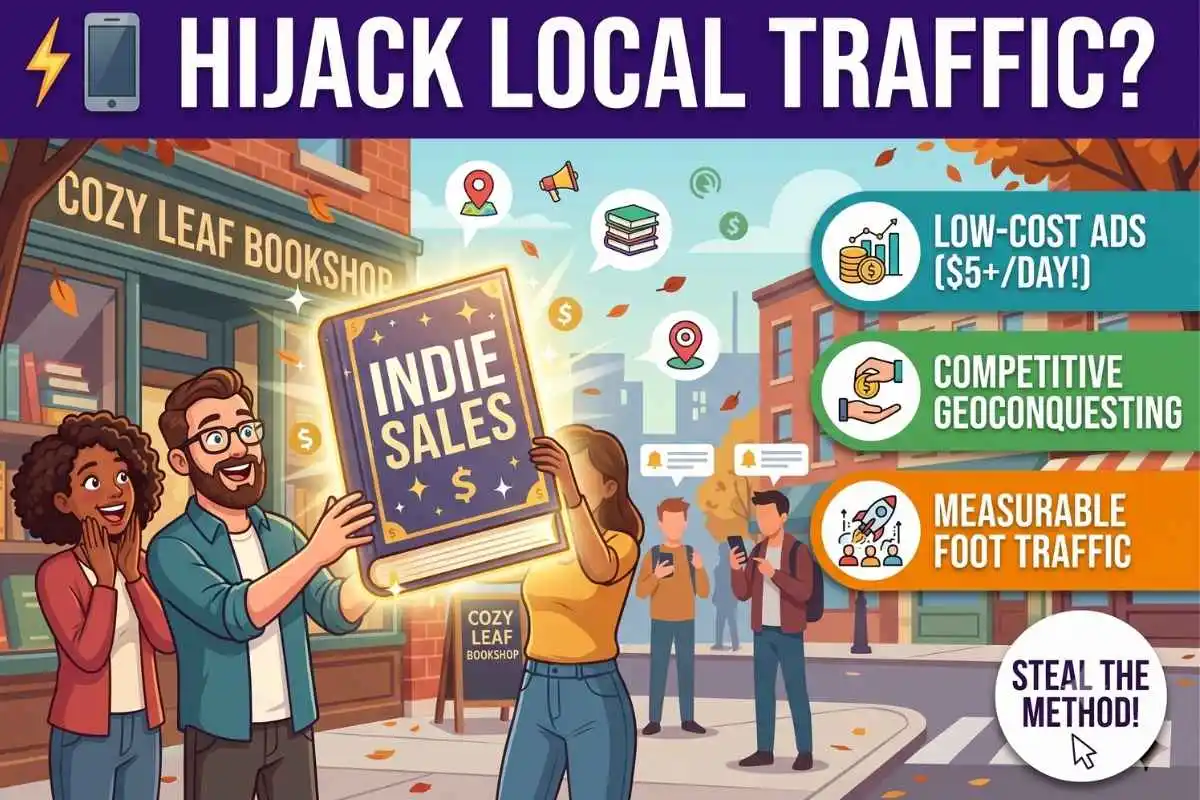
Imagine a brisk autumn afternoon in your neighborhood, where a reader is strolling past a busy corporate coffee chain with a latte in hand. Their smartphone buzzed softly in their coat pocket, not with a generic corporate notification, but with a wonderfully timed invitation: “Looking for your next great read? Show this alert at the Cozy Leaf Bookshop just two blocks away for a complimentary bookmark and 15% off our newly featured local indie paperback!” Within ten minutes, that anonymous pedestrian has pivoted away from their usual routine, walked through your shop’s jingling front door, and purchased a book they never knew existed. This is not science fiction or futuristic retail magic; it is the remarkable precision of geofenced marketing designed for local bookshops.
The Invisible Boundary: What is Geofencing?
At its core, local mobile advertising relies on setting up virtual perimeters around physical locations in the real world, a digital architecture commonly known as geofencing technology. When a potential customer carrying a smartphone steps across this invisible geographical line, the boundary triggers a pre-programmed digital action inside specific mobile apps they already use. The mechanics behind this hyper-local advertising strategy are powered by a combination of cellular data, Wi-Fi triangulation, and the satellite network managed by the Global Positioning System. Because modern smartphones constantly communicate with these positioning networks to provide mapping services and weather updates, advertisers can pinpoint when a device enters a specific area with astonishing accuracy. For an independent bookstore owner, this means you can draw a virtual circle around your own block, a nearby university campus, or a park where people frequently read.
The Art of Ethical “Hijacking”
One of the most powerful and creative ways to utilize location-based advertising is through a strategy known as competitive geoconquesting, which allows small shop owners to ethically capture foot traffic from nearby complementary locations or even larger chain bookstores. Imagine drawing a virtual perimeter directly around the parking lot of a massive big-box book retailer located three miles away from your shop. When shoppers visit that sprawling store and check their mobile devices, you can display an advertisement celebrating the cozy charm, personalized staff recommendations, and exclusive signed paperback editions available only at your independent shop. To make this successful without coming across as intrusive, your messaging must focus heavily on warmth and neighborhood connection rather than surveillance. When you present your shop as a welcoming local sanctuary, the digital interruption feels like a helpful tip from a well-read friend.
Crafting an Irresistible Local Offer
Even the most brilliantly targeted campaign will fall flat if the advertisement fails to offer a compelling reason for a pedestrian to alter their walking route immediately. Because you are attempting to capture individuals who are actively on the move, your call to action must create a gentle sense of urgency combined with an irresistible, highly specific incentive. Offering a generic discount on any purchase is rarely enough to change human behavior; instead, promote a signature indie paperback featuring a local author, accompanied by a complimentary cup of artisan tea or a beautifully designed, limited-edition bookmark. Furthermore, it is essential to ensure that the mobile landing page attached to your advertisement is optimized for speed and simplicity. By removing every possible bit of friction between the digital click and the physical doorway, you maximize the percentage of nearby impressions that successfully convert into enthusiastic, paying bookshop patrons.
Measuring Success: From Impressions to Actual Foot Traffic
Unlike traditional print advertising or radio broadcasts where measuring real-world return on investment is notoriously difficult, modern mobile advertising platforms provide robust analytics that track exactly how many targeted individuals actually visit your shop. This advanced measurement capability is made possible through what digital marketers call conversion zones, which are secondary virtual boundaries drawn strictly around your bookstore’s physical floor plan. When a user sees your advertisement while standing inside a targeted perimeter and subsequently walks into your bookstore within a specified number of days, the platform registers that visit as a verified physical conversion. This powerful feedback loop allows independent booksellers to see precisely which neighborhoods, coffee shops, or competing retail centers are generating the most actual foot traffic and revenue, enabling you to refine your marketing spend with scientific precision.
To better understand why location-based digital marketing is revolutionizing how small bookshops attract local readers, it is helpful to compare this innovative technique against traditional advertising methods. Historically, independent booksellers relied heavily on static local outreach, such as community bulletin boards, print newspaper advertisements, and generic social media promotions that broadcast across entire cities without geographic precision. While those legacy approaches still hold some cultural value for overall brand recognition, they lack the immediate behavioral impact and trackable return on investment offered by spatial targeting. By examining these channels side by side, booksellers can see why precision beats volume. The comparison table below highlights the operational differences between legacy neighborhood marketing and modern geofenced promotional campaigns.
| Marketing Channel | Targeting Precision | Cost Efficiency | Primary User Mindset | Real-World Tracking |
| Geofenced Ads | Hyper-local (within meters) | High (only pays for nearby users) | Active, mobile, and ready to explore | Verified physical foot-traffic visits |
| Print Flyers | Neighborhood-wide (blocks) | Low (high printing and waste costs) | Passive and often distracted | Unconfirmed unless coupons are saved |
| Local SEO | City or zip code radius | Medium (requires ongoing optimization) | Searching actively for specific terms | Digital clicks and phone calls |
| Broad Social Ads | Regional or city-level | Medium (impressions diluted over distance) | Browsing casually at home or work | Website traffic and online orders |
Frequently Asked Questions
How much money does an independent bookstore need to launch a geofencing campaign?
One of the most encouraging aspects of modern location-based advertising is that it no longer requires the massive marketing budgets once reserved for national retail conglomerates. Independent bookshops can launch highly targeted promotional campaigns with modest daily budgets, often starting for as little as five to ten dollars per day on major advertising networks. Because you only pay to display advertisements to individuals who enter very specific, highly localized geographical zones, your marketing dollars are never wasted on distant populations. This financial efficiency allows small shop owners to test different promotional strategies and scale their investment gradually as actual bookstore foot traffic and book sales increase.
Can an independent bookshop target specific buildings, such as a university campus or library?
Yes, modern geo-targeting platforms allow advertisers to draw highly complex, customized polygon boundaries around specific structures rather than simple circular radiuses. For an independent bookstore, this means you can carefully outline the perimeter of a university literature department during final exam week or a civic center hosting a local author lecture. By tailoring your digital creatives to match the unique context of the building or event you are targeting, you create a seamless narrative that speaks directly to the immediate interests and physical surroundings of your prospective readers, dramatically increasing the likelihood of an immediate store visit and paperback purchase.
Does location-based marketing work on people who have their smartphone location services turned off?
Geofencing technology relies on access to device location data, meaning that individuals who have completely disabled location services across all their mobile applications will not trigger your geographic boundary alerts. However, the vast majority of modern smartphone users keep location services active for essential daily utilities, including mapping navigation, weather forecasts, ride-sharing services, and local restaurant search engines. When users grant these popular applications permission to access their geographical coordinates, advertising networks utilizing those same platforms can successfully deliver your neighborhood bookstore promotions to their screens while they explore the surrounding commercial district and walk past your welcoming bookstore storefront.
The Future of the Neighborhood Bookstore
As we look toward the future of physical retail, the intersection between digital technology and traditional brick-and-mortar commerce will only become more vital for small business survival. The neighborhood bookstore has always been a cornerstone of cultural life, offering a tactile, serendipitous sanctuary that no online algorithm can truly duplicate. By embracing innovative tools like geofenced advertising, independent booksellers are not abandoning their traditional charm; rather, they are using modern digital bridges to guide wandering pedestrians back into the enriching world of printed paperbacks. The next time you see someone walking down your avenue with their eyes glued to a smartphone, remember that they are not lost to the digital void—they are simply waiting for a well-timed invitation to step inside your cozy literary world today.