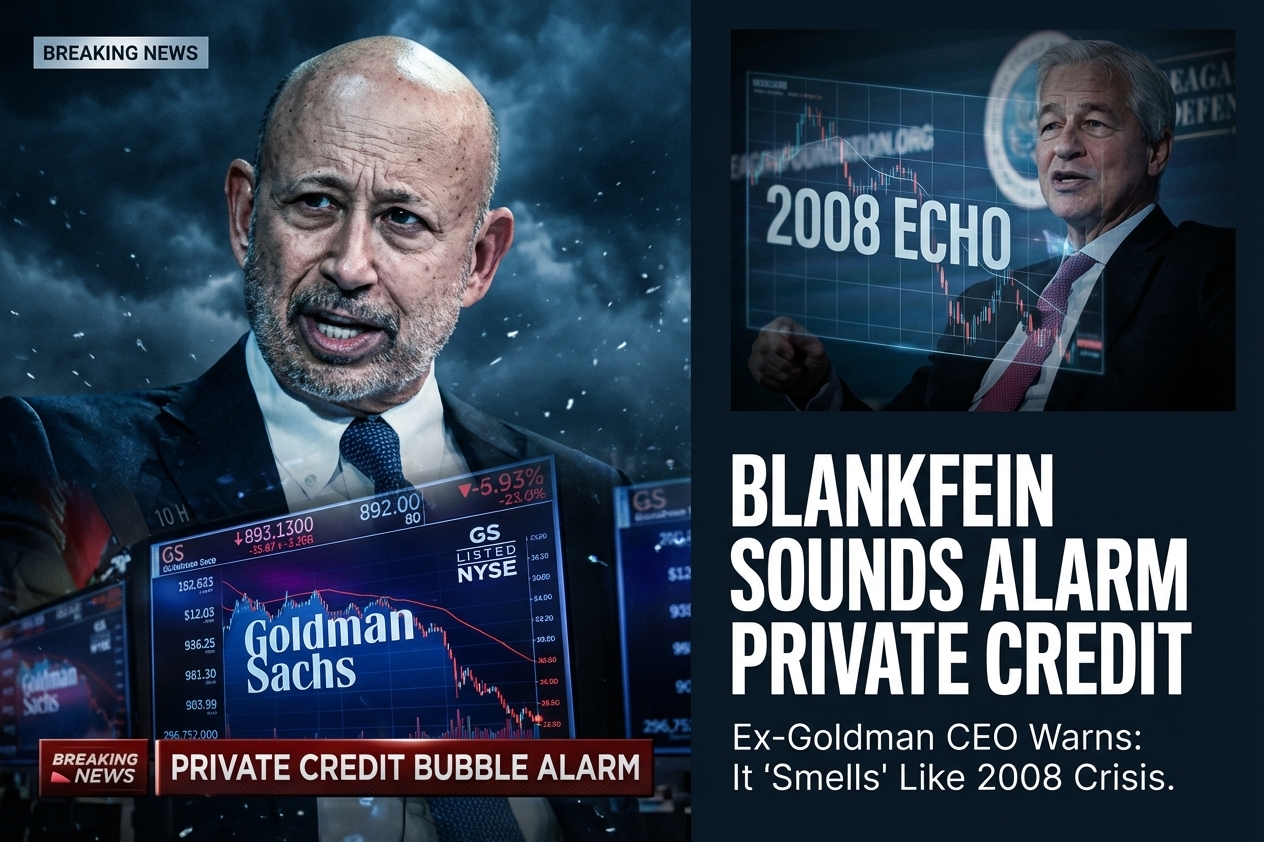
The Ghost of Financial Crises Past: Why Lloyd Blankfein Fears the Private Credit Surge
The air in major financial hubs is thickening with a familiar, unsettling tension. It is the kind of tension that rattles the foundation of even the most robust balance sheets. Lloyd Blankfein, the seasoned warhorse who steered Goldman Sachs through the catastrophic collapse of 2008, has sounded the alarm. His warning is direct, powerful, and aimed squarely at the booming sector of private credit, a $1.8 trillion behemoth currently operating largely outside the glare of traditional banking regulation. Blankfein suggests the current environment is eerily similar to the late stages before the last great financial reckoning, a moment captured by his evocative phrase: it “smells” like 2008\. For Main Street investors, especially those nearing retirement, this isn’t just abstract Wall Street chatter; it represents a tangible threat where hidden leverage could turn accessible yield pitches into massive losses.
What exactly is private credit, and why does it spark such dread in the mind of a man who saw the mortgage-backed security machine grind to a halt? Private credit refers to loans channeled directly from non-bank entities—think private equity firms, hedge funds, and specialized asset managers—to corporations. This circumvents the traditional scrutiny applied to commercial lending by regulated banks. As interest rates stayed suppressed for years, investors desperately sought better returns than traditional bonds offered, embracing these higher-yield, less-transparent instruments. Blankfein’s anxiety stems from the opacity of this ecosystem. He wonders aloud where the “hidden secret leverage” resides, a question echoing the very structure of the subprime crisis where complex derivatives hid mountains of toxic assets beneath layers of insurance and securitization. He reminds us that in 2008, the consensus belief was that leverage was contained, right up until the moment risk surfaced spectacularly, citing the unexpected fallout in places like Iceland.
The expansion of this market into the retail sphere is the accelerant Blankfein sees turning a simmering problem into a potential wildfire. Recent regulatory shifts, including those that opened 401(k)s to these products, mean that ordinary savers, individuals diligently putting aside funds for their future retirement, are now being marketed these complex, illiquid assets. When Blankfein points out that firms are actively pushing these products just as systemic risks appear to be mounting, he implies a dangerous alignment of incentives: the push for fees today might be ignoring the potential for disaster tomorrow. When losses eventually hit individual consumers, the political and regulatory backlash is swift and severe, a consequence Blankfein, having faced Congressional scrutiny himself, understands intimately.
The Market’s Unsettled Gut Feeling: Tracing Parallels to the Mortgage Crisis
To understand the gravity of Blankfein’s comparison to 2008, one must revisit the mechanics of that crisis. In the lead-up to 2008, the proliferation of subprime mortgages was celebrated for democratizing homeownership, yet the true danger lay in how those mortgages were sliced, diced, and distributed as seemingly safe collateralized debt obligations CDOs. The leverage was not just on the initial loans but amplified through interconnected financial contracts. When the underlying asset quality deteriorated, the entire edifice of perceived safety crumbled. The critical lesson was that complexity can successfully mask fragility until liquidity dries up.
The private credit market today is not explicitly housing loans, but the structure shares troubling echoes. Instead of mortgages, the underlying assets are often loans to leveraged companies—businesses that may already be carrying significant debt loads from previous private equity buyouts. If the economy slows, or if interest payments jump too high, default rates in this private pool could rise sharply. Because these loans don’t trade on open exchanges like corporate bonds, there is no immediate, transparent price discovery when distress hits. This lack of liquidity means that when one fund needs to sell to meet redemptions, the lack of a buyer forces a steep markdown, triggering wider panic as other funds holding similar hidden assets are forced to mark down their books, creating an illusion that the problem is larger than it is, or perhaps, hiding the true extent of the underlying problem.
The recent minor tremors mentioned in the market provide tangible evidence that this nervousness is justified. Reports of souring loans at major asset managers and the insolvency of smaller lenders are not isolated incidents; they are the “whinnying horses” Blankfein mentioned. These serve as stress tests exposing the weakest links. While Goldman Sachs, under Blankfein’s past leadership, faced settlements related to misleading sophisticated clients about mortgage risks, the current dynamic is far broader, directly impacting less sophisticated retail participation. The historical context shows that when the risks are contained to elite institutions, the damage is severe but manageable; when retail savings, particularly retirement funds, are directly exposed, the political economy shifts toward aggressive, painful intervention.
The Anatomy of Opaque Leverage: Why Regulators Sleep Poorly
The core complaint against the unregulated growth of private credit circles back to the concept of unmonitored leverage. Traditional commercial banks must adhere to strict capital requirements dictated by Basel accords, ensuring they hold enough capital buffer to absorb expected losses on their loan books. This acts as a safety brake. Private credit funds, however, often operate under far looser collateralization rules. They can borrow heavily against the assets they hold, magnifying both gains and potential losses without the public oversight of bank regulators.
Consider the mechanics. A private credit fund might raise $100 million from investors. Through structured finance techniques common in this space, they might borrow another $150 million from a wholesale funding market, enabling them to originate $250 million in loans. If the portfolio performs well, the fund generates excellent returns for investors. If defaults rise, however, the lenders providing the $150 million start demanding more collateral or refuse to roll over the short-term loans. Suddenly, the fund is forced to sell its underlying company loans into a falling market, magnifying losses for the original $100 million investors. This chain reaction, absent the transparency of public markets, creates systemic risk—a dark pool where the true size of potential losses remains unknown until a wave of defaults forces a reckoning.
Furthermore, the nature of the corporate borrowers in private credit is increasingly precarious. As Jamie Dimon of JPMorgan Chase has also pointed out, some of these loans are going to companies already struggling, often saddled with debt from prior leveraged buyouts. These borrowers lack the pricing power or healthy balance sheets to withstand an extended period of elevated interest rates or recessionary pressure. When these companies start cutting staff or furloughing operations, the ripple effect moves beyond finance into the real economy, impacting employment and consumer spending, exacerbating the financial downturn.
The Retail Invasion: When Yield Chasing Hits Home Accounts
The most alarming development, according to Blankfein, is the active funneling of these complex products toward everyday investors saving for life events like college or retirement. The promise is compelling: instead of the meager 2% offered by a Treasury bill, these private funds purport to deliver 8% or 10%. For a generation scared of outliving their savings, this high yield sounds like a lifeline, not a trap.
The issue rests in the trade-off between risk and liquidity. Traditional stock and bond investments offer daily liquidity; you can sell your shares almost instantly at the prevailing market price. Private credit assets are fundamentally illiquid. Once committed, capital is often locked up for five to seven years, or more. If the market narrative shifts, or if a personal financial emergency strikes, the investor hoping to access that capital often finds their options severely limited, potentially forced to sell through secondary markets at massive discounts or simply wait years for the fund to mature.
This dynamic creates vulnerability not just for the individual but for the broader financial ecosystem. If a significant number of retail investors try to exit their private credit exposure simultaneously—perhaps spurred by a sharp correction in the S&P 500 or rising unemployment—the fund managers responsible for structuring these products will be unable to meet redemption requests efficiently. This imbalance between embedded illiquidity and the expectation of liquidity is a classical recipe for panic and regulatory intervention. The government response Blankfein anticipates will be unpleasant, involving bailouts or heavy-handed restrictions designed to protect citizens who, ironically, were chasing the higher yields that seemed too good to pass up.
Three Futures: Tracking the Potential Trajectories of Private Credit Distress
Predicting the precise nature of the next financial correction is impossible, but we can map out the logical possibilities based on the current instability in the private credit sector. The severity rests entirely on whether regulators act quickly or whether defaults remain isolated events.
Scenario one is the Managed Decompression. In this relatively benign future, the recognized vulnerabilities in private credit—the souring loans at specialized lenders—lead to contained failures. Regulators, alerted by figures like Blankfein and Dimon, impose higher capital adequacy requirements specifically on the non-bank lenders engaged in wholesale funding. This forces a slow, orderly reduction in leverage over the course of 18 to 24 months. Returns on private credit drop closer to public market equivalents, but widespread retail losses are averted, and the systemic contagion effect is minimized because the plumbing is strengthened before the next shock hits. Investors are disappointed but intact.
Scenario two is the Liquidity Freeze. This occurs if a major, highly leveraged corporate borrower defaults, triggering rapid margin calls across multiple private credit funds simultaneously. The wholesale funding markets that supply short-term cash to these funds seize up, fearing counterparty risk. While the underlying loans might be recoverable over time, the immediate inability of funds to meet investor cash calls forces widespread suspensions of withdrawals. This panic causes a sharp, unrelated sell-off in public equity markets as investors liquidate stocks to raise cash, leading to a broader economic slowdown and substantial, though not catastrophic, losses for those whose retirement assets are trapped in suspended funds. This scenario brings unwelcome government attention but stops short of a full systemic meltdown.
Scenario three is the 2008 Echo Cascade. This is the outcome Blankfein truly fears. A major private credit firm, perhaps one deeply intertwined with broader insurance or pension systems, collapses due to hidden leverage, fraud, or a massive default wave. This failure triggers a contagion across the regulated banking system via complex inter-lending arrangements that were assumed safe. Because so many retail products now mirror the complexity that defined mortgage-backed securities, public confidence evaporates instantly. In this future, the government is compelled to intervene with massive liquidity injections and potentially nationalization or guaranteed backstops for retail investors, leading to intense fiscal strain and deep, prolonged economic contraction reminiscent of 2009, all because opacity was mistaken for safety. The market is watching nervously to see which path we begin to follow.
FAQ
What specific financial comparison is Lloyd Blankfein drawing when warning about the current private credit surge?
Blankfein suggests the current environment in private credit
How does private credit differ fundamentally from traditional commercial lending overseen by banks?
Private credit involves loans channeled directly from non-bank entities like private equity or hedge funds to corporations. This circumvents the strict capital requirements and routine regulatory scrutiny applied to commercial lending by traditional, regulated banks. This lack of mandatory oversight is a primary source of systemic concern.
What is the primary attraction that has driven investors toward private credit assets in recent years?
Investors have been drawn to private credit because it offers higher yields compared to traditional, suppressed-rate instruments like government or investment-grade corporate bonds. This search for greater returns pushed capital into less-transparent, higher-yield products when traditional avenues offered little growth.
What is the ‘ghost’ Blankfein is fearful of regarding the hidden leverage in private credit?
The ghost is the previously unseen leverage built up in complex financial structures, similar to how mountains of toxic assets were hidden within securitizations before 2008. Blankfein questions where the ‘hidden secret leverage’ resides, suggesting it could destabilize the system rapidly when risk materializes.
What specific change in the market structure is introducing more retail investors to this risky sector?
Recent regulatory shifts have reportedly opened up access to private credit products within retail investment vehicles, specifically mentioning 401(k) accounts. This directs ordinary savers, seeking retirement security, toward complex and often illiquid assets.
How are the underlying assets in private credit loans structurally similar to the subprime mortgages that doomed CDOs in 2008?
While not mortgages, private credit often involves loans to leveraged companies already burdened by debt from prior buyouts. If the economy falters, the fragility of these already indebted borrowers could lead to sharp spikes in default rates within the private pool.
What is ‘price discovery,’ and why is its absence in private credit markets problematic during distress?
Price discovery is the process of determining the fair, transparent market value of an asset based on supply and demand on open exchanges. Because private credit loans aren’t traded publicly, distress causes immediate, unverified markdowns, potentially triggering panic among linked funds.
What does Jamie Dimon’s concern about corporate borrowers add to the private credit risk profile?
Dimon has noted that borrowers in the private credit space are often already struggling companies lacking pricing power. These weak balance sheets make them particularly vulnerable to sustained high interest rates or recessionary pressure, causing immediate real-economy impact through layoffs.
Why do capital requirements for traditional banks, like those dictated by Basel accords, not apply to private credit funds?
Traditional banks must hold substantial capital buffers to absorb losses on their books as mandated by international accords. Private credit funds operate outside this regime, allowing them to use far looser collateralization rules and maximize borrowing against their assets.
Explain the mechanics of magnified losses in a leveraged private credit fund when funding markets seize up.
A fund might originate $250M in loans using $100M of investor capital and $150M in borrowed wholesale funding. If defaults rise, the wholesale lenders demand collateral or refuse to refinance, forcing the fund to sell underlying assets into a falling market, magnifying losses for the original investors.
What is the critical difference between stocks/bonds and private credit regarding investor liquidity?
Traditional stocks and bonds offer daily liquidity, allowing investors to sell almost instantly at the prevailing market price. Private credit commitments often lock up investor capital for five to seven years or more, creating significant inflexibility.
What is meant by the ‘Retail Invasion’ that Blankfein views as an accelerant for potential disaster?
The Retail Invasion is the current trend of funneling complex, high-yield, illiquid private credit products into the retirement savings of ordinary, less-sophisticated investors. This broadens the base of potential damage from purely institutional losses to Main Street accounts.
What is the potential negative consequence if a large number of retail investors simultaneously demand redemptions from private credit funds?
Because the assets are illiquid, fund managers cannot meet mass redemption requests efficiently, leading to systemic panic and forcing desperate sales in other markets. This imbalance between expected liquidity and embedded illiquidity is a classic recipe for regulatory intervention.
What is characterized as ‘Scenario One: The Managed Decompression’ trajectory for the private credit market?
This benign future involves regulators responding quickly to vulnerabilities by imposing higher capital requirements on non-bank lenders. This forces a slow, orderly reduction in leverage over 18-24 months, averting widespread retail losses and systemic contagion.
What event triggers ‘Scenario Two: The Liquidity Freeze’ in the private credit market structure?
This scenario is triggered when a large, highly leveraged corporate borrower defaults, causing simultaneous margin calls across many private credit funds. The wholesale funding markets freeze due to counterparty risk, trapping investor cash but stopping short of a full systemic meltdown.
What defines the risks associated with the ‘2008 Echo Cascade’ (Scenario Three) that Blankfein fears the most?
This worst-case scenario involves a major, interconnected private credit firm collapsing due to hidden leverage, leading to contagion across the regulated banking system. Public confidence would evaporate, likely forcing massive government intervention and a deep economic contraction.
What concrete examples of market ‘tremors’ are cited as evidence justifying current nervousness?
The text mentions reports of souring loans at major asset managers and the documented insolvency of smaller lenders operating in the space. These are described as the ‘whinnying horses’ that expose the weakest links in the system.
What is the historical parallel Goldman Sachs faced under Blankfein’s leadership that informs his current understanding of risk exposure?
Blankfein’s past leadership faced scrutiny and settlements related to misleading sophisticated clients about the risks associated with mortgage-backed securities. He understands how catastrophic misrepresentations of risk can become when they affect large pools of capital.
How might rising interest rates specifically impact borrowers within the private credit ecosystem?
Many private credit borrowers are already highly indebted from leveraged buyouts; elevated interest rates drastically increase their financing costs. This heightens the risk that these companies will default when they lack the pricing power to absorb higher payments.
Why is the lack of transparency in private credit characterized as creating a ‘dark pool’ for systemic risk?
Because private credit transactions are opaque, the true extent of potential losses from defaults or leverage remains unknown to the broader market and regulators. Losses only become evident after a cascade of defaults forces an emergency reckoning, obscuring the true danger beforehand.
What consequence does Blankfein suggest awaits when retail retirement funds absorb significant losses from private credit products?
When retail savings are directly impacted, the political economy shifts dramatically towards aggressive and potentially painful regulatory intervention or government bailouts. This is due to the inevitability of severe political backlash when ordinary citizens’ futures are threatened.