


The Unexpected Signal Amidst Papal Preparations
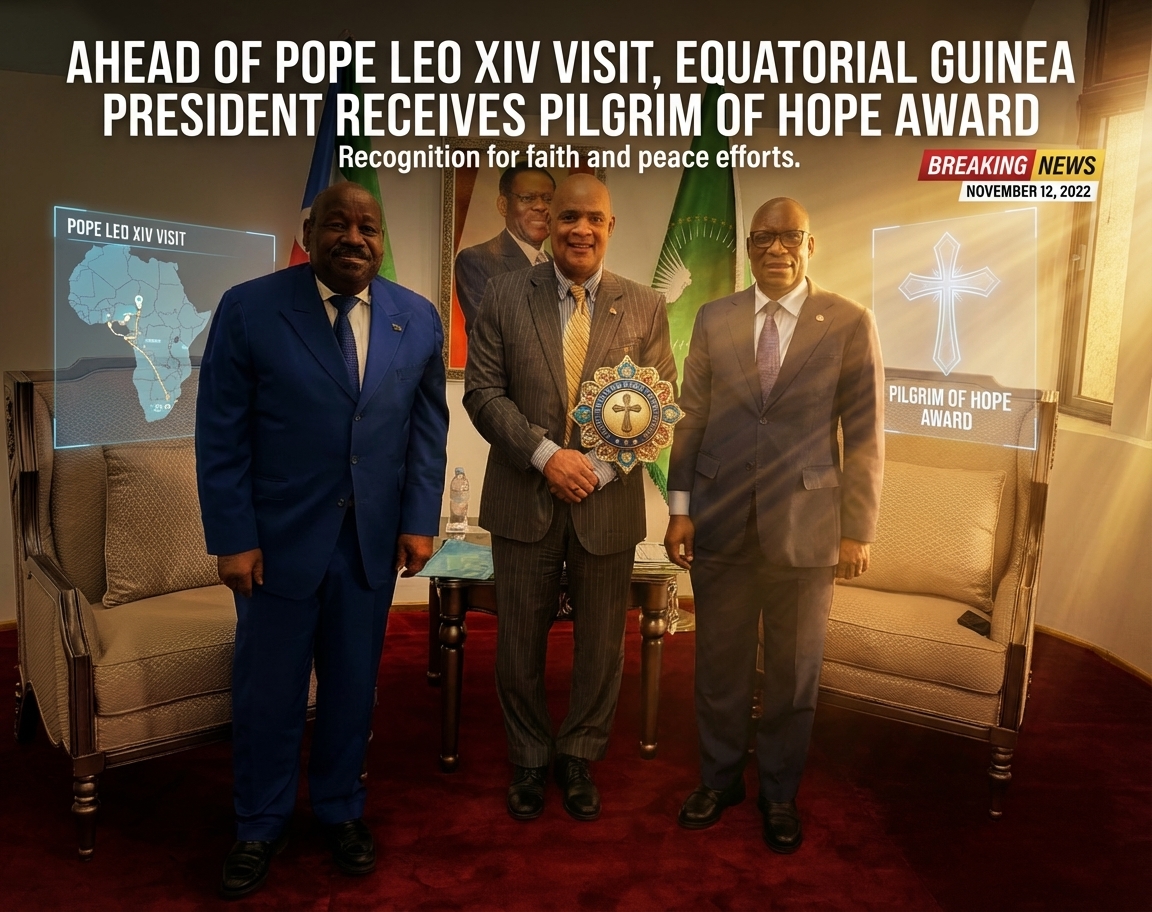
The geopolitical chessboard of West Africa is often dominated by discussions of resource extraction, regional security, and governance challenges within the Gulf of Guinea states. However, the quiet drama unfolding in Malabo ahead of Pope Leo XIV’s highly anticipated visit offers a fascinating counter-narrative. The focus today is not strictly on the billions flowing from offshore oil fields, nor the imminent spiritual significance of the Papal journey, but rather on the symbolic weight of an honor bestowed upon President Teodoro Obiang Nguema Mbasogo: the Pilgrim of Hope Award. This award, presented by Victor Mooney of the Goree Challenge following his transatlantic row, is a masterstroke in soft power projection, especially when viewed through the lens of international finance and reputation management.
When a nation like the Republic of \*\*Equatorial Guinea\*\*, frequently scrutinized for its governance record, hosts a figure like Mooney—a rower welcomed by multiple Popes for his HIV advocacy—the message reverberates far beyond religious circles. It functions as an intentional pivot away from narratives centered solely on resource nationalism and toward themes of personal dedication, faith, and national aspiration. It is an expertly choreographed diplomatic dance, designed to influence sovereign risk models and investor sentiment long before the Pope’s plane even touches down.
The logistics surrounding this event alone speak to a targeted communications strategy. The presence of the Minister of Foreign Affairs, H.E. Mr. Simeón Oyono Esono Angüe, alongside the Permanent Ambassador to the UN, H.E. Mr. Anatolio Ndong Mba, signals that this award presentation was treated with the seriousness usually reserved for bilateral treaty signings. This isn’t mere local ceremony; it is high-level signaling to the international community that the leadership is focused on moral and spiritual legitimacy as much as economic KPIs. For investors seeking stability and predictability, such endorsements, however symbolic, chip away at the institutional risk profile.
The Historical Echoes: From Suppression to Spiritual Restoration
To truly grasp the magnitude of the current moment in \*\*Equatorial Guinea\*\*, one must rewind to the foundational shift of 1979\. The coup that brought President Obiang to power marked a definitive break from a regime notorious for suppressing religious expression. The subsequent declaration of “religious restoration” wasn’t just a policy change; it was a profound realignment of state identity. When current events are framed against this backdrop—a journey from state-enforced silence to hosting the leader of the Catholic world—the narrative becomes sticky and compelling for global audiences.
This historical context amplifies the resonance of the whispers attributed to Pope John Paul II’s previous visit, where the President allegedly questioned why neighboring nations prospered with natural resources while his remained impoverished. That narrative, whether apocryphal or not, establishes a powerful mythological foundation: the nation was blessed, but the blessing was slow to materialize. The massive oil revenue surge in the 1990s, leading to the construction of vital infrastructure, is then cast not as a mere economic windfall, but as the fulfillment of that ancient plea, divinely sanctioned.
This framing is crucial for viral financial journalism because it offers a shortcut to understanding complex national development. It transforms a challenging case study in petro-state economics into a story of faith, perseverance, and eventual reward. For an editor targeting Google Discover, a headline that hints at spiritual destiny intersecting with real-world wealth generation is inherently more engaging than a dry report on bond yields. The award acts as a modern token confirming that the stewardship mandate, hinted at decades ago, is progressing.
The Economic Engine: Oil, Infrastructure, and the Stewardship Imperative
The transformation enabled by the offshore oil discoveries in the 1990s cannot be overstated. Vast wealth flooded the national coffers, providing the financial muscle to power the ambitious national development plan. Highways cutting through dense rainforests, social housing projects, and the expansion of educational and healthcare facilities in otherwise isolated villages represent tangible markers of this new era. These infrastructure investments are the physical manifestation of the President’s promise made nearly five decades prior.
However, the reality of resource-dependent economies means that the narrative of stewardship must constantly contend with the specter of the resource curse. For \*\*Equatorial Guinea\*\*, maintaining positive international perception is not merely about diplomatic niceties; it directly impacts the perceived stability of long-term energy contracts and infrastructure debt repayment capabilities. When the nation actively courts high-profile goodwill gestures, it is actively attempting to de-risk its sovereign profile in the eyes of major energy multinationals and international lending bodies.
The current focus on the Pope’s visit, themed “Christ, Light of \*\*Equatorial Guinea\*\*, Towards a Future of Hope,” provides the perfect vehicle for this de-risking exercise. It allows the state apparatus to showcase its social investment side—the schools and hospitals—while simultaneously celebrating a milestone in national evangelization history, the 170th anniversary. This dual focus frames the nation’s leadership as dedicated to both the temporal well-being and the eternal salvation of its citizenry, a powerful combination in the narrative warfare against persistent political criticism.
The Mooney Factor: A Transatlantic Message of Validation
Victor Mooney’s journey, culminating in this Presidential recognition, serves as a carefully selected PR mechanism. The Goree Challenge, focused on HIV advocacy, aligns perfectly with global health imperatives recently emphasized by major international bodies. By linking the President to this cause—a cause that has historically enjoyed support from previous Popes—the administration subtly asserts its engagement with contemporary global humanitarian concerns, moving beyond internal political dialogues.
Furthermore, Mooney’s background as a devout Catholic from Queens, NY, provides a crucial bridge to Western audiences and institutions. His previous receptions at the Vatican by Popes John Paul II and Francis lend immediate, unimpeachable credibility to his endorsement. When Mooney declares President Obiang “the epitome of hope,” he is channeling an institutional authority that surpasses that of any single geopolitical analyst or NGO report. This kind of endorsement is currency in shaping the initial, surface-level reception of the country by the global financial press.
This strategic use of moral authority is vital. In markets where perception can quickly trigger capital flight, actively cultivating narratives of spiritual progress and personal commitment from leadership provides a necessary buffer. The award acts as a symbolic shield, offering a layer of humanitarian association around the often-stark realities of oil revenue management. It is, fundamentally, a sophisticated attempt to control the framing of the nation’s legacy as it approaches decades under singular leadership.
Projecting Forward: Three Scenarios for the Next Fiscal Cycles
Looking beyond the immediate glow of the award ceremony, the success of this soft power push will influence three critical future scenarios for the nation’s financial trajectory. The first, the \*\*Optimal Resonance Scenario\*\*, sees this positive momentum translate into concrete investor confidence. International bond ratings agencies, taking note of the cultural stability and internationally endorsed leadership continuity, slightly improve their outlooks. This eases the cost of future sovereign borrowing, allowing the government to issue debt at marginally lower rates to fund the next phase of non-oil infrastructure development, perhaps focusing on sustainable energy grids.
The second path, the \*\*Stagnant Scrutiny Scenario\*\*, is more probable if the goodwill proves transient. Global markets remain skeptical, viewing the award as mere window dressing. While the immediate impact of the Papal visit may generate positive local press, long-term capital allocation decisions still heavily weigh metrics like transparency indices and economic diversification efforts. In this scenario, the infrastructure projects slow down, and the reliance on existing hydrocarbon revenues remains dangerously high, leaving the nation susceptible to the next sharp dip in global crude prices. The spiritual messaging fails to overcome long-standing governance concerns.
The final, more challenging trajectory is the \*\*Diplomatic Overreach Scenario\*\*. If the government attempts to leverage this moment of international goodwill too aggressively—perhaps pushing for premature inclusion in certain Western trade blocs or demanding concessions based on the perceived moral endorsement—it risks alienating partners who prioritize governance benchmarks over ceremonial accolades. This overreach could backfire, causing the soft power gain to reverse, leading to renewed focus from international watchdogs on the very issues the state was attempting to temporarily obscure with symbols of faith and hope.
Ultimately, the interplay between faith, resources, and global image defines the modern challenge for the Republic of \*\*Equatorial Guinea\*\*. The Pilgrim of Hope Award is a high-stakes opening statement in a continuous negotiation over its place in the world economy. The success of this narrative positioning will be measured not in applause at the Presidential Palace, but in the subtle shifts in the spreadsheets and risk models used by global capital flows over the next 18 months. The shelter described in Psalm 91 may be spiritual, but its material benefits depend entirely on how well this hope is managed in the corridors of global finance.
FAQ
What is the primary symbolic event highlighted in Equatorial Guinea’s current diplomatic surge, aside from the impending Papal visit?
The primary symbolic event is the bestowal of the ‘Pilgrim of Hope Award’ upon President Teodoro Obiang Nguema Mbasogo. This honor is viewed as a significant exercise in soft power projection and international reputation management.
Who presented the Pilgrim of Hope Award to the President of Equatorial Guinea?
The award was presented by Victor Mooney of the Goree Challenge, following his participation in a transatlantic rowing event. Mooney is notable for his advocacy regarding HIV awareness.
How does the focus on the Pilgrim of Hope Award function as a strategic pivot for Equatorial Guinea’s international narrative?
It functions as an intentional shift away from criticisms centered purely on resource nationalism and governance failures. The focus moves toward themes of personal dedication, faith, and national aspiration to influence investor sentiment.
What high-level officials attended the award presentation, signaling its diplomatic importance?
The event was attended by the Minister of Foreign Affairs, H.E. Mr. Simeón Oyono Esono Angüe, and the Permanent Ambassador to the UN, H.E. Mr. Anatolio Ndong Mba. Their presence elevated the ceremony to the level usually reserved for bilateral treaty signings.
What historical context amplifies the significance of Equatorial Guinea hosting the leader of the Catholic world?
The significance is amplified by the historical break in 1979, when the current President took power following a regime that actively suppressed religious expression. The journey from state-enforced silence to hosting the Pope creates a compelling national alignment narrative.
What mythological foundation is established by the alleged past questioning from President Obiang to Pope John Paul II regarding resource prosperity?
This alleged incident establishes a mythological foundation where the nation felt divinely promised blessings that were slow to materialize. The subsequent oil revenue surge in the 1990s is then framed as the fulfillment of that old plea, making the current events feel divinely sanctioned.
Why is framing national development as a story of faith and perseverance beneficial for financial journalism coverage?
This framing offers a simplified shortcut for global audiences to understand complex petro-state economics, transforming it into a more engaging narrative of perseverance and reward. Such stories are inherently more engaging for platforms like Google Discover than dry economic reports.
What are the tangible economic manifestations of Equatorial Guinea’s oil wealth that the current narrative seeks to showcase?
Tangible manifestations include the construction of highways through rainforests, social housing projects, and the expansion of essential educational and healthcare facilities into isolated villages. These are presented as physical proof of the President’s developmental promise.
How does maintaining positive international perception directly impact Equatorial Guinea’s financial standing?
Positive perception is crucial as it directly impacts the perceived stability of long-term energy contracts and the nation’s ability to repay infrastructure debt. Active courting of goodwill gestures is an effort to de-risk its sovereign profile.
How does the central theme of the upcoming Papal visit aid the government’s de-risking exercise?
The theme, ‘Christ, Light of Equatorial Guinea, Towards a Future of Hope,’ allows the state to showcase its social investment initiatives alongside a major milestone in national evangelization (the 170th anniversary). It frames leadership as dedicated to both temporal and eternal well-being.
What specific global health imperative does Victor Mooney’s HIV advocacy align with, lending credibility to the award?
Mooney’s advocacy aligns with contemporary global health imperatives recently emphasized by major international bodies. By linking the President to this cause, the administration asserts its engagement with current humanitarian concerns.
Why is Victor Mooney’s background as a devout Catholic rower from Queens, NY, strategically important for Western audiences?
His background provides a crucial and unimpeachable bridge to influential Western institutions and audiences. Previous receptions by Popes John Paul II and Francis lend immediate institutional authority to his endorsement.
In volatile financial markets, what function does a symbolic endorsement from a figure like Mooney serve for the administration?
Such endorsements function as currency in shaping the initial reception by the global financial press, acting as a symbolic shield. It provides a layer of humanitarian association around the realities of managing oil revenue.
What is the ‘Optimal Resonance Scenario’ in terms of Equatorial Guinea’s future fiscal cycles?
This scenario predicts that positive momentum leads to improved outlooks from international bond rating agencies. This improvement would ease the cost of future sovereign borrowing for new non-oil infrastructure funding.
What characterizes the ‘Stagnant Scrutiny Scenario’ and what persistent risk remains?
In this more probable scenario, global markets remain skeptical, dismissing the award as superficial, and capital allocation decisions still heavily weigh transparency indices. The primary enduring risk is a dangerous over-reliance on hydrocarbon revenues.
Why might the ‘Diplomatic Overreach Scenario’ backfire on the government’s soft power efforts?
This scenario occurs if the government aggressively leverages the goodwill to demand premature concessions or inclusion in trade blocs based solely on ceremonial accolades. This risks alienating key partners who prioritize governance benchmarks over symbolism.
What is the core metric by which the success of Equatorial Guinea’s narrative positioning will ultimately be measured?
Success will be measured not by local applause or the ceremony itself, but by subtle shifts in the spreadsheets and sovereign risk models utilized by global capital flows over the next 18 months.
What type of governance challenges does Equatorial Guinea actively attempt to obscure or counterbalance with this public relations strategy?
The strategy attempts to counterbalance persistent political criticism and the challenging case study presented by its resource-dependent economy and governance record. It seeks to shift focus from institutional risk to moral legitimacy.
How is the current leadership attempting to frame its mandate in relation to the nation’s historical journey?
The leadership is framing its mandate as the fulfillment of a long-sought stewardship, moving the nation from a state of perceived past impoverishment despite resource wealth to one of fulfillment and divine reward.
What financial instrument might see marginally lower costs if the positive momentum successfully resonates with rating agencies?
The cost of sovereign borrowing is expected to ease, allowing the government to issue future sovereign debt at marginally lower rates. This would specifically benefit funding for subsequent phases of non-oil infrastructure development.
What specific reference is used to draw the final conclusion about the material benefits of ‘hope’ in Equatorial Guinea?
The conclusion invokes Psalm 91, noting that while the shelter described there is spiritual, its material benefits in the modern context depend entirely on how well the narrative of hope is managed within the corridors of global finance.

