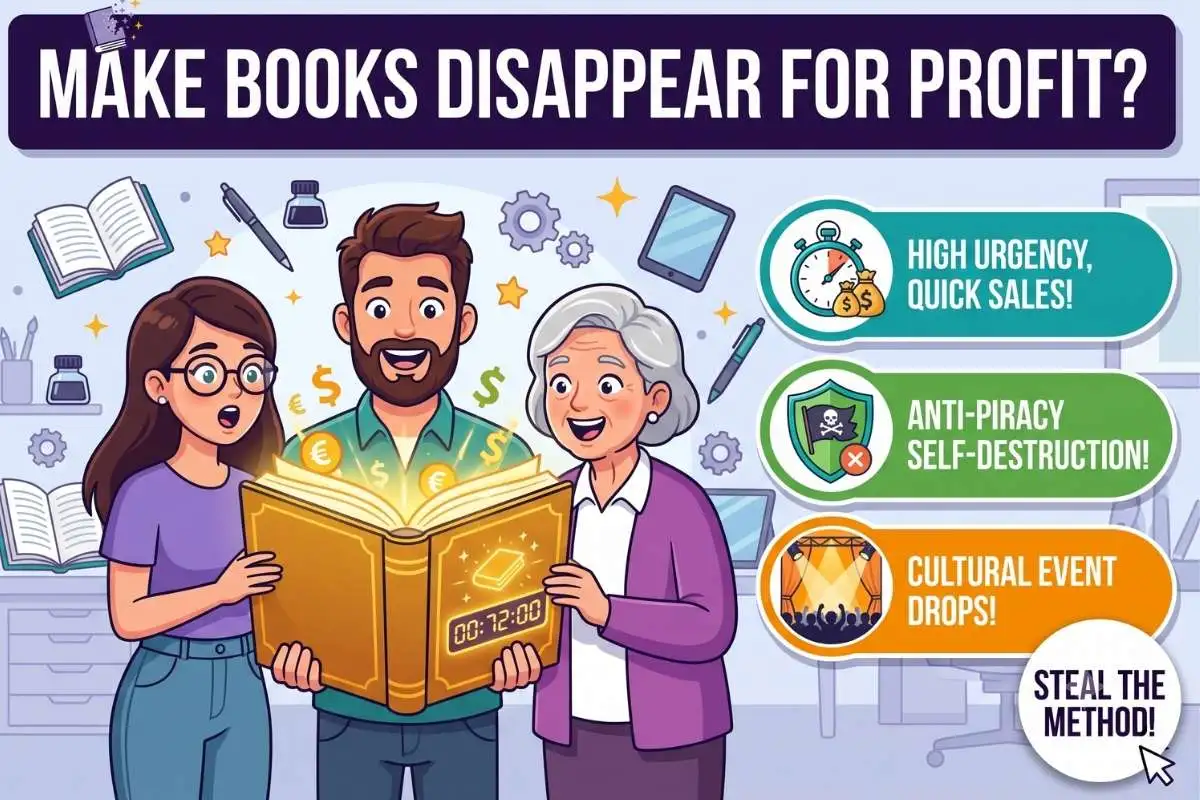
Imagine eagerly waiting for midnight to download the latest thriller from your favorite author. You get the file, open it on your e-reader, and dive into the story. But there is a catch: you only have seventy-two hours to reach the final page. After that, the words will literally vanish from your device, never to be read again. Welcome to the exhilarating, high-stakes world of ephemeral publishing in 2026. What sounds like a nightmare to traditional bookworms is actually an innovative and lucrative marketing strategy. Smart authors are deliberately creating disappearing books—stories with a strict expiration date—to drive insane hype, skyrocket immediate sales, and transform the solitary act of reading into a collective global event. Let’s explore how the impermanence of these texts is capturing the attention of modern readers. It is a bold reimagining of the relationship between the creator, the audience, and the medium itself. By embracing the temporary, these authors are not just selling a story; they are selling a fleeting moment in time, an adrenaline rush wrapped in prose.
The Cultural Shift Toward Vanishing Media
For over a decade, we have been conditioned to consume media that is designed to disappear. It started with social media features like Snapchat stories and Instagram reels, where photos and short videos vanished after a mere twenty-four hours. This bred a culture of immediate consumption, teaching audiences that if they do not pay attention right now, they will miss out forever. In 2026, the publishing industry has boldly adopted this very philosophy, turning books into fleeting experiences. Instead of writing a novel intended to sit on a shelf for generations, visionary authors are engineering their narratives to self-destruct. This radical shift acknowledges that in an information-overflowed world, permanence can sometimes lead to procrastination. When a book is available forever, a reader might buy it but leave it in their digital “to-be-read” pile for years. Ephemeral publishing shatters that complacency. By introducing an absolute deadline, authors force readers to prioritize their work instantly, turning a casual hobby into an urgent, unmissable cultural moment. It transforms the act of reading from a leisurely, open-ended commitment into a thrilling race against the clock. The structure of disappearing books forces readers to clear their schedules and engage deeply with the material before it evaporates.
The Psychology of FOMO and Hyper-Engagement
At the core of this publishing revolution lies a deep understanding of human psychology, specifically the scarcity principle and the pervasive anxiety known as the Fear of missing out. When an object or experience is perceived as scarce or limited in time, its subjective value skyrockets. In the context of ephemeral books, readers are not just buying a story; they are buying an exclusive ticket to a temporary event. Because the text cannot be endlessly revisited or saved for a rainy day, readers approach the material with a heightened level of focus and emotional investment. There are no distractions, no skimming, and no putting the book down halfway through. You either consume it now or lose it forever. This intense concentration mimics the experience of watching a live theater performance, where the magic happens once and then lives on only in the memories of the audience. The resulting social media frenzy is organic and explosive, as fans rush to discuss the plot, share their theories, and prove they were part of the exclusive club that experienced the narrative before it faded into the digital ether. The psychological impact of this enforced scarcity heightens sensory perception and emotional responsiveness.
The Technology Making Disappearing Books Possible
How exactly does a book disappear? The execution relies on a clever blend of modern digital rights management (DRM) and innovative physical materials. On the digital front, publishers use highly secure, encrypted file formats that cannot be screen-grabbed, copied, or forwarded. Once the reader opens the file, a server-side countdown begins. When the clock runs out, the decryption key is revoked, and the file instantly corrupts itself, leaving behind only a blank digital shell. But the trend is not limited to e-books. In the physical realm, boutique presses are utilizing advanced, light-sensitive and oxygen-reactive inks. These special editions are vacuum-sealed in opaque packaging. Once the seal is broken and the pages are exposed to the environment, the ink gradually begins to fade. Depending on the chemical composition, the words might completely vanish within a week or a month, leaving behind a perfectly bound book of blank pages. This ties back to the historical concept of Ephemera—paper items like pamphlets or ticket stubs originally designed for short-term usefulness—but elevates it to a premium art form. The physical editions have become highly sought-after collector’s items even after the text has vanished.
The Blockbuster Economics for Authors
From an economic standpoint, the shift toward ephemeral publishing is proving to be incredibly lucrative for savvy authors who know how to market themselves. Traditional publishing relies on a long-tail economic model, where a book slowly accumulates sales over months or years. However, this often requires sustained marketing efforts that yield diminishing returns. By contrast, disappearing books utilize a “drop” model, heavily inspired by streetwear fashion brands and limited-edition sneaker releases. Authors can charge a premium price for these fleeting experiences because of their exclusive nature. Furthermore, the immense hype generated by the impending disappearance often leads to massive upfront sales that overshadow years of traditional royalties. Once the book vanishes, the author retains total control over the intellectual property. They can choose to resurrect the story years later, adapt it into a screenplay, or simply let it remain a legendary myth among their fanbase. The urgency also acts as a powerful deterrent against piracy; by the time illegal copies could be effectively transcribed and distributed, the cultural conversation has already moved on. By controlling the scarcity of their work, authors dictate the terms of engagement and ensure maximum financial impact in a matter of hours.
The Reader’s Emotional Journey and the Critique of Impermanence
Despite the commercial success, ephemeral publishing has sparked fierce debate among literary critics, librarians, and archivists who argue that literature should be a permanent record of human thought. The idea of deliberately erasing a work of art feels contrary to the very purpose of writing, which historically has been to achieve a form of immortality. Yet, proponents of the movement argue that permanence often breeds apathy. For the reader, the journey through a disappearing book is deeply emotional. Knowing that the story will soon be gone forces a profound connection with the characters and the prose. Readers report feeling a sense of mourning when the text finally vanishes, a unique grief that cements the story in their minds far more effectively than a permanent book ever could. It challenges our desire to possess and hoard art, teaching us to appreciate the beauty of the present moment. In a society obsessed with data storage and endless digital footprints, there is something remarkably freeing about a beautiful story that refuses to be archived, existing only as a shared, fleeting dream. This philosophical shift forces us to reevaluate what constitutes a truly valuable reading experience.
Comparing the Publishing Models
| Feature | Traditional Publishing | Ephemeral Publishing (2026) |
| Sales Window | Infinite, slow accumulation | Strict, short-term availability |
| Reader Urgency | Low | Extreme |
| Marketing Model | Sustained promotional campaigns | High-impact, event-driven “drops” |
| Content Security | Vulnerable to long-term piracy | High |
| Cultural Impact | Gradual community building | Instantaneous social media frenzy |
Frequently Asked Questions
What exactly is an ephemeral or disappearing book?
It is a book published in either a digital or physical format that is designed to become inaccessible after a specific period. Digital versions delete themselves or lock readers out, while physical versions use special inks that fade to blank pages.
Can I take screenshots or copy the digital versions to save them?
No. Publishers utilize advanced digital rights management (DRM) and proprietary reading applications that completely block screenshots, screen recording, and text copying functions to preserve the experience.
Does the physical ephemeral ink really fade completely?
Yes. The specialized inks are formulated to react with oxygen and ambient light. Once the protective vacuum seal is broken, the chemical degradation begins instantly, eventually leaving the pages completely blank.
Why wouldn’t an author want their book to last forever?
Authors use this strategy to create urgency, drive immediate sales, and foster a highly engaged community. The impermanence turns the release into an exclusive event and allows authors to maintain strict, unyielding control over their intellectual property.
The Final Page: Embracing the Beauty of Letting Go
As we look toward the remainder of 2026 and beyond, the ephemeral publishing trend shows no signs of slowing down. It has fundamentally challenged our long-held assumptions about the permanence of art and literature. The disappearing book has carved out a fascinating new niche that reminds us that sometimes, the most profound experiences are those we cannot hold onto forever. By forcing us to pay attention, to be present, and to let go, ephemeral books might just be the most impactful literary invention of our generation. The next time you see a countdown timer on a highly anticipated novel, remember: the magic isn’t just in the story, it’s in the fleeting moment you have to experience it before it vanishes.
The disappearing trend of pocket-sized books from shelves
While the concept of books vanishing entirely is a new phenomenon driven by hype, the physical shifting of literature is not new, as seen by the steady disappearance of older formats from traditional retail spaces over time.