
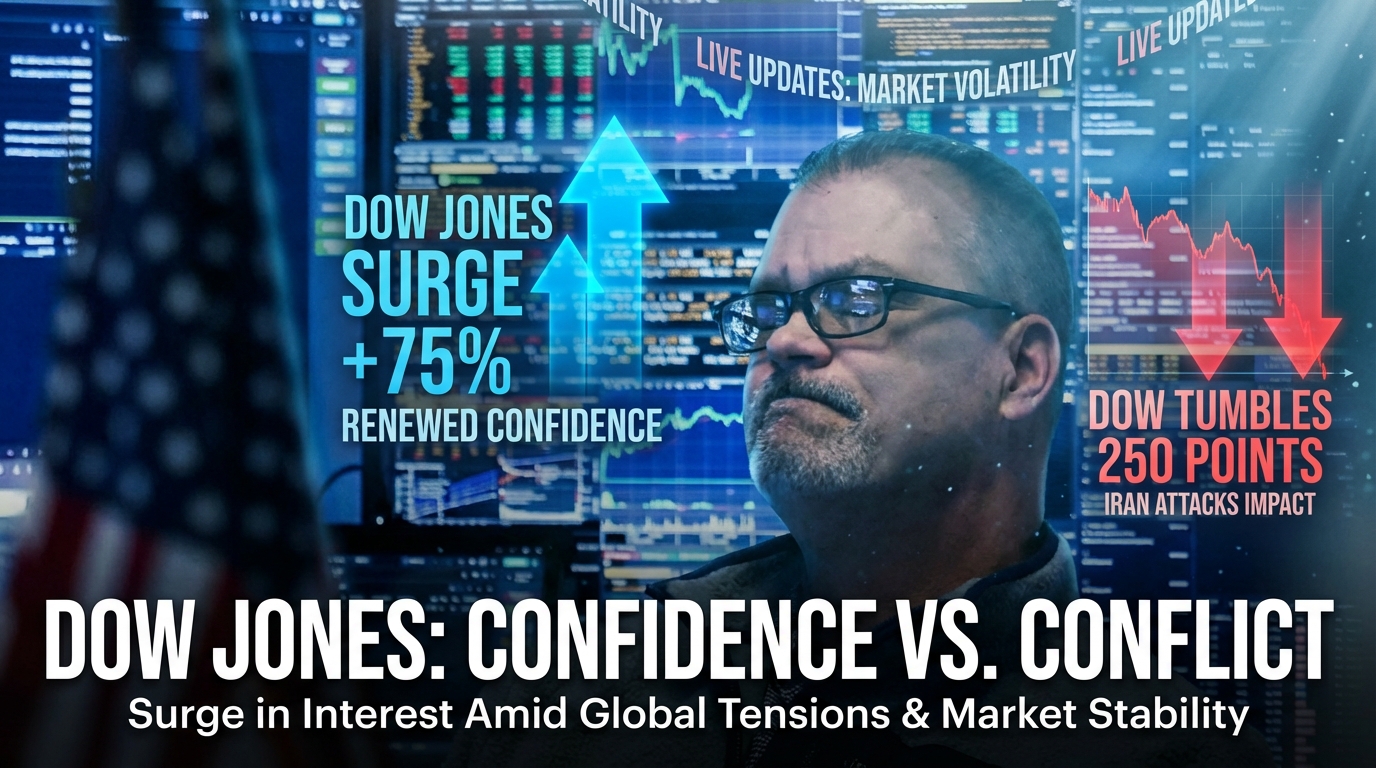
The financial markets are currently performing a brutal and fascinating tightrope walk. Over the weekend, geopolitical risk, long simmering beneath the surface of global equity markets, erupted into open conflict, instantly wiping out vast swathes of market confidence. The initial reaction was textbook panic: stocks tumbled, volatility spiked to alarming highs, and safe-haven assets like gold saw immediate, frantic buying. We saw the \*\*Dow Jones\*\* Industrial Average plummet over 600 points at its session lows, a raw demonstration of how quickly geopolitics can override economic fundamentals. Yet, the story that demands our attention is not the initial drop, but the powerful, almost reflexive recovery that followed, a pattern that suggests a deep, possibly irrational, confidence remaining in the market’s underlying structure.
This isn’t just a day-trader’s twitch; this is a fundamental stress test. The joint U.S.-Israeli strikes against Iran, leading to the death of Supreme Leader Ayatollah Ali Khamenei, represented a genuine inflection point, a moment that many analysts feared could trigger a regional conflagration. The immediate result was exactly what macro analysts dread: oil prices surged by more than 6%, threatening to inject a toxic dose of inflation back into an economy already wrestling with interest rate uncertainties. The CBOE Volatility Index, often dubbed Wall Street’s fear gauge, shot up to its highest levels recorded in 2026, signaling widespread anxiety among institutional players hedging their bets against the unknown variables unleashed in the Middle East.
However, the market’s bottoming out provided a crucial clue about investor psychology. While the most intense fear drove the indices down significantly, the averages clawed back substantial ground by the close. The \*\*Dow Jones\*\* Industrial Average settled down just 282 points, a massive rally off the session’s worst levels. This recovery was clearly underpinned by specific, high-quality defensive sectors. Defense contractors like Northrop Grumman and RTX saw significant jumps, benefiting directly from the heightened state of global readiness, while energy giants Exxon Mobil and Chevron also gained traction as traders priced in sustained higher crude costs. This selectivity suggests that while investors are deeply worried about geopolitical instability, they are not entirely abandoning risk assets; rather, they are rotating aggressively into perceived winners and inflation hedges.
The Ghosts of Geopolitical Shocks Past: Contextualizing the Volatility
To truly grasp the significance of Monday’s trading action, we must place it within the historical context of market reactions to sudden geopolitical shocks. We have seen precursors to this level of panic before, though perhaps not with this specific combination of risk factors. Think back to other flashpoints where conflict threatened global supply chains or energy security. These moments typically trigger an initial “sell everything” reflex, where liquidity is prioritized over valuation. The speed of the initial drop—the Dow nearing a 1.2% intraday fall—aligns with reactions seen during past sudden escalations in the region, moments when the Strait of Hormuz, the world’s vital oil chokepoint, came under threat.
What makes this event arguably more complex, however, is the backdrop against which it occurred. Unlike past shocks that hit a generally bullish or stable environment, this surge of risk landed on an equity landscape already showing significant internal cracks. We were already seeing volatility related to the artificial intelligence sector, with fears growing that the much-touted AI spending boom might lead to business model disruption and, consequently, layoffs. This existing fragility meant that the geopolitical “tail risk” was amplified. Analysts at institutions like Citi pointed out that this new volatility event must be “bucketed” alongside existing concerns, suggesting it acts as an accelerant rather than the sole cause of any eventual downturn. The market’s inability to sustain the lowest levels suggests a lingering institutional memory of quick de-escalation, but the initial fear was potent precisely because of what was already priced in.
Furthermore, the commodity reaction tells a familiar story. Gold futures surged nearly 2%, confirming their roles as the ultimate safe harbor against systemic risk. Simultaneously, the behavior of the oil market provided a sharp, inflation-focused metric. When oil prices jump over 6% based purely on potential supply disruption—even before any physical disruption occurs—it signals that inflation expectations are being immediately recalibrated upward. This dynamic complicates the Federal Reserve’s decision-making process, tying geopolitical action directly back to domestic monetary policy. If this uncertainty persists, that inflationary scare that Janus Henderson warned about becomes a very real probability, forcing a potentially painful choice between allowing inflation to run hot or raising rates into a slowing growth environment.
The Anatomy of the Tech Rally: Why Nvidia Saved the Day
The most intriguing element of the market’s stabilization was the role played by the technology heavyweights. Names like Nvidia and Microsoft were instrumental in pulling the Nasdaq and the broader averages back from their lows. This resilience, in the face of systemic risk, offers a profound insight into where capital believes long-term growth truly resides. One might expect capital to flee tech for tangible assets during war scares, but the opposite materialized. This is because the current AI growth narrative, despite its valuation stress, is seen by many large funds as an unstoppable, structural force that supersedes cyclical geopolitical jitters—at least in the short term.
The logic here is subtle but powerful. A prolonged conflict in the Middle East, while certainly hammering energy prices, does not necessarily prevent massive corporations from continuing their capital expenditure on digital transformation and automation. If anything, supply chain resilience and localized production might become more critical, further demanding investment in advanced computing and software solutions. Technology stocks are therefore being treated less like traditional cyclical stocks sensitive to economic slowdowns and more like essential infrastructure. This belief allowed some investors to view the dip as a once-in-a-quarter opportunity to add core growth holdings at a momentary discount.
This sector divergence points toward a fundamental market bifurcation. On one side, traditional energy and industrial stocks reacted directly to kinetic military risk, while on the other, the digital economy demonstrated a powerful insulating effect. For those looking at the future competition in semiconductor technology, players like \*\*AMD\*\*, while perhaps not experiencing the same intraday bounce as the giants, operate within this same protected growth corridor. The ability of the high-multiple growth stocks to absorb shock suggests that the fear of missing out on the AI revolution outweighs the fear of a temporary oil shock, provided the geopolitical conflict remains geographically contained.
The Economic Counter-Narrative: Stability vs. Escalation
We must contrast the initial panic with the official commentary. President Trump’s assertion that U.S. military operations were “ahead of schedule” hints at a managed containment strategy, designed to deliver a strong deterrent message without immediately spiraling into a protracted regional war. This managerial approach reassures a specific subset of investors who are betting on a short, sharp conflict resolution. Barclays’ analysis, while cautioning against immediate buying, noted that they do not foresee the conflict drastically altering the overall U.S. economic outlook, provided it doesn’t drag on interminably. This reliance on the expectation of a quick de-escalation mirrors past geopolitical risk events where the market priced in the immediate shock but then quickly forgot the incident once diplomatic soundings improved.
However, the risk remains that this pattern breaks. If Iranian retaliation widens the conflict, or if critical infrastructure like the Strait of Hormuz is demonstrably threatened for more than a few days, the short-term impact assessment will fail. A sustained disruption to global oil traffic would not just cause price spikes; it would immediately crush global supply chains built on the assumption of cheap and predictable energy. Such a scenario would rapidly transition from a geopolitical uncertainty event to a full-blown stagflationary crisis, forcing the Fed’s hand away from any potential easing cycle. This pathway is the one that sent the VIX soaring and prompted investors to seek the ultimate safety of gold.
The market rotation into defense contractors highlights the current reality: certain industries are structurally benefitting from global instability across the board. RTX and Lockheed Martin gains signal that defense spending is viewed as a sustained growth trajectory, irrespective of specific regional conflicts. This suggests that portfolio managers are building defenses against a world that is becoming fundamentally more fractured and uncertain. Money flowing into these names is money betting against global harmony, a sober indicator that the market believes the era of predictable geopolitical stability may be over, even if the immediate energy supply chain holds.
Three Futures: Where the Market Unravels or Resumes Normalcy
Looking ahead, the market will be anchored by speculation about which of three scenarios materializes over the coming weeks. The first, and the one the initial market rally is implicitly betting on, is the Rapid De-escalation Scenario. In this future, rhetoric remains heated, but tangible escalations cease immediately. Oil prices stabilize or retreat slightly as the Strait of Hormuz remains open, and the market focuses its attention back on corporate earnings and the AI spending cycle, largely shaking off the geopolitical impact within ten trading days. This scenario validates the recent tech rebound and supports a return to pre-event valuations, likely sending tech stocks higher as risk appetite returns.
The second is the Protracted Friction Scenario. This is the sticky middle ground. Oil remains elevated, perhaps hovering consistently above $95 or $100 a barrel due to ongoing low-level skirmishes or persistent threats to shipping lanes. This scenario means inflation expectations remain high, forcing the Federal Reserve into a holding pattern, possibly delaying rate cuts well into the next year. This outcome crushes investor sentiment, as seen in the initial fear gauges, and would exert broad downward pressure on risk assets, leading to a sustained period of sector rotation and weakness, where even the strong software names struggle to hold gains against rising input costs and slower consumer demand.
The final, most severe outcome is the Full Regional Spillover Scenario. This involves a direct, sustained military confrontation that significantly impairs global energy flows or draws in major regional powers. If this occurs, the initial 600-point drop in the Dow becomes a mere rounding error. Inflation accelerates wildly, supply chains halt, and liquidity dries up as global risk premiums skyrocket. Under this dark outlook, the market would prioritize cash and tangible assets, potentially leading to a sharp contraction in capital available for investment in areas like next-generation processors, despite the long-term structural importance that companies like \*\*AMD\*\* represent. Investors are currently praying this scenario remains strictly off the table, as the confidence shown in the technology sector’s recovery is entirely predicated on geopolitical containment.
FAQ
How severely did the Dow Jones Industrial Average initially react to the Middle East geopolitical shockwave?
The Dow Jones Industrial Average initially plunged by over 600 points during the session’s lows, illustrating the immediate widespread loss of market confidence driven by geopolitical risk. However, the index staged a powerful recovery by the close, settling down significantly less.
What macroeconomic factor saw an immediate and drastic surge following the Middle East conflict escalation?
Oil prices immediately surged by more than 6% in reaction to the potential for supply disruption following the strikes in the Middle East. This rapid rise threatens to reintroduce significant inflationary pressure into the economy just as the Fed handles interest rate uncertainty.
What metric often dubbed Wall Street’s ‘fear gauge’ indicated institutional anxiety?
The CBOE Volatility Index (VIX) shot up to its highest recorded levels for the year 2026. This spike signaled widespread anxiety among institutional investors hedging their portfolios against rapidly unfolding geopolitical variables.
Which specific industry sectors benefited directly from the post-shock market rotation?
Defense contractors, such as Northrop Grumman and RTX, experienced significant jumps as investors priced in higher global readiness spending. Energy giants like Exxon Mobil and Chevron also gained traction due to anticipated sustained higher crude oil costs.
What key economic indicator signaled that investors were immediately recalibrating inflation expectations upward?
The 6% surge in oil prices based purely on potential supply disruption signaled an immediate upward recalibration of inflation expectations. This makes the Federal Reserve’s domestic monetary policy decisions significantly more complicated.
How did the market’s behavior on Monday differ from a pure ‘sell everything’ panic reflex?
While the initial reaction was panic selling across the board, the market demonstrated resilience by clawing back substantial intraday losses to close much higher. This recovery indicated a belief in the market’s underlying structure, particularly within defensive sectors.
In historical context, what factor makes this current geopolitical shock arguably more complex than past events?
This risk surge landed on an equity landscape that already showed significant internal cracks, specifically volatility related to the artificial intelligence spending boom. The existing fragility amplified the impact of the ‘tail risk’ event.
What role did safe-haven assets, specifically gold, play during the initial market turmoil?
Gold futures surged nearly 2%, confirming its traditional role as the ultimate safe harbor against systemic risk and uncertainty. This reaction is typical when investors prioritize liquidity over asset valuation during sudden crises.
Why were major technology stocks like Nvidia instrumental in pulling the Nasdaq back from its lows?
Many large funds view the current AI growth narrative as an unstoppable, structural force that overrides cyclical geopolitical jitters in the short term. Technology stocks were thus treated as essential infrastructure rather than purely cyclical assets.
How are technology stocks being treated differently by investors during this particular geopolitical shock?
Instead of fleeing tech for tangible assets, investors treated the dip as an opportunity to accumulate core growth holdings at a discount. This suggests that the long-term AI growth narrative is now insulating these stocks from immediate economic worries.
What is the significance of the gains seen by defense contractors like Lockheed Martin?
These gains signal that portfolio managers are treating defense spending as a sustained growth trajectory, betting against global harmony. It suggests market belief that the era of predictable geopolitical stability might be ending.
What is the ‘Rapid De-escalation Scenario’ and what does it imply for tech stocks?
This scenario assumes that tangible escalations cease immediately, leading to oil stabilization and a return to focusing on corporate earnings within ten trading days. This outcome validates the recent tech rebound and supports a return to pre-event valuations.
What is the key determinant that would shift the market from the ‘Rapid De-escalation’ to the ‘Protracted Friction Scenario’?
The key determinant is sustained high oil prices, perhaps staying consistently above $95 or $100 a barrel due to ongoing threats to shipping lanes. This keeps inflation expectations high and forces the Federal Reserve into a holding pattern on rate cuts.
How does President Trump’s commentary about military operations ‘ahead of schedule’ affect investor sentiment?
This assertion hints at a managed containment strategy designed to deliver a strong deterrent without triggering a protracted regional war. This reassures investors betting on a short, sharp resolution to the conflict.
What is the ‘Full Regional Spillover Scenario’ regarding geopolitical risk?
This is the most severe outcome, involving sustained military confrontation that significantly impairs global energy flows or draws in major regional powers. In this event, the initial Dow drop would be followed by a stagflationary crisis and liquidity drying up.
What challenge does ongoing geopolitical uncertainty pose specifically for the Federal Reserve’s monetary policy?
The oil-driven inflation scare complicates the Fed’s decision-making, potentially forcing a painful choice between allowing inflation to run hot or raising rates into an already slowing growth environment.
Why are companies like AMD considered to be within the same ‘protected growth corridor’ as the tech giants?
AMD, as a key player in semiconductor technology, benefits from the belief that investment in advanced computing and automation remains critical, even amidst geopolitical instability. This belief suggests it is insulated by the structural importance of digital transformation.
According to institutional analysis cited, how should this new volatility event be categorized alongside existing market concerns?
Analysts at institutions like Citi suggested that this new volatility event must be ‘bucketed’ alongside existing concerns, implying it acts as an accelerant rather than the sole driver of any potential downturn. This acknowledges pre-existing market fragility.
What is the primary risk associated with a sustained disruption to the Strait of Hormuz?
A sustained disruption to this vital oil chokepoint would immediately crush global supply chains built on cheap and predictable energy. This would rapidly transition the situation from geopolitical uncertainty to a full-blown stagflationary crisis.
What does the market rotation into defense contractors suggest about the broader outlook on global stability?
This rotation suggests that portfolio managers see global instability as a sustained trend, betting against long-term global harmony. It implies expectations that the era of predictable geopolitical calm is over.
What would happen to investments in next-generation processors like those from AMD under the ‘Full Regional Spillover Scenario’?
Under the worst-case scenario, where liquidity dries up and risk premiums skyrocket, capital would prioritize cash and tangible assets. This could lead to a sharp contraction in investment for growth areas like next-generation processors.
