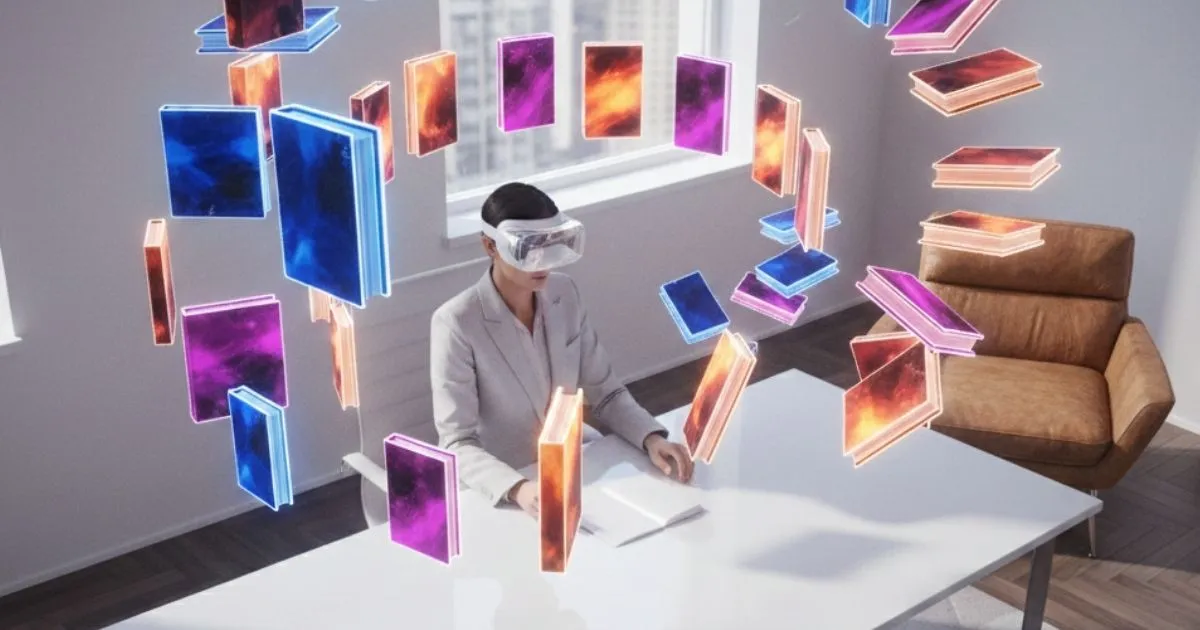
I remember standing in a digital bookstore three years ago, staring at a flat grid of book covers that looked exactly like the ones on my physical shelf, only less tactile and more depressing. It felt like we were trying to force a 500-page ocean into a thimble. But walking into a virtual library today, in the early months of 2026, the experience is unrecognizable. You don’t just “scroll” anymore. You navigate. You exist within a discovery layer where the geometry of the room matters as much as the metadata of the title. This is the era of designing for Spatial Search, and if you are still thinking in terms of horizontal keywords and blue links, you are essentially ghostwriting for a graveyard.
The shift hasn’t been subtle. We moved from the “Search Bar” to the “Search Environment” almost overnight as headsets became lighter and the optics finally stopped giving everyone a headache. For authors and publishers, winning the 2026 VR book market isn’t about having a pretty cover anymore. It is about how your “object” behaves when a user’s gaze lingers on it in a 3D space. I’ve seen brilliant writers fail because their digital assets were “too heavy” or lacked the proper spatial anchors, while mid-list novelists are becoming titans simply because they understood that in a spatial web, your book is an entity, not just a file.
The mechanics of Spatial Search SEO in immersive environments
We have to stop treating SEO like a game of Scrabble and start treating it like urban planning. When a reader enters a virtual bookstore, the search engine isn’t just looking for text matches. It is calculating the proximity of entities. If a user is standing in a “Cyberpunk Noir” themed room, the Spatial Search SEO algorithms are looking for books that have high contextual weight within that specific 3D coordinate. This is where the technical meets the creative. I’ve spent a lot of time looking at how metadata is now being “baked” into the volumetric assets of a book. It isn’t just about the blurb on the back, but the “vibe” signals—the lighting, the ambient sound attached to the preview, and the way the book responds to virtual touch.
The winners right now are those who treat their book’s digital presence as a persistent object. In 2026, discovery is about “presence signals.” If your VR books 2026 strategy doesn’t include spatial triggers—like a character’s voice that whispers a hook when a reader walks past a specific shelf—you are invisible. I’ve noticed that the most successful authors are those who collaborate with spatial designers to ensure their work is “findable” not by a keyword, but by a gesture. It is a strange, beautiful new world where a reader’s physical movement toward a glowing spine on a high shelf is the new “click-through rate.” We are optimizing for human curiosity in three dimensions, and that requires a level of intentionality that most traditional marketing departments simply aren’t equipped for yet.
Building for future discovery through architectural narrative
There is a certain irony in the fact that to succeed in the most high-tech market in history, we had to go back to the basics of architecture. I often think about how a well-designed physical library makes you feel—the quiet, the smell of paper, the way light hits a leather binding. In the virtual space, we are recreating that “serendipity” through code. Future discovery is no longer a linear path from search query to purchase. It is a journey through a narrative landscape. I’ve seen authors build entire “discovery worlds” where the book isn’t the destination, but the prize at the end of a short immersive experience.
The strategy here is what I call “Environmental Anchoring.” You aren’t just selling a story; you are selling a piece of a world that the reader wants to inhabit. This is where the smart money is moving. While some are still arguing over Kindle royalties, the real innovators are looking at their digital assets as high-value intellectual property that can be flipped, traded, or integrated into larger spatial ecosystems. I’ve talked to creators who are seeing their “search visibility” skyrocket because they’ve integrated their books into popular social VR hubs. Their work becomes a landmark in the digital city. When your book becomes a destination, you stop worrying about the algorithm. The algorithm starts following the crowd to you.
It makes me wonder how long it will take for the laggards to realize that the “page” is dead as a primary unit of consumption. In 2026, the unit of consumption is the “experience.” If I can walk through the setting of your thriller before I buy the first chapter, I am a thousand times more likely to convert. This isn’t just marketing; it is a fundamental shift in the relationship between creator and consumer. We are no longer just writers; we are world-builders, and the tools we use to build those worlds—the agency services that help us render these realities—are becoming the most important tools in our kit.
The landscape is changing so fast that even the term “book” feels a bit archaic. We might need a new word for these volumetric, interactive, spatially-searchable containers of human thought. But whatever we call them, the objective remains the same: to be found, to be felt, and to be remembered. In a world of infinite digital noise, the only way to stand out is to be the most “solid” object in the room. You have to occupy space—literally.
I find myself looking at my own physical bookshelves lately with a bit of melancholy. They are static. They are silent. They don’t know I’m looking at them. In the VR market of 2026, the books look back. They know where you’re standing, what you’re interested in, and how long you’ve been hovering near the mystery section. Some might find that intrusive, but for the author who has been struggling to find their audience in a sea of flat text, it is the greatest opportunity since the invention of the printing press. We are finally moving past the era of being “indexed” and into the era of being “experienced.”
What does it look like for you? Are you still trying to fit your ocean into a thimble, or are you ready to start building the ocean itself? The tools are there, the audience is wearing their headsets, and the spatial web is waiting for its first great monuments. The only question left is who will be brave enough to stop writing for the screen and start writing for the space.