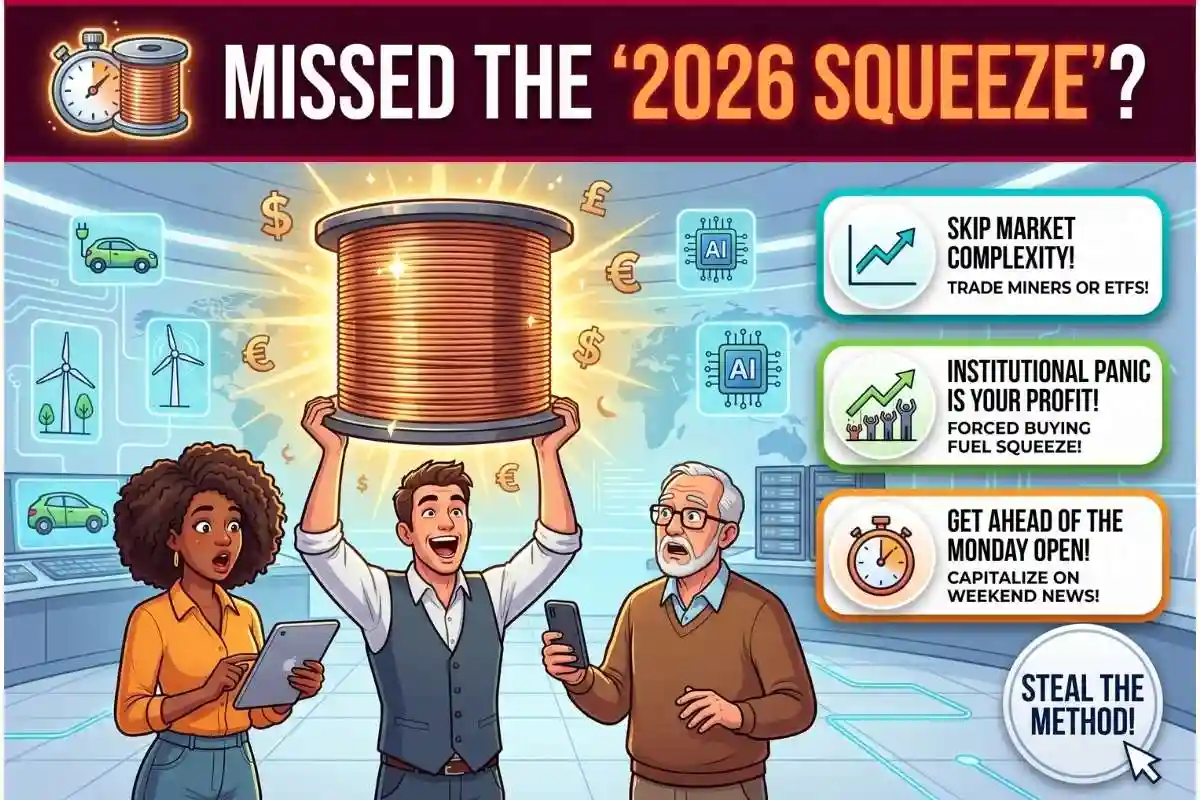
The world is running out of its most essential wire, and Wall Street is finally waking up to the reality of the 2026 copper shortage. Imagine a scenario where the unstoppable force of the global energy transition meets the immovable object of a stagnant mining supply chain. What you get is an explosive market dynamic known as a “squeeze.” For the everyday investor, the metals market can often feel like a distant, archaic arena reserved for institutional giants and industrial conglomerates. However, the current landscape has shifted dramatically. Driven by the rapid proliferation of artificial intelligence data centers, government-mandated electric vehicle targets, and a sprawling expansion of renewable energy grids, the demand for copper has skyrocketed. But the supply simply isn’t there. This perfect storm has created a unique, time-sensitive trading opportunity. As geopolitical tensions simmer and weekend headlines threaten to disrupt supply routes, understanding how to position yourself before the Asian commodity markets open on Monday could be the difference between catching the wave and being left on the shore. This article will guide you through the mechanics of the 2026 copper squeeze and how you can strategically navigate it.
The Anatomy of the 2026 Copper Squeeze
To grasp the magnitude of the current trading opportunity, you first need to understand the mechanics of a short squeeze in the commodities market. A short squeeze occurs when traders who have bet against an asset’s price—hoping it will drop so they can buy it back cheaper—are suddenly forced to purchase the asset to cover their positions as the price unexpectedly rises. In the context of 2026, numerous institutional funds had previously bet that the high interest rates and sluggish global manufacturing output of the past few years would suppress copper demand. They heavily shorted the market. However, they drastically underestimated the sheer velocity of the global energy transition.
As physical copper inventories in warehouses registered by the London Metal Exchange (LME) and the COMEX plummeted to record lows, the price began to tick upward. Those short sellers are now trapped in a classic squeeze. Every time the price of the “red metal” climbs, more short sellers are forced to buy copper contracts to exit their losing trades, which in turn drives the price even higher. This creates a self-fulfilling cycle of rapid price appreciation. For the agile trader, recognizing this institutional panic provides a blueprint for profit. By analyzing the open interest in copper futures and monitoring warehouse inventory levels, traders can anticipate these violent upward price spikes. The key is to establish a position just before the squeeze reaches its crescendo, capitalizing on the forced buying of the financial giants who misjudged the future of the global economy. For more foundational knowledge on the properties and history of this vital element, you can read about Copper on Wikipedia.
The Energy Transition’s Insatiable Appetite
The narrative driving the 2026 copper market is fundamentally anchored in the global energy transition. We are witnessing the most significant overhaul of the world’s energy infrastructure since the Industrial Revolution, and copper is the crucial conductive tissue binding it all together. Unlike fossil fuel power plants, renewable energy technologies are remarkably copper-intensive. To put this into perspective, a single one-gigawatt offshore wind turbine requires upwards of 2,800 tonnes of copper. Solar photovoltaic panels use roughly five tons of copper per megawatt of capacity. When you multiply these figures by the aggressive climate targets set by nations worldwide, the scale of required raw materials becomes staggering.
But renewables and electric vehicles are only half the story. The unexpected wildcard of the decade has been the explosion of Artificial Intelligence. The massive data centers required to train and run complex AI models consume unfathomable amounts of electricity. Upgrading the power grids to support these facilities, alongside the intricate cooling systems and internal wiring of the servers themselves, has introduced a massive new vector of copper demand that forecasters completely missed just five years ago. We are literally trying to wire the future, and there isn’t enough metal to do it. The United States government has recognized this vulnerability, actively updating policies regarding supply chains for crucial resources. You can explore the strategic importance of these resources through the Critical Minerals Materials Program at the Department of Energy. The collision of green energy mandates and the AI revolution has guaranteed that the appetite for copper will remain insatiable for the foreseeable future.
Geopolitics and the Supply Chain Crunch
While the demand side of the copper equation is surging, the supply side is facing an unprecedented series of crises. It is a common misconception that when the price of a commodity goes up, miners simply dig more of it out of the ground. In reality, developing a new tier-one copper mine from initial discovery to commercial production can take anywhere from 10 to 15 years. You cannot simply flip a switch and flood the market with new supply. Furthermore, the quality of the ore currently being mined is steadily declining. Mines in Chile and Peru, which historically account for a massive portion of global production, are having to dig deeper and process significantly more rock just to extract the same amount of copper they did a decade ago.
Compounding these geological challenges is the increasingly fragile state of global geopolitics in 2026. Resource nationalism is on the rise, with copper-rich nations demanding a larger share of the profits through increased taxes and royalties, which disincentivizes new exploration. Additionally, localized strikes, water shortages in South America, and unexpected supply chain bottlenecks—such as the recent acute shortages of sulfuric acid necessary for the refining process—have led to severe production downgrades. Every time a major mining operation announces a delay or a force majeure, the market tightens further. For a trader, keeping a close eye on the geopolitical landscape of Latin America and central Africa is just as important as reading a stock chart. The supply chain crunch is structural, deeply entrenched, and provides the fundamental bedrock that makes the copper squeeze strategy so potent.
The Weekend Window: Why “Before Monday Opens” Matters
Timing is everything in trading, and the commodities market operates on a unique global clock that can catch novice investors off guard. When we talk about positioning yourself “before Monday opens,” we are referring to the critical weekend window where news flow dictates the upcoming week’s price action. Unlike the standard stock market, which rests on the weekends, global events do not pause. Geopolitical developments, macroeconomic data releases from China (the world’s largest consumer of copper), or unexpected mining disruptions often break over the weekend. Because the Asian commodity markets open late Sunday evening Eastern Time, any major news is immediately priced into the futures contracts.
If you wait until the New York market opens on Monday morning at 9:30 AM to react to weekend news, you have already missed the boat. The price will have “gapped up,” meaning the opening price is significantly higher than Friday’s closing price, and the institutions will have already taken their profits. To effectively execute the copper squeeze strategy, a trader must proactively evaluate the macro environment on Friday afternoon. Are inventories drawing down? Are there rumors of stimulus packages in Asia? Are strike negotiations at a major mine breaking down? By taking a calculated position—perhaps through a copper Exchange Traded Fund (ETF) or an options contract—before the Friday close, you position yourself to capture the explosive move that occurs when the global futures markets violently adjust to the new reality on Sunday night. It is a strategy that requires anticipation rather than reaction.
The Data: Shifting Copper Consumption (2020 vs. 2026)
To visualize the sheer scale of the demand shock, consider how the primary uses of copper have evolved over the past six years. The table below illustrates the estimated percentage increase in copper consumption across key growth sectors.
| Industry Sector | Est. Global Consumption (2020) | Est. Global Consumption (2026) | Percentage Growth | Primary Driver |
| Electric Vehicles (EVs) | 600,000 Tonnes | 2,800,000 Tonnes | +366% | Battery tech & charging networks |
| Wind & Solar Energy | 1,100,000 Tonnes | 3,100,000 Tonnes | +181% | Offshore wind expansion & grid ties |
| AI Data Centers | 150,000 Tonnes | 850,000 Tonnes | +466% | Server cooling & heavy power draw |
| Traditional Construction | 8,500,000 Tonnes | 9,100,000 Tonnes | +7% | Baseline housing & infrastructure |
Note: The massive leaps in the EV, Renewable, and Data Center sectors highlight the structural shift away from traditional construction as the sole driver of copper prices.
Executing the Trading Strategy
Understanding the macroeconomic theory is fascinating, but translating that knowledge into a profitable, real-world portfolio is the ultimate goal. For the retail investor, executing the copper squeeze strategy does not mean buying physical pallets of industrial wire and storing them in your garage. Modern financial markets offer several accessible, liquid vehicles for gaining exposure to the price of copper. The most direct route for those with access to futures accounts is trading COMEX copper futures (ticker symbol HG). However, this involves leverage and carries significant risk if the market turns against you.
For the average investor, a much safer and highly effective method is utilizing exchange-traded funds (ETFs) that physically back their shares with stored copper, or funds that track the performance of the futures market. Another lucrative, albeit slightly more volatile, approach is investing in the equity of copper mining companies. When the price of the underlying commodity rises, the profit margins of these miners expand exponentially, often leading their stock prices to outperform the physical metal itself. However, it is crucial to remember the golden rule of risk management: never allocate capital you cannot afford to lose, and never chase a “gap up” on a Monday morning. The essence of the strategy is entering during periods of quiet consolidation when the fundamental thesis remains intact, patiently waiting for the institutional squeeze to ignite the price action.
Frequently Asked Questions (FAQ)
- What is the simplest way for a beginner to invest in the copper market? The most accessible method for beginners is through standard brokerage accounts by purchasing shares of Copper ETFs or investing in large, diversified mining companies that have significant copper operations. This provides exposure without the complex mechanics and high leverage of the commodities futures market.
- Can the price of copper suddenly crash despite the shortages? Yes, absolutely. Copper is highly sensitive to the global macroeconomic environment. If there is a sudden, severe global recession that halts construction and manufacturing, demand will temporarily plummet, and prices will drop, regardless of the long-term energy transition narrative. Trading always involves risk.
- Why is copper often referred to as “Dr. Copper”? In financial circles, it is affectionately called “Dr. Copper” because it is said to have a Ph.D. in economics. Because it is used in almost every sector of the economy—from housing to electronics to transportation—its price is traditionally viewed as one of the most reliable leading indicators of global economic health.
- What exactly is a short squeeze? A short squeeze happens when a heavily shorted asset suddenly increases in price, forcing those short sellers to buy back the asset to prevent further losses. This forced buying creates a snowball effect, pushing the price up even faster.
- How does an AI data center use so much copper? AI data centers require massive amounts of electricity. Copper is the most cost-effective, highly conductive metal available. It is heavily utilized in the miles of power cables, transformers, busbars, and the sophisticated heat exchangers needed to keep the supercomputers from overheating.
A Final Curiosity: The Metal That Built the World
As we look forward to the technological marvels of 2026 and beyond, it is worth pausing to appreciate the deep historical irony of our situation. Copper was the very first metal ever manipulated by human hands, ushering in the Chalcolithic period (the Copper Age) nearly ten thousand years ago. It pulled humanity out of the Stone Age, allowing for the creation of new tools and weapons.
Today, the exact same element is pulling us into the future, acting as the irreplaceable foundation for quantum computing, artificial intelligence, and clean energy. Despite the millions of tons mined over millennia, if you were to gather all the copper ever extracted throughout human history and melt it down, it would form a solid cube measuring just roughly 500 meters on each side. That single, surprisingly small block of red metal has literally built the modern world, and as the great squeeze of 2026 unfolds, it has never been more valuable.