


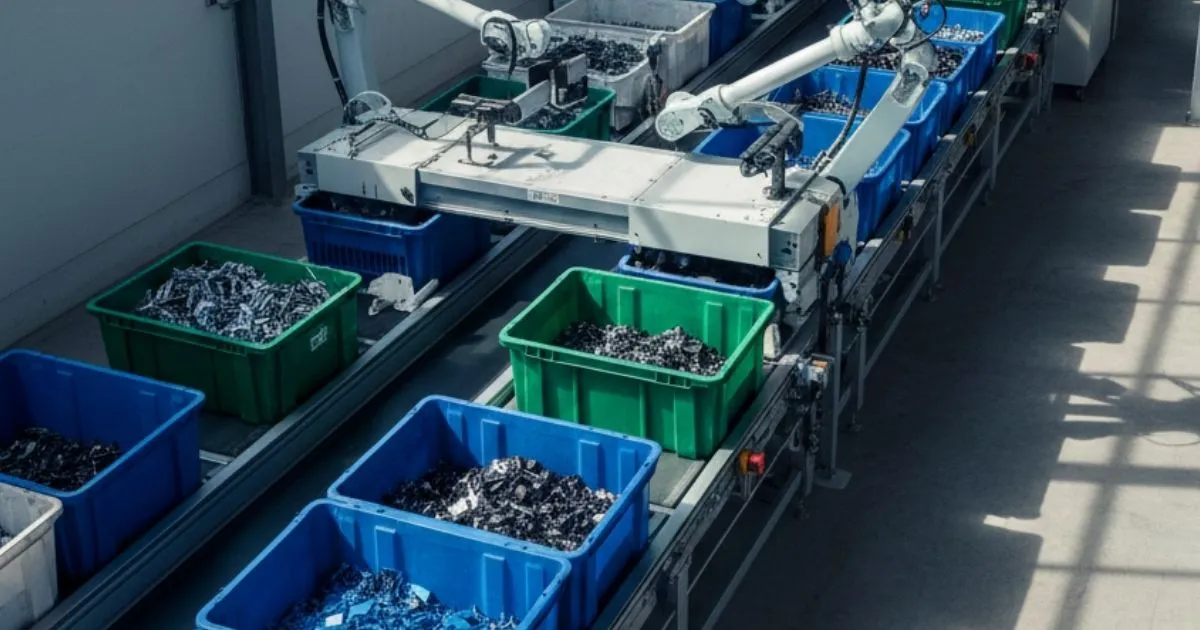
The old logic of the industrial age was simple, brutal, and effective for a century. You take a raw material, you make something people want, and you sell it until it breaks or goes out of fashion. Then, you start over. But as we move deeper into 2026, that straight line has started to feel like a dead end for the savvy investor. I was recently looking at the quarterly filings for a mid-market electronics firm that everyone had written off as a legacy player. While their competitors were scrambling to secure lithium and rare earth minerals amidst yet another geopolitical supply crunch, this particular company was quietly posting record margins. They weren’t mining the earth, they were mining their own past. By embracing a Circular Supply Chain, they had effectively decoupled their growth from the volatility of the raw commodities market. It was a masterclass in financial resilience that few saw coming.
We have reached a point where waste is no longer an environmental problem to be managed, it is a massive, untapped line item on a balance sheet. In the current fiscal climate, the most aggressive profit seekers aren’t looking for the next shiny disruption. They are looking at the trash. They are looking at the things we used to throw away and seeing high-purity inputs that can be fed back into the machine at a fraction of the cost of virgin materials. This isn’t about being green for the sake of a PR badge. This is about the cold, hard reality of Sustainable profit in a world where resources are becoming tighter and more expensive to extract.
The Architecture of Perpetual Value and Sustainable Profit
The shift toward circularity is fundamentally a shift in how we value assets over time. In a traditional model, an asset depreciates until it hits zero and becomes a liability. In 2026, the firms that are winning are the ones that view a sold product as a temporary loan of materials to a consumer. When a company retains the responsibility for the end-of-life of its products, it secures its own future feedstock. This creates a closed loop where the financial leakage of a business is minimized. I remember talking to a CFO who told me that once they mastered their reverse logistics, their cost of goods sold dropped by nearly twenty percent. They stopped buying from volatile overseas suppliers and started “buying” from their own customer base.
This approach creates a level of stability that is incredibly attractive to institutional investors. When you control your material loop, you aren’t at the mercy of a sudden tariff or a shipping lane closure in the Suez. You have a predictable, local source of materials that you already know are high quality because you made them the first time. This predictability is the foundation of Sustainable profit. It turns the supply chain from a series of external risks into a controllable internal engine. We are seeing this happen in everything from heavy machinery to high-end fashion. The companies that are thriving are the ones that have figured out how to make their products easier to take apart than they were to put together.
The math is quite simple when you strip away the jargon. Extracting aluminum from an old soda can or a discarded laptop frame requires about five percent of the energy needed to pull it out of the ground. In an era where energy costs are a major driver of inflation, that ninety-five percent saving is pure margin. It is the kind of efficiency that allows a firm to underprice its competitors while simultaneously achieving better earnings. This isn’t a theoretical future. It is the competitive landscape of today. If you are looking at a business that doesn’t have a plan for its own waste, you are looking at a business that is slowly bleeding its own equity.
Redefining the Modern Business Model for a Resource-Constrained Era
The transition to a circular economy is forcing a total rethink of the traditional Business model. We are moving away from ownership and toward access. Think about the way we consume software now. No one buys a box with a disc anymore, we subscribe to a service. That same logic is now being applied to physical goods. When a manufacturer moves to a product-as-a-service model, they are incentivized to make that product last as long as possible. If a washing machine breaks, it is the manufacturer’s problem, not the consumer’s. This means the manufacturer will use the most durable components and design for easy repair.
This change in the Business model creates a recurring revenue stream that is much more valuable than a one-time sale. It also ensures that the manufacturer gets the materials back at the end of the product’s life. It is a virtuous cycle that aligns the interests of the company with the longevity of the product. I’ve seen small-to-medium enterprises reinvent themselves overnight by pivoting to this strategy. They stop being commodity sellers and start being service providers. In the eyes of a potential buyer or an acquisition firm, a company with a high percentage of recurring revenue and a secured supply of its own materials is worth a significant premium over a traditional manufacturer.
There is also a profound regulatory tailwind pushing us in this direction. Governments are increasingly moving toward extended producer responsibility laws. If you make it, you own it, forever. While some see this as a burden, the most profitable firms of 2026 see it as a moat. By building the infrastructure to handle their own products at the end of their lives, they are creating a barrier to entry that smaller, less sophisticated competitors simply cannot cross. They are turning compliance into a competitive advantage. It is a subtle shift, but it is one that is redefining who the winners and losers will be in the next decade of finance.
We often talk about the economy as if it is something separate from the physical world, a series of numbers on a screen. But every one of those numbers eventually traces back to a physical object, a piece of energy, or a liter of water. The firms that have realized this are the ones currently dominating the market. They have understood that in a finite world, the only way to grow infinitely is to get better at using what we already have. It is a realization that is as much about philosophy as it is about finance.
The most interesting thing about this entire shift is how it changes the nature of what we consider a “valuable” company. It used to be about how much you could produce. Now, it is about how much you can retain. The “Circular” supply chain isn’t just a logistical trick, it is a fundamental reimagining of what a business is for. As we look at the landscape of 2026, the companies that are truly built to last are the ones that have figured out how to never truly say goodbye to their products. They are always in the system, always providing value, and always contributing to the bottom line. It makes you wonder why we ever did it any other way.

